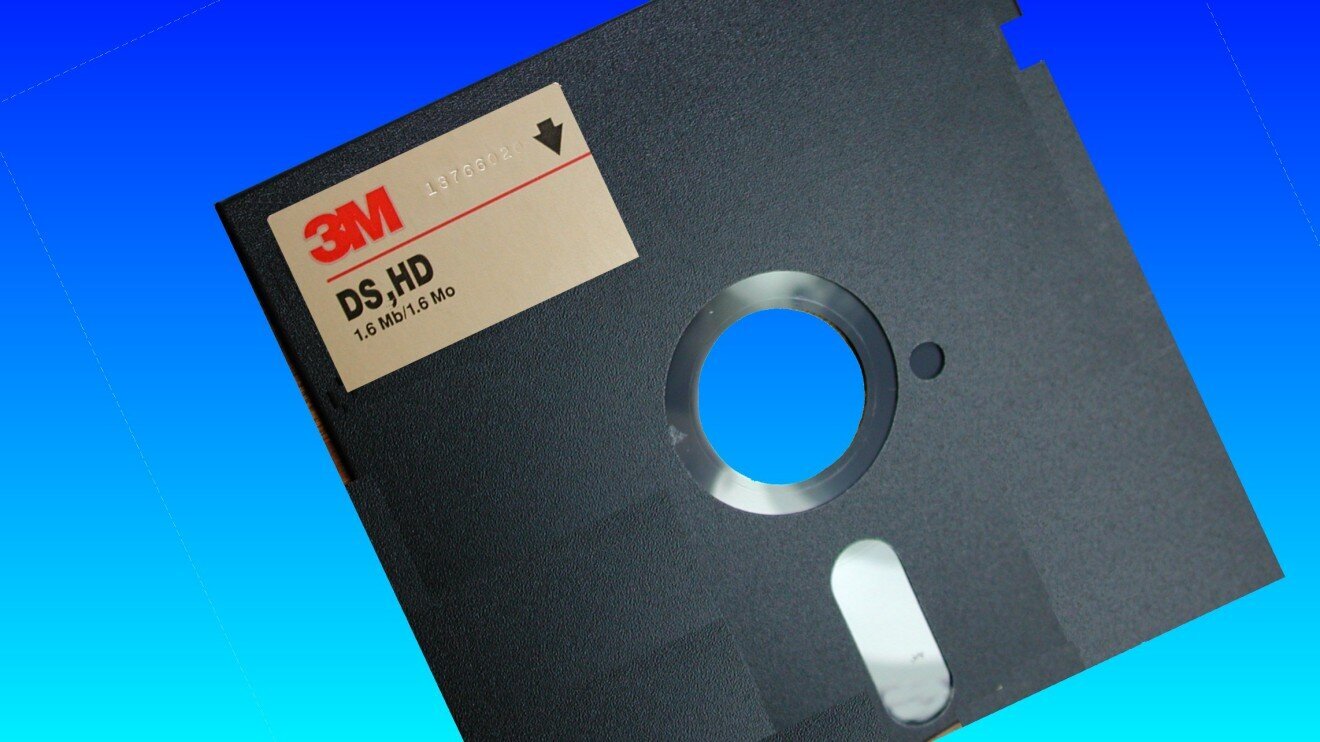
In 1993, the floppy disk was the primary and most accessible way of transferring digital information between computers. For businesses of the time, working with floppy disks every day was as routine as sending files by email is today.
What a floppy disk was
By 1993, the standard was the 3.5-inch, 1.44 MB floppy disk in its rigid plastic shell. This was a revolutionary leap compared to the earlier 5.25-inch "floppy" disks, which bent easily and required careful handling. The new disks had a protective metal shutter that opened automatically when inserted into the drive, and a small plastic write-protect switch.
A capacity of 1.44 MB might seem laughably small by today's standards, but in the early 1990s it was enough to hold a great many text documents, spreadsheets, or small databases. The MS-DOS operating system took up only a few megabytes, and many programs fit on a single floppy disk.
Floppy disks in 1993 Russian business
In the emerging Russian market economy, floppy disks played a critically important role in running a business. Computers were expensive and relatively rare, so a database was often kept on a single computer, and information was moved to other machines precisely by floppy disk.
A typical workflow looked like this: at the end of the working day, sales data, inventory figures, or financial transactions were copied to a floppy disk, which was then physically carried to the main office or to the accountant. There, the information was loaded into the main database and processed.
Practical problems of the floppy-disk era
- Reliability: Floppy disks were easily damaged by dust, moisture, magnetic fields, and physical impact
- Limited capacity: Large databases had to be split across several floppy disks
- Slowness: Read/write speeds were very low by modern standards
- The need for synchronization: Working with multiple databases required constantly transferring and merging information
The "sneakernet"
An informal term, "sneakernet" (a pun on "internet," describing data moved on foot rather than over a network), described exactly this system of exchanging data by physically carrying floppy disks around. It was, in effect, a "network" before real computer networks existed. A courier with a bag of floppy disks played the role of the internet service provider of the time.
For many Russian entrepreneurs of the early 1990s, working with floppy disks was a daily routine. A business's success often hinged on how quickly and accurately information could be passed between points of sale and management offices.
The technical side
Floppy disks of 1993 spun at 300 revolutions per minute (except for high-density 5.25-inch disks, at 360 rpm). Data was written to both sides of the disk by magnetic heads, which read and wrote information by touching the surface of the medium. This made floppy disks vulnerable to wear, but ensured relatively reliable data storage with proper handling.
Formatting a floppy disk created 80 tracks of 18 sectors each, giving a theoretical capacity of 1,474,560 bytes, or roughly 1.44 MB after accounting for system overhead.
The floppy disk icon is still used in computer programs today as the symbol for the "Save" command, a reminder of an era when saving data was, quite literally, the physical act of writing to a magnetic medium.