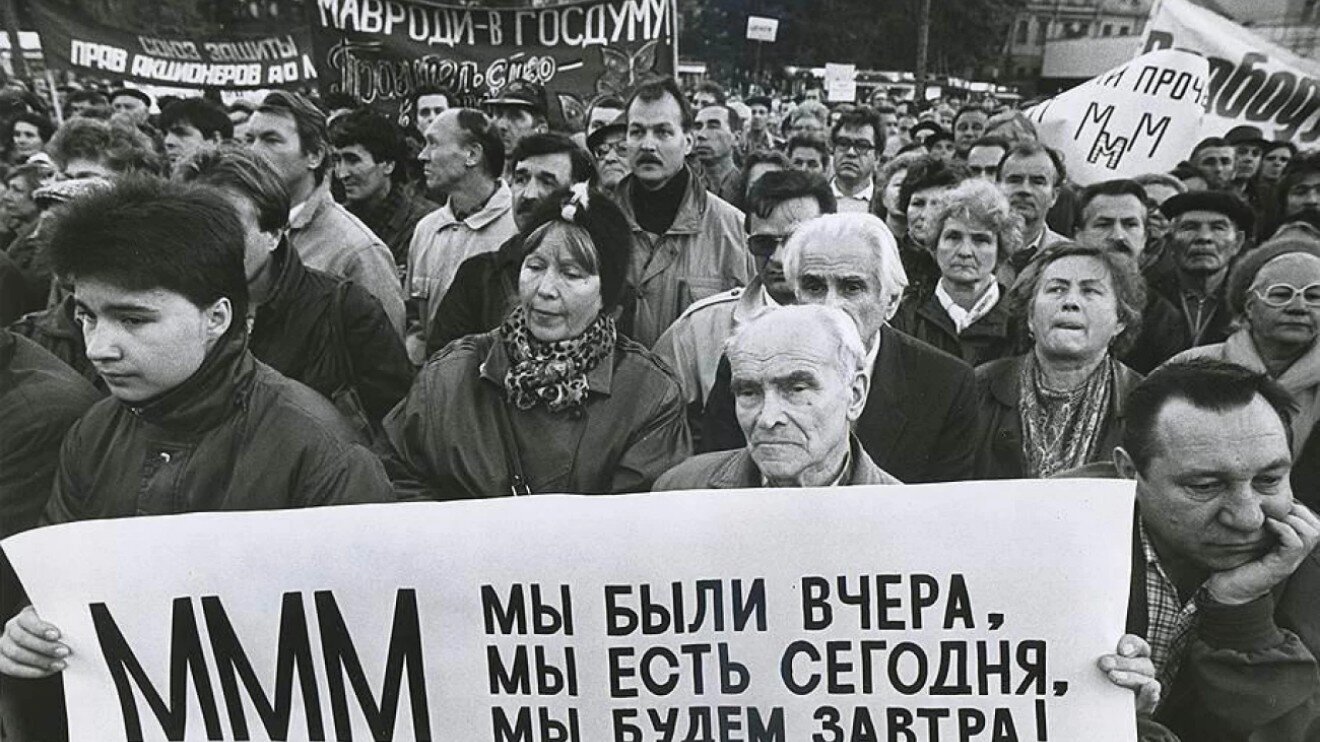
The joint-stock company MMM became a symbol of the "wild nineties" and the largest Ponzi scheme in Russian history, drawing millions of citizens into its operations.
The history of its founding
The MMM company was founded in 1989 by three co-founders: brothers Sergei and Vyacheslav Mavrodi, and Olga Melnikova (Vyacheslav's first wife). The name was an acronym of the founders' surnames' initials. The firm originally traded in imported office equipment, importing computers and components into the USSR.
On October 20, 1992, the open joint-stock company "MMM" was officially registered, and in 1993 the company was authorized to issue its first tranche of stock — 991,000 shares, each with a face value of 1,000 rubles.
How the pyramid scheme worked
On February 1, 1994, MMM shares went on open sale. The company set "two-way quotes" with constantly rising prices, on the principle that "today is always more expensive than yesterday." When the Finance Ministry refused to register a second share issue of a billion shares, Mavrodi began issuing so-called "MMM tickets" — documents that were not formally securities, priced at one-hundredth the value of a share.
Later, a system of "voluntary donations" was introduced: formally, citizens weren't buying tickets, but donating money to Mavrodi personally, receiving tickets as a souvenir. Prices were set by Mavrodi himself twice a week — on Tuesdays and Thursdays.
Advertising and popularity
MMM's success owed much to a powerful advertising campaign featuring an ordinary Russian named Lyonya Golubkov (played by actor Vladimir Permyakov) and his wife Rita, who dreamed of "new boots, a car, and a house in Paris." These characters became cult figures for an entire generation of Russians.
By mid-1994, Sergei Mavrodi ranked among Russia's 50 most influential businessmen, placing 12th on the list. By some estimates, the company earned around $50 million a day in Moscow alone.
The collapse of the pyramid
On August 4, 1994, tax inspectors, backed by riot police, stormed MMM's office, presenting claims for 49.9 billion rubles in unpaid taxes. Sergei Mavrodi was arrested but soon released after being elected a deputy of the State Duma from the Mytishchi constituency.
On July 29, 1994, Mavrodi announced that share prices would be cut 127-fold — back down to their original face value of 1,000 rubles. This amounted to the pyramid's collapse and the loss of savings for millions of citizens.
The scale of the tragedy
By various estimates, between 2 and 15 million people took part in MMM. After the pyramid collapsed, 50 people took their own lives. Damages are estimated at anywhere from $110 million to $70–80 billion. The investigation officially recognized more than 10,000 people as victims, though the real number affected was significantly higher.
An epidemic of Ponzi schemes
MMM's success spawned a genuine epidemic of financial pyramids. Around 1,700 similar structures appeared in Russia, the best known of which included:
- "Vlastilina" — one of the largest pyramids, promising extremely high returns
- Chara Bank — a financial institution operating on the pyramid principle
- "Russky Dom Selenga" — a regional pyramid active mainly in Siberia
- "Khoper-Invest" — attracted depositors with promises of fast riches
- "Tibet" — an exotic name hiding an ordinary financial pyramid
- Various hype projects — a swarm of smaller pyramids copying the MMM model
- Stock Generation — an internet pyramid created later by Mavrodi himself
Social consequences
The collapse of MMM and other pyramids dealt a serious blow to Russians' trust in a market economy. According to a survey by the Public Opinion Foundation, one in five citizens came to view market reforms in Russia more negatively after the MMM scandal.
The MMM phenomenon reflected the specific character of Russia's economic transition in the early 1990s: a population with no financial literacy, weak regulatory institutions, and citizens' urgent need for ways to preserve and grow their savings amid high inflation.