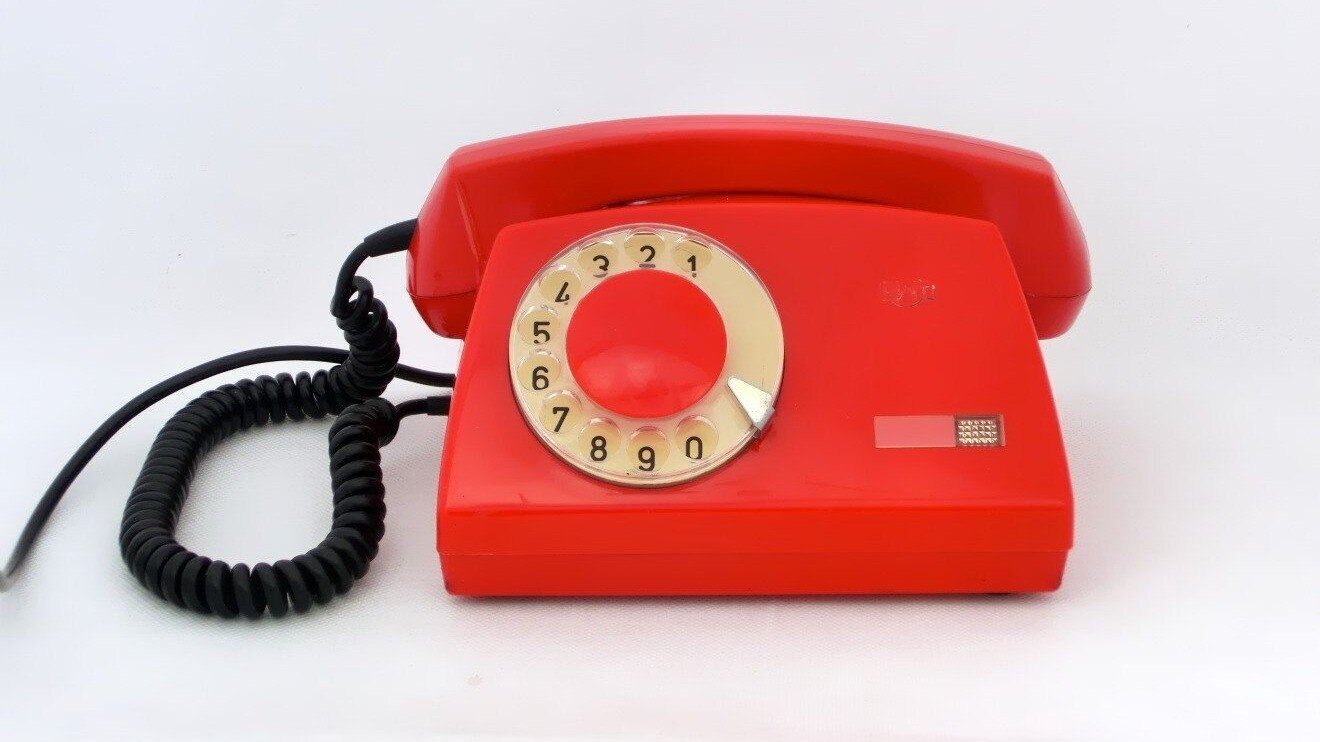
The rotary telephone is the classic phone equipped with a mechanical dial in the form of a rotating disc with numbered holes. To dial a number, the caller spun the disc, generating a series of pulses transmitted to the telephone exchange.
History
The first rotary dial was patented by the American inventor Almon Strowger in 1891. Interestingly, Strowger was an undertaker, not an engineer. According to legend, he invented it out of business rivalry: a competitor’s wife worked as a telephone operator and was routing his customers’ calls to her husband instead, undercutting Strowger’s business.
The first telephones with rotary dials were installed in La Porte, Indiana, in 1892. Widespread adoption of rotary telephones, however, didn’t come until the 1920s, when the Bell System began mass-producing them in the US.
Fun Fact
In the USSR, mass production of rotary telephones began in the 1930s. The best-known model was the TA-6, produced from 1955 onward, which became a symbol of the Soviet era.
How It Worked
The mechanism of the rotary dial worked as follows:
- The caller placed a finger in the hole for the desired digit and rotated the disc clockwise until it hit a metal stop.
- Upon release, the disc returned to its starting position under spring tension, opening and closing the electrical circuit in a series of breaks.
- The number of breaks corresponded to the digit dialed (one break for «1,» ten breaks for «0»).
- The telephone exchange registered these pulses and established a connection with the desired number.
History of Use
Rotary telephones dominated global telephony for most of the twentieth century:
- 1920s-1940s — a period of active spread of rotary phones around the world.
- 1950s-1960s — peak popularity. Various modifications appeared during this period, including desk and wall-mounted models.
- 1970s — the beginning of the gradual displacement of rotary phones by push-button models with tone dialing.
- 1980s-1990s — rotary phones remained in use mainly in developing countries and rural areas.
- 2000s — production ceased entirely and they disappeared from active use. Rotary telephones became collector’s items and vintage accessories.
Cultural Significance
The rotary telephone holds a special place in twentieth-century culture. The distinctive sound of the spinning disc and the clicks as it returned became a recognizable acoustic symbol of the era. Rotary phones often appear in film and literature as a marker of a particular time, evoking nostalgia in older generations.
The Evolution of Telephone Communication
The gradual shift from rotary to push-button phones, and later to mobile devices, reflects the technological evolution of communications. Even though rotary phones have become functionally obsolete, they retain aesthetic and historical value as witnesses to the era of analog telephony.