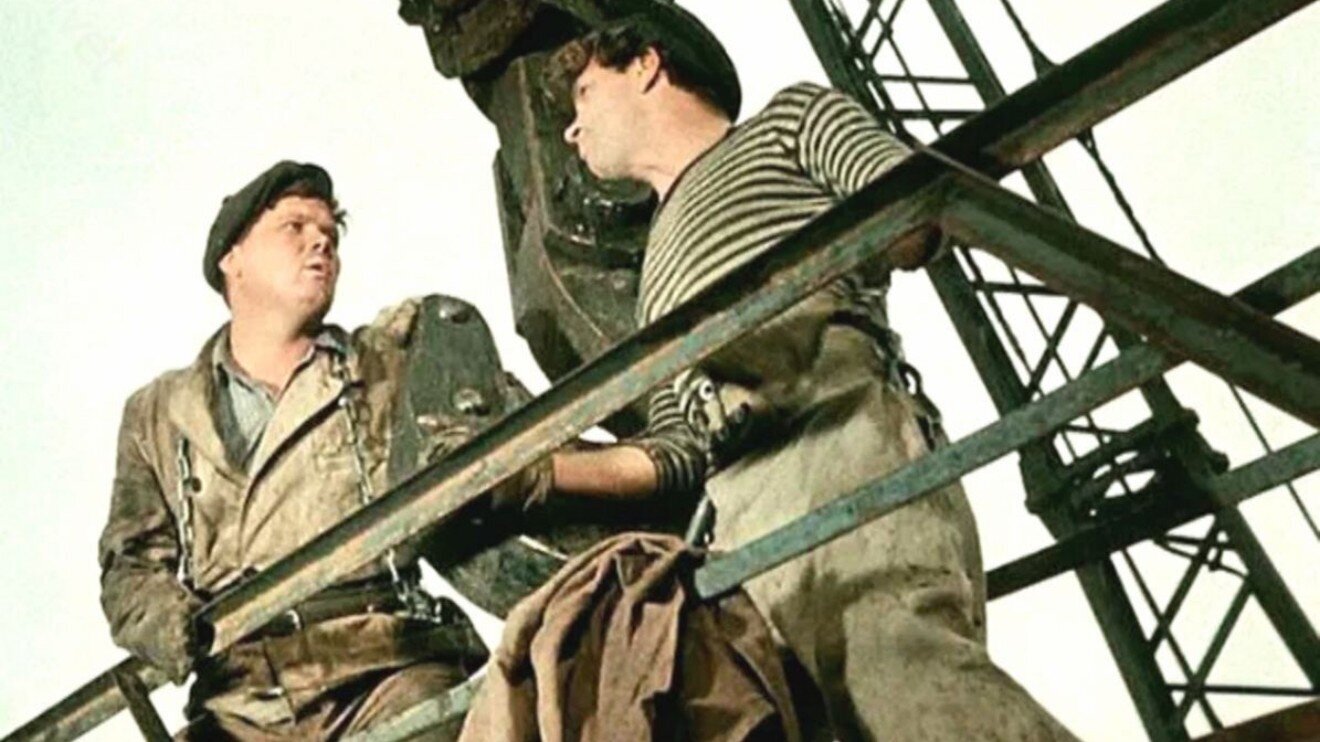
«The Riggers’ March,» also known by its opening line, «We’re Not Stokers, We’re Not Carpenters,» is a landmark Soviet song written specifically for the feature film «Vysota» («Height,» 1957), directed by Alexander Zarkhi at the Mosfilm studio.
The music was written by the outstanding Soviet composer Rodion Konstantinovich Shchedrin, with lyrics by the poet Vladimir Kotov. The song was first performed by actor Nikolai Rybnikov, who played the film’s lead role, the high-rise rigger Nikolai Pasechnik.
Historical Context
The song was written during a period when Soviet cinema was actively developing the theme of labor heroism and the romance of working-class professions. «Vysota» became a striking example of the industrial drama, a genre celebrating the labor achievements of Soviet people.
«The Riggers’ March» fit perfectly into the concept of a film about the builders of a blast furnace. The song quickly outgrew the film and became popular among broad segments of the population, turning into an unofficial anthem for builders, riggers, and other working-class professions.
About the Composer
Rodion Konstantinovich Shchedrin (born December 16, 1932) is one of the greatest Russian composers of the 20th and 21st centuries. At the time he wrote the music for «Vysota,» Shchedrin was just 25 years old, a budding composer who had recently graduated from the Moscow Conservatory. He would go on to write numerous works across many genres: ballets («Carmen Suite,» «Anna Karenina»), operas («Not Love Alone,» «Dead Souls»), and symphonic and choral works.
Shchedrin proved himself a master of musical stylization and a gifted melodist. «The Riggers’ March» shows off his ability to write memorable, life-affirming melodies attuned to the spirit of the times.
About the Poet
Vladimir Ivanovich Kotov (1924-1994) was a Soviet poet and translator. He worked in the editorial offices of various literary journals, writing poems and songs for films. His work often turned to themes of labor and creation, celebrating working-class professions.
In the lyrics of «The Riggers’ March,» Kotov managed to convey the romance of high-altitude construction work, the pride workers took in their profession, and the particular sense of camaraderie characteristic of high-rise rigging crews.
Cultural Significance
«The Riggers’ March» is a vivid example of Soviet mass song, celebrating the labor and skill of the working man. The song expresses the worldview characteristic of the 1950s, when labor for the good of society was seen as the highest value and a source of personal happiness.
The line «We’re not stokers, we’re not carpenters» became a catchphrase, and the song itself an inseparable part of Soviet musical culture. It was performed at concerts and holidays, and entered the repertoire of many singers and ensembles.
The song’s success owed a great deal to the charismatic performance of Nikolai Rybnikov, who created a memorable image in «Vysota» of a bold, cheerful high-rise worker. Thanks to the film and the song, the profession of high-rise rigger was romanticized and gained particular prestige among the youth of the time.
Legacy
«The Riggers’ March» remains one of the most recognizable songs of the Soviet era. It’s regularly included in collections of the best Soviet songs and performed in concert programs devoted to the music of past decades.
The song became a cultural symbol of the era of industrialization and labor enthusiasm, a reflection of the time of great construction projects and faith in the transformative power of human labor.