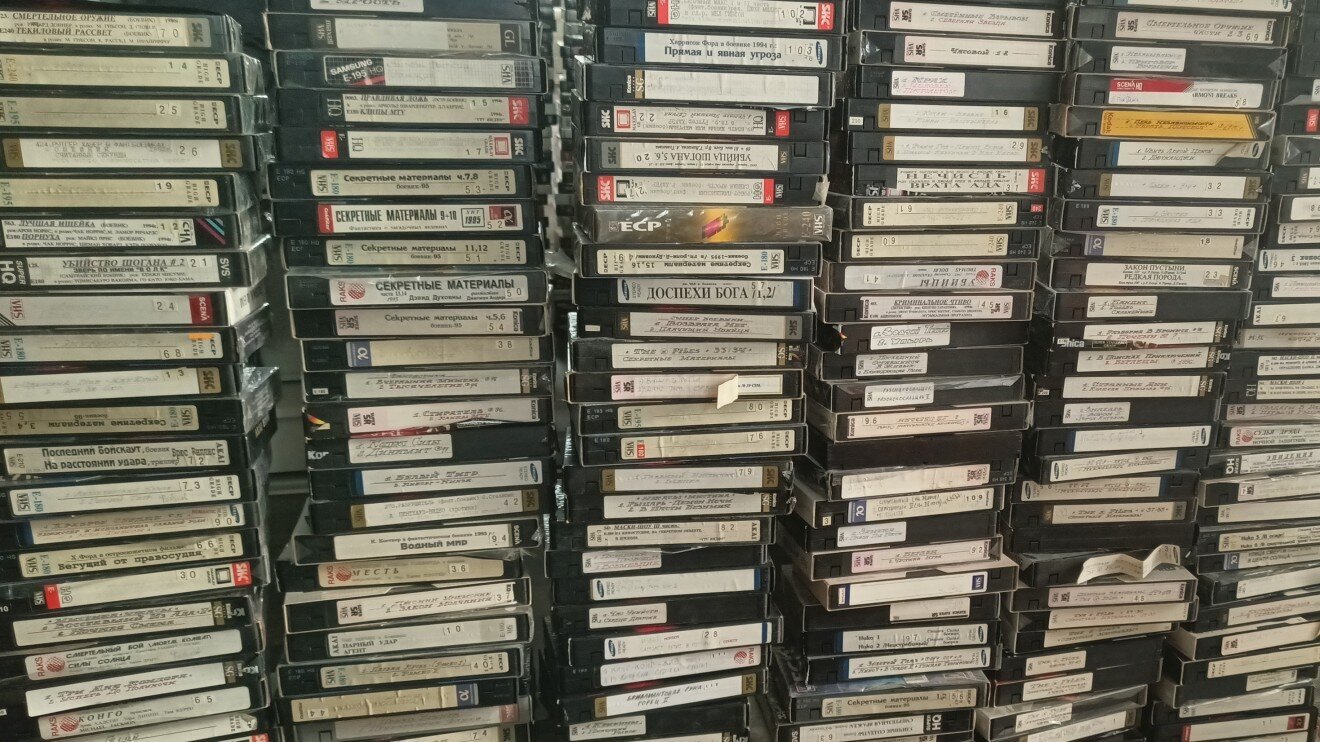
Dopiska (literally "add-on recording") is a specific phenomenon of the VHS-cassette era, referring to extra content recorded on a tape after the main film. The term became firmly entrenched in the vocabulary of video-rental customers, and became an integral part of the home-video culture of the late 1980s through the 1990s.
The point of a dopiska was making the most efficient use of the magnetic tape. Standard VHS cassettes came in various lengths, but the most common were E-180 cassettes (for the European PAL/SECAM standard), rated for three hours of recording. Since most feature films ran from an hour and a half to two and a half hours, there was inevitably free space left on the tape. Pirates and video-rental owners, seeking to squeeze maximum value out of every cassette and attract customers with extra content, filled this space with a second, and sometimes even a third, work.
Typical dopiska content
Cartoons
The most common type of dopiska was animated films and series. This was for several reasons:
- The short runtime of individual episodes (usually 7-25 minutes), ideal for filling the leftover space on a cassette
- The universal appeal of cartoons — every family member could watch them
- The popularity of Western animation, practically unavailable through official channels
- The relative ease of translating it, or the option of watching without translation at all
Especially popular were episodes of "Tom and Jerry," "Donald Duck," "The Pink Panther," "Scooby-Doo," and other classic American animated characters. Japanese anime series, which were just beginning to win over the Soviet and later Russian viewer, often turned up as a dopiska too.
TV series
The second most popular type of dopiska was episodes of foreign TV series. The TV-episode format was ideally suited for filling the remaining time on a cassette:
- An episode usually ran 40-50 minutes (counting ads and credits), which fit perfectly into the space left after a two-hour film
- Series held independent appeal, and attracted an additional audience
- Many viewers specifically rented cassettes not for the main film, but for the dopiska, to catch the next episode of a favorite series
Typical dopiska fare included "Santa Barbara," "Derrick," "Twin Peaks," various British series like "Jeeves and Wooster" (mentioned in the text), and action shows like "The A-Team" or "Knight Rider."
Music videos and concerts
Another popular option for a dopiska was music videos by Western performers. In an era when music television in Russia was only just beginning, videos by Madonna, Michael Jackson, Queen, Scorpions, and other stars were a real treasure. Concert recordings and fragments of music TV shows often ended up as dopiskas as well.
Short films and documentaries
Less often, but still occasionally, one found dopiskas with short fiction films, documentaries, or educational programs. Sometimes trailers for other films available at the rental shop turned up as a dopiska too — a kind of advertisement built right into the product.
The technical particulars of the dopiska
The runtime problem
One characteristic feature of the dopiska was the problem of precisely calculating time. Video-rental owners didn't always take great care in selecting material, and the following often happened:
- The dopiska wouldn't fit entirely — the film or series episode would cut off right at the most interesting moment, sometimes just minutes before the end
- After the dopiska, a small stretch of tape would remain, filled with whatever was at hand — scraps of other films, ads, "snow"
- The main film's closing credits were mercilessly trimmed to make room for the dopiska
For viewers, it was routine to see the main film's ending credits cut short, or a dopiska breaking off mid-sentence. This was accepted as an inevitable inconvenience — the price of getting extra content.
Recording quality
The quality of a dopiska often differed from that of the main material. This was because:
- The dopiska was usually made from other sources, often already copied many times over
- Copying cassettes caused signal degradation — each successive generation of a copy lost quality
- A dopiska might be added later, onto an already used cassette
- The technical parameters of the recording (brightness, contrast, color) could differ significantly between the main film and the dopiska
Often the main film was recorded in reasonably decent quality, while the dopiska was an unwatchable mess of interference bands, dropped audio, and drifting color.
The cultural significance of the dopiska
The dopiska as a bonus
Within the video-rental system, the dopiska played the role of a kind of bonus, an added value. Customers often chose cassettes not just for the main film, but with an eye to what was on the dopiska. Rental owners understood this, and tried to pick interesting extra content.
There was even a certain hierarchy of dopiska value. A cassette with a new film and fresh episodes of a popular series as its dopiska was far more attractive than one with the same film but worn-out cartoons, or no dopiska at all.
The dopiska as a way of discovering new content
For many viewers, the dopiska became a way of stumbling onto new works by chance. Having rented a cassette for the main film, a viewer might discover a series on the dopiska that would go on to become a favorite, or come across the work of a director they'd never heard of before. This element of unexpectedness, of surprise, was an important part of video-rental culture.
The dopiska and family viewing
Having cartoons or other family-friendly material as a dopiska made a cassette more versatile. Parents could rent a film for themselves, knowing that cartoons for the kids were on the dopiska. This was especially relevant for families where the VCR was the only source of home entertainment.
The economics of the dopiska
Maximizing use of the medium
From the video-rental owner's point of view, the dopiska was a direct result of economic necessity. A blank videocassette in the early 1990s cost 50 to 150 rubles (depending on the maker and quality), which, against an average salary of 300-500 rubles, was a substantial sum. Leaving an hour of tape unused was an unaffordable luxury.
Moreover, the work of copying films took time. The process happened in real time — copying a two-hour film required two hours of the VCR running. Filling the entire cassette was a way to get some return on the time and electricity spent.
A competitive edge
Amid fierce competition between video-rental shops, having a good dopiska could become a competitive advantage. Customers remembered which shop usually had interesting series on its dopiskas, and preferred to rent there.
Terminology and slang
A certain slang formed around the dopiska phenomenon:
- "Dopiska" — the main term for the extra content
- "Dopis'" — a shortened variant
- "Bonus" — a more positive name for the same thing
- "Dovesok" ("extra weight") — a somewhat dismissive term
- "S dopis'yu" / "bez dopisi" ("with a dopiska" / "without a dopiska") — how a cassette was described
- "Oborvannaya dopiska" ("a cut-off dopiska") — a dopiska that didn't fit entirely on the cassette
When advising customers, rental-shop staff always made sure to mention what was on the dopiska, if it was something interesting or popular.
The dopiska in home collections
People who recorded films for their own collection (copying from rental cassettes or recording off the television) also practiced dopiskas. Enthusiasts building video collections tried to make the most efficient use of every cassette, combining films on it by various principles:
- By genre (two action films, two comedies, and so on)
- By actor (Sylvester Stallone films, Arnold Schwarzenegger films)
- By director
- By release year
- Or simply by "whatever fit"
Putting together the optimal combination of films on a cassette was a kind of art. There were enthusiasts who kept detailed catalogs of their collections, noting exactly which films, and in what order, were recorded on each cassette.
VHS: a brief note on the format
Origin and technical specifications
VHS (Video Home System) is an analog magnetic-tape video-recording format developed by the Japanese corporation JVC. The format was introduced to the Japanese market in 1976, and is credited to engineer Shizuo Takano.
The main technical specifications of the VHS format:
- Tape width: 12.65 mm (½ inch)
- Tape speed in SP mode: 2.339 cm/s for the European 625/50 standard (PAL, SECAM)
- Maximum recording time: up to 6 hours in the European standard, on E-300 cassettes
- Resolution: about 240 TV lines, corresponding to roughly 352×576 pixels (PAL/SECAM)
- Cassette dimensions: 188×104×25 millimeters
Victory in the "format war"
In the early 1980s, VHS won the so-called "format war" against its competitors — Betamax from Sony and Video 2000 from Grundig and Philips. The reasons for VHS's victory included:
- An absence of strict licensing restrictions
- The simplicity and reliability of the M-loading tape mechanism
- Longer recording time (the first Betamax cassettes held only an hour)
- Lower prices for VCRs and cassettes
- Better compatibility between cassettes recorded on different machines
Its spread in the USSR and Russia
In the USSR, the VHS format spread starting in the second half of the 1980s. The first Soviet VHS VCR, the "Elektronika VM-12," was released in 1984, and was a copy of the Japanese Panasonic NV-2000.
A distinctive feature of the Soviet period was that VCRs and cassettes were a scarce commodity. Imported equipment could be bought in hard-currency "Beryozka" stores or on the black market, at prices exceeding an average citizen's annual income. Soviet-made VCRs were sold through a special waiting list, on which people could wait for years.
The decline of the VHS era
From the mid-2000s, VHS began rapidly losing ground to the optical DVD format. In 2003, DVD rentals overtook VHS-cassette rentals. In 2006, the last film was released on VHS — David Cronenberg's "A History of Violence." In 2008, the last major manufacturer (JVC) stopped producing VHS cassettes, and in 2016 the company Funai announced it was ending production of VHS VCRs, finally closing out the format's era.
Video rental in 1990s Russia
The emergence of video-rental shops
Video-rental shops opened en masse in Russia in the late 1980s and early 1990s, on the wave of perestroika and economic liberalization. After private enterprise was legalized, video rental became one of the first successful forms of small business.
Before video-rental shops appeared, the USSR had official "video salons" — rooms with a TV, a VCR, and chairs, where, for a fee, one could watch a film. Such salons opened at Komsomol district committees, schools, vocational colleges, and cultural centers. A ticket to a video salon cost 1 to 1.5 rubles, significantly more expensive than a trip to an ordinary movie theater (10-50 kopecks).
How a video-rental shop was set up
A typical video-rental shop of the early 1990s consisted of:
- A small kiosk or separate room — video-rental shops were often located inside post offices, stores, or in standalone kiosks
- A display case with cassettes — the case showed cassettes in original packaging with covers and blurbs, or in homemade boxes
- Back shelves with copies — the shelves held several copies of each film; 10-15 copies were made for new releases
- A workstation with a VCR and TV — for checking recording quality and showing clips to customers
The economics of video rental
Consumables
Cassettes for copies were bought in two ways:
- From the public — people sold their used cassettes for 10 rubles apiece
- New blank cassettes — bought for the most in-demand new releases
Original cassettes (master copies) were usually kept back from customers, to avoid damaging them and to always be able to make a new copy if needed.
Pricing
A typical pricing scheme at an early-1990s video-rental shop:
- Renting an ordinary cassette for a day: 3 rubles
- Late fee: 3 rubles for each additional day
- Renting erotic films: 10 rubles a day (for a three-hour cassette of German films)
- The "2+1" promotion: renting two cassettes got you a third for free
For comparison: in the late 1980s and early 1990s, the average salary in Russia was 300-500 rubles, a loaf of bread cost 20-30 kopecks, and a ride on public transit cost 5 kopecks.
The deposit system
To get a cassette, a customer had to:
- On their first visit, present a passport, whose details were entered into a logbook
- Leave their passport as a deposit the first time; once returned safely, no deposit was required on future visits
- If they had no passport, or didn't want to leave it, pay a cash deposit (usually 10 rubles or more)
- If their registered residence was elsewhere, a passport or cash deposit was always required
The selection
Video-rental shops offered a wide range of content:
- Foreign action films — movies with Sylvester Stallone, Arnold Schwarzenegger, Jean-Claude Van Damme, Chuck Norris
- Comedies — from classic Hollywood to contemporary titles
- Thrillers and horror — especially popular among young people
- Dramas and melodramas — for an older audience
- Erotica and pornography — made up a substantial share of the selection, and of the profits
- Soviet films — present too, though in smaller numbers
- TV series — both foreign and Latin American soap operas
Quality and problems
Media degradation
The main problem with rental cassettes was the rapid degradation of recording quality:
- Repeated viewings wore down the magnetic layer
- Horizontal interference bands would appear
- The sound would become muffled or drop out entirely
- The picture would lose sharpness and color
- Cassettes would start getting "chewed up" by VCRs
Customers regularly complained about quality, and rental-shop staff had to check the cassettes on their own equipment. Often it turned out the problem wasn't the cassette but the customer's dirty video heads, and a recommendation to clean the heads solved the issue.
Piracy
Practically all the content at Russian video-rental shops in the 1990s was pirated. Legal videocassettes with licensed films appeared only in the second half of the 1990s (studios like "Videoservis" and "Yekaterinburg Art Home Video"), but cost significantly more.
A typical pirated cassette had:
- A simple paper label with the title handwritten or typed
- No official cover, or a homemade one
- Two films on one cassette, to save space
- Trimmed credits
- A single-voice amateur or professional translation
The social role of video rental
Video-rental shops played an important social and cultural role in 1990s Russia:
- Access to Western culture — for the first time, mass audiences could watch Hollywood films
- Getting around censorship — videocassettes offered films that Soviet television would never have shown
- An alternative to movie theaters — the ability to watch films at home, whenever convenient
- A source of income — for many people, video rental became a way to survive the difficult 1990s
- A place to socialize — video-rental shops were places to chat, discuss films, and swap recommendations
The decline of video rental
With the appearance and spread of DVD players in the early 2000s, VHS video-rental shops began rapidly losing popularity. DVDs offered far better picture and sound quality, didn't degrade from repeated viewing, and were more compact and convenient to use.
By the mid-2000s, most video-rental shops had either shifted to DVD or closed. The final blow came with the arrival of broadband internet and online streaming services, which made the very concept of physical rental obsolete.
Nonetheless, for an entire generation of Russians, video-rental shops remained an important part of cultural memory — a symbol of an era of change, when, after decades of isolation, a window opened onto world culture, however murky the picture on the TV screen and however nasal the single-voice translation.
How a video-rental shop operated
Hours
Video-rental shops usually kept a flexible schedule, adapting to customer needs. A typical schedule ran from 10-11 in the morning to 8-9 in the evening, seven days a week. Peak traffic came on weekday evenings and weekends. Owners often hired students or high schoolers to work the counter, since it required no special qualification.
Relations with the authorities
Official registration of a video-rental business wasn't always accompanied by full tax accounting. A typical scheme:
- Officially, revenue of 12-20 rubles a day was recorded
- Real revenue was 150 to 300 rubles a day
- There often wasn't a cash register; receipt forms were filled out at the end of the shift instead
- The "roof" for a video-rental shop could be connections in the police, the tax service, or local administration
Additional services
Besides their main business, video-rental shops often offered:
- Copying films — onto a customer's own cassette, for a fee
- Selling blank cassettes — both new and used
- Selling recorded cassettes — for those wanting their own collection
- Cassette repair — splicing torn tape, replacing the case
- Cleaning video heads — for a small fee, or free for regular customers
The culture of interaction at a video-rental shop
A video-rental shop was not just a point of service, but a place of social interaction. Regular customers knew the staff by name, discussed films with them, and asked for recommendations. Rental-shop employees became a kind of film expert, able to match a film to a customer's mood and taste.
An informal system of privileges existed:
- Friends and acquaintances of the staff got cassettes free or at a discount
- Regular customers might get their rental period extended at no extra charge
- New releases were held back for "regulars"
- Especially valued customers might be given the original cassette to watch instead of a worn-out copy
Translation of films on VHS cassettes
Single-voice translation as the standard
The vast majority of films on VHS cassettes in Russia carried a single-voice voiceover translation — one person voiced every character in the film, regardless of sex, age, or number. The original audio track was muted but not fully removed, creating the distinctive sound that became the calling card of the era.
Legendary translators
Alexei Mikhalyov (1949-1994)
One of the most famous and respected translators of the VHS era. Over his career, he made more than 300 translations that became genre classics. The features of Mikhalyov's style:
- A gift for adapting humor for a Russian-speaking audience
- A vivid, expressive delivery that conveyed the characters' personalities
- Interesting renderings even of technical dialogue and on-screen text
- The ability to make a mediocre film interesting through the quality of the translation alone
Andrei Gavrilov
Another cult-favorite translator, known for his distinctive voice timbre and professional approach to the work. Gavrilov's translations were noted for their accuracy and literary quality.
Leonid Volodarsky
Nicknamed "the man with the clothespin on his nose" for his characteristic nasal voice. Despite this, his translations were extremely popular and instantly recognizable.
Amateur translations
Alongside the professionals, there were many amateur translations of varying quality — from quite decent to downright hopeless. Typical problems with amateur translations:
- Poor knowledge of the source language, leading to gross errors
- A flat, monotone delivery with no emotional coloring
- Poor microphone technique, with distracting background noise
- Literal translation of idioms and jokes, losing all meaning
The double-translation problem
A common problem arose when Russian translators worked not from the original audio track, but from a version already dubbed into German or another European language. This happened because films were often recorded off local cable television in European hotels. Double translation led to catastrophic distortions of meaning, but viewers put up with it for lack of any alternative.
The evolution of attitudes toward translation
With the arrival of DVD, and the ability to choose between full dubbing, multi-voice translation, and the original track with subtitles, attitudes toward single-voice translation changed. For some, it became a symbol of nostalgia for the VHS era; for others, a sign of low quality. Nonetheless, the translations of legendary masters like Mikhalyov continue to be prized, and are actively shared by enthusiasts online.
Conclusion
The phenomenon of the dopiska on VHS cassettes is a vivid example of how technical limitations and economic realities shape cultural practices. What began as a way to make the most efficient use of an expensive storage medium turned into an integral part of the home-video viewing experience for an entire era.
A dopiska was both a bonus and a lottery — you never knew in advance what would turn up after the main film: an interesting episode of a favorite series, an unfamiliar cartoon that would become a discovery, or a concert recording worn down beyond recognition. This unpredictability, this element of surprise, was part of the charm of the videocassette era.
For a modern viewer used to streaming services with catalogs of tens of thousands of titles and instant selection, video-rental culture and the dopiska may seem archaic. But there was a charm precisely in these limitations — having to go to the rental shop, choosing from what was available, putting up with mediocre recording quality and an unknown dopiska. It was an experience of physical interaction with a storage medium, an experience of social contact at the rental counter, an experience of chance discovery.
The era of VHS and video rental has ended, but for those who lived through it, the dopiska will forever remain one of the most characteristic symbols of that time — alongside the nasal single-voice translation, the interference bands on the screen, and the handwritten label on the cassette.