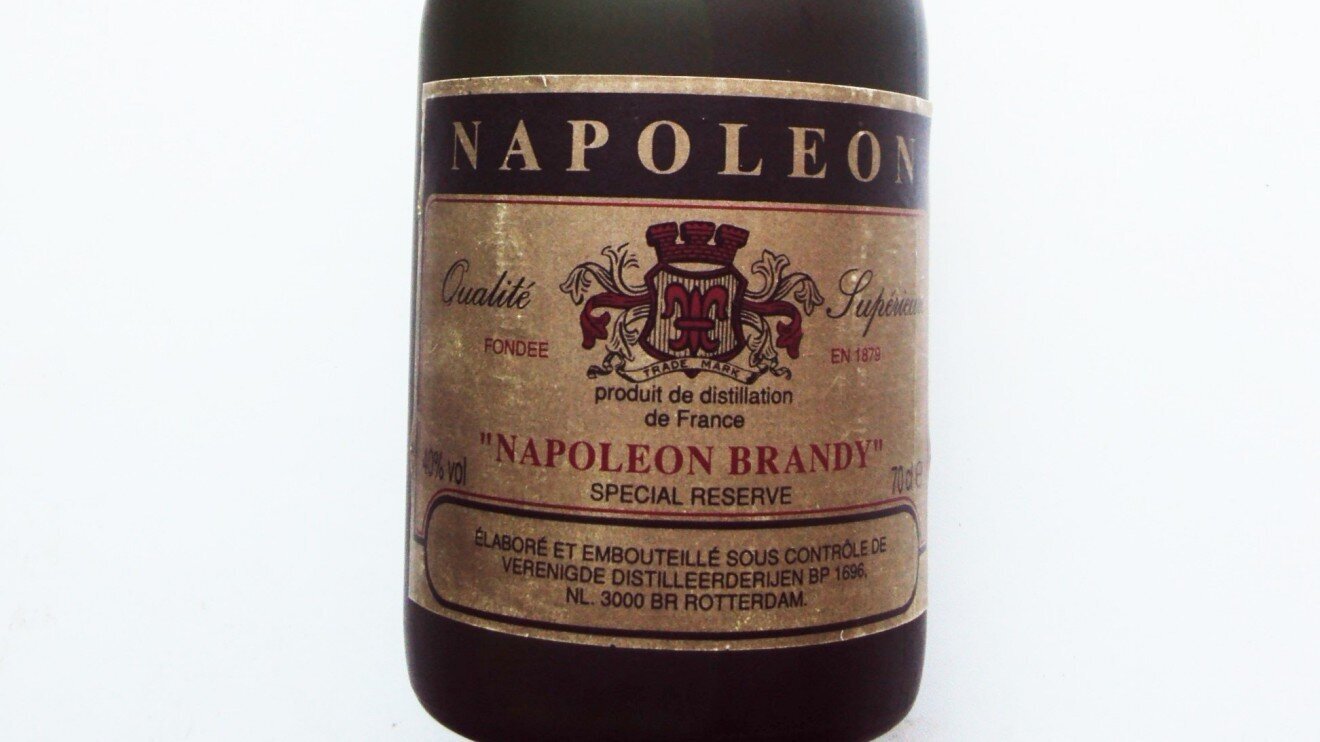
The name "Napoleon" on a bottle of cognac is not a specific producer's trademark, but a designation of the drink's age. For several generations of Soviet people, however, the word "Napoleon" meant something entirely different: a symbol of prestige, an inaccessible luxury, an object of dreams. The history of this name is full of confusion, legend, and astonishing turns.
What "Napoleon" actually is
The French cognac industry has a traditional system for labeling cognacs by age. The most common designations are V.S. (Very Special, a minimum of 2 years), V.S.O.P. (Very Superior Old Pale, a minimum of 4 years), and X.O. (Extra Old, a minimum of 6 years under the old standards, and a minimum of 10 years since 2018).
The term "Napoleon" refers to a category of cognacs aged at least 6 years — in effect, a synonym for X.O. This designation, however, is not an official standard under French cognac law; it is more of a commercial name that producers use at their own discretion.
The origin of the name: the legend of the Courvoisier house
Cognac's connection to the name of Emperor Napoleon I goes back to the history of the famous Courvoisier cognac house. In 1809, wine merchant Emmanuel Courvoisier and Louis Gallois, the mayor of the Parisian suburb of Bercy, founded a joint company trading in wine and cognac.
According to legend, in 1811 Emperor Napoleon visited the wine cellars in Bercy, where he tasted Courvoisier's cognac and praised it highly. Moreover, it is claimed that Napoleon took several barrels of this cognac with him into exile on the island of St. Helena in 1815. Whether this is true or a clever piece of marketing is impossible to establish today, but the legend has become firmly attached to the Courvoisier house.
In 1828, Félix Courvoisier, the founder's son, moved production to the town of Jarnac, located in the very heart of the Cognac region. The connection to the imperial family continued under Napoleon III, who in 1869 granted Courvoisier the title of official supplier to the imperial court. From that point on, the imperial coat of arms appeared on the labels.
In 1909, when the company was bought by the British Simon brothers, it was decided to make Napoleon I's silhouette the house's logo. At the same time, a special line of cognacs called "Napoleon" appeared — in honor of the drink's legendary admirer.
"Napoleon" becomes a common noun
The Courvoisier house did not patent the name "Napoleon" as an exclusive trademark. This was a commercial mistake, but at the same time a gift to the entire cognac industry. Other producers quickly seized on the successful name, and began using it for their own aged cognacs.
Gradually, "Napoleon" turned into an unofficial but widely used designation for quality, long-aged cognac. French producers, English trading houses, Spanish and Portuguese companies — all used this name. By the mid-20th century, "Napoleon" had become a globally recognized designation for prestigious cognac.
It's important to understand that this name was never a protected designation of origin (AOC), unlike the word "Cognac" itself. Any cognac producer could add the word "Napoleon" to their label, as long as their product met a certain minimum age.
"Napoleon" in the Soviet Union
Attitudes toward French cognac in the USSR were special. On the one hand, the country produced its own "cognacs" — Armenian, Georgian, Moldovan, and Dagestani. Under French law, these had no right to be called cognac, since they were not produced in the Cognac region, but the Soviet Union disregarded this rule.
On the other hand, real French cognac remained a symbol of Western luxury and unattainable quality. In 1959, the USSR's Ministry of Foreign Trade signed contracts with several French cognac houses for the supply of their products. The imported brands included Courvoisier, Hennessy, Rémy Martin, Martell, and others.
The price of prestige
A bottle of French cognac in Soviet stores was very expensive — roughly a third of an average monthly salary. This put the drink out of reach for everyday consumption, even for people of good means. French cognac was bought:
- For anniversaries and important family celebrations
- As a valuable gift for managers and influential people
- As a token of gratitude for a favor or "solving a problem"
- As a kind of currency in the shadow economy and corruption schemes
"Napoleon" — king of the cognacs
Among all the imported brands, "Napoleon" enjoyed a special status. There were several reasons for this:
- A recognizable historical name, connected to Russia through the war of 1812
- A beautiful legend about the emperor's love for this cognac
- A memorable label with Napoleon's silhouette
- A regular presence in Soviet retail (unlike other brands, which appeared only sporadically)
For most Soviet citizens, "Napoleon" was not a designation of age — it was a specific brand of cognac, the best-known and most desired. When characters in a Remarque novel drank cognac, the Soviet reader pictured exactly that bottle with the emperor's profile. When French cognac appeared in a store, people in line would ask: "Are they giving out Napoleon?"
Polish "Napoleons" and other fakes
The shortage and high price of real French cognac gave rise to an entire counterfeiting industry. Poland played a special role in this, occupying, within the socialist camp, an intermediate position between East and West.
Why Poland specifically
Polish entrepreneurs discovered a legal loophole: since "Napoleon" was not a registered trademark, but merely a designation of age, it could be used on labels without infringing copyright. Formally, they were not counterfeiting a specific brand — they were simply bottling their own alcohol and calling it "Napoleon."
Polish "Napoleons" were produced in various ways:
- From local grape spirit with added flavorings and colorants
- From a mixture of spirits of various origins
- By diluting a small amount of real cognac with cheaper spirit
- Simply from moonshine, with coloring and flavoring added
Labels and packaging
Polish producers carefully copied the look of French bottles. Labels bearing Napoleon's silhouette were printed, imitating Courvoisier's design. Similar fonts, gold embossing, seals, and "coats of arms" were used. The labels might read "Napoleon Cognac," "Napoleon Brandy," or simply "Napoleon" alongside some French words.
Bottles of a special shape were sourced — with a wide base and narrow neck, copying Courvoisier's famous "Josephine" bottle. Some "producers" went so far as to apply imitation French tax stamps to the glass.
Routes of distribution
Polish "Napoleons" reached the USSR by several routes:
- Through "shuttle traders" — people who traveled to Poland for scarce goods
- Through shadow trade between Polish and Soviet speculators
- Through diplomatic channels and Soviet citizens working abroad
- Sometimes even through official retail — passed off as "Polish cognac"
The quality of these drinks ranged from tolerable to appalling. Some Polish "Napoleons" really were decent brandies, aged in oak barrels. Others were outright rotgut, dangerous to health. Judging quality by appearance alone was practically impossible.
How to tell real cognac from a fake
In the USSR, folk methods existed for determining the authenticity of French cognac:
- Price: Real French cognac could not be cheap. If the price seemed suspiciously low, it was a fake.
- Place of purchase: In state stores like "Beryozka" or specialized wine departments, the chance of running into a fake was minimal. At a market or bought "off the street," it was very high.
- Tax stamp: Genuine imported bottles carried a Soviet import stamp of the established design.
- Label quality: French labels were printed on quality paper, with clean typefaces and even gold embossing. Polish fakes often had smudged printing and crooked letters.
- The cork: Original bottles were sealed with quality cork stoppers bearing the producer's seal.
Even these markers, however, guaranteed no absolute protection. Skilled counterfeiters learned to imitate nearly every element of the original packaging.
Other producers and brands
Although the text mentions the cognac "Otard," this really was a genuine and respected French brand, founded in 1795 in the town of Cognac. The Otard house was located in the Château de Cognac, once a residence of French kings.
In the USSR, however, this brand was much less well known than "Napoleon" or "Hennessy." Otard was supplied irregularly and in smaller quantities, so even many cognac enthusiasts had never heard of it. This made it a kind of marker of "sophistication" — someone who knew and valued Otard clearly understood the drink better than the average person.
Drinking culture
The Soviet tradition of drinking cognac with lemon had no equivalent in other countries. According to legend, this custom was introduced by Emperor Nicholas II, whom the acidity of lemon helped cope with the cloying sweetness of low-quality cognacs. French producers were always surprised by this habit, believing that lemon killed the drink's subtle aroma.
A proper French tasting involved:
- Special tulip-shaped snifter glasses
- Warming the cognac in one's palms to release the aroma
- Slowly savoring small portions
- Pairing with coffee or a cigar, but not with food
In Soviet practice, however, cognac was often drunk like ordinary vodka — in one gulp, in large portions, with hearty food alongside. "Cultured" consumption, warming the glass in one's palms and taking unhurried sips, was the privilege of the intelligentsia and people with access to Western culture.
Cognac in literature and film
Russian and Soviet literature preserves many examples of the special attitude toward cognac. Leo Tolstoy, in "Anna Karenina," described Vronsky "ordering himself" cognac with seltzer water. Anton Chekhov and Saltykov-Shchedrin mentioned cognac in their works as an attribute of gentry life.
A special role was played by Erich Maria Remarque, whose novels were extraordinarily popular in the postwar USSR. Cognac appears constantly in his books, "flowing like liquid gold," creating an atmosphere of melancholy and philosophical reflection. It's hard to say which came first: Soviet readers' love of Remarque contributing to cognac's popularity, or the reverse — a familiar and accessible (in its Soviet variant) drink making the pages of the German writer feel closer.
Mikhail Bulgakov, in "The Master and Margarita," created one of the most vivid cognac scenes in Russian literature: the cat Behemoth turns the water in a fountain into cognac, causing panic and delight among Soviet citizens. This was not merely a comic episode, but a satire on Soviet shortages and the cult of unattainable things.
In Soviet cinema, cognac became a symbol of celebration and prosperity. The famous scene from "Carnival Night," in which a drunken lecturer holds forth about the stars on cognac labels ("two stars, three stars... but best of all, of course, five stars!"), forever tied cognac to New Year's celebrations.
The legacy of "Napoleon"
After the collapse of the USSR, the situation changed radically. French cognacs became available in any quantity, and their aura of unattainable luxury vanished. Polish fakes practically disappeared from circulation — there was no longer any point risking one's reputation for a few kopecks of profit in a saturated market.
The term "Napoleon" itself gradually lost its magical ring for new generations. Young people who grew up in the 2000s no longer associate the word with a dream of an unattainable drink. For them, it is just one of the age designations, no more important than V.S.O.P. or X.O.
But for those who lived through the Soviet period, the word "Napoleon" forever retained a special flavor. It is a symbol of an era when imported goods were a rarity, when a bottle of French cognac was an event, not a routine occurrence. It is a memory of a time when obtaining a scarce good meant more than simply buying it.
Interesting facts
- The Courvoisier museum in Jarnac holds a letter from Napoleon I, dated 1811, concerning the supply of cognac to the imperial artillery, as well as the emperor's personal belongings, including a redingote and a bicorn hat from the Battle of Friedland.
- In 1951, Courvoisier released a special "Josephine" bottle, with a wide base and narrow neck — in honor of Empress Josephine, Napoleon's first wife. It was exactly this shape that counterfeiters most often copied.
- Courvoisier's labels, besides Napoleon's silhouette, feature the coat of arms of Napoleon III and the symbol of the Bonaparte dynasty — the golden bee.
- Courvoisier cognac was served at the inauguration of the Eiffel Tower in 1889, which Russian guests attended. This helped popularize the brand in Russia.
- In the USSR, there was an unspoken price list for bribes: a bottle of "Napoleon" corresponded to a specific category of favors, and stood higher in this hierarchy than the cash equivalent of its price.