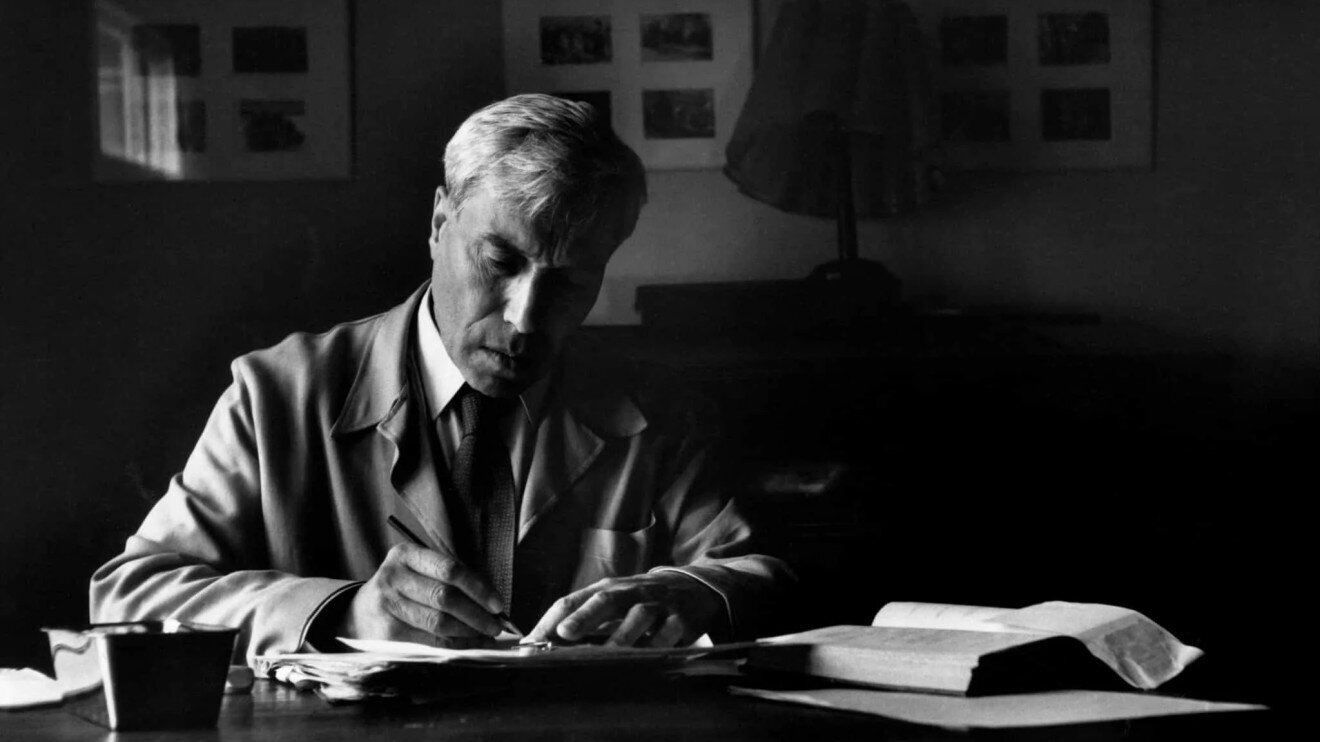
A note on the reference to Boris Pasternak’s poem in the text
About the poem
The Russian original of this chapter quotes Pasternak’s poem in full, all four stanzas. Because Pasternak died in 1960, the poem remains under copyright in Russia until 2030, and a full English translation would itself be a new work requiring the same rights as the original. It is not reproduced here in translation. Its famous opening line is widely rendered in English as: «February. Get ink and weep!» – the same allusion the chapter itself makes, in passing, over a crude joke about a woman’s figure.
Origin and significance
«February! Get Ink and Weep!» was written by Boris Pasternak in 1912, when the poet was only 22. It’s one of his earliest works and, at the same time, one of his most famous – a kind of calling card that has stayed with him ever since.
The poem appeared in his debut collection, «Twin in the Clouds» (1914), which Pasternak himself would later consider immature. And yet this particular poem already displayed his singular poetic voice – synesthesia (the blending of different senses), unexpected metaphors, and a distinctive relationship to the creative process itself.
Poetics and style
Synesthesia
Pasternak blends different sensory registers – sound, sight, and touch fuse into a single poetic image, as when a downpour is described as louder than ink and tears, or spring is said to «burn black.»
Metaphor
Rooks likened to charred pears falling from trees, wind «riddled with cries» – bold, unexpected comparisons that became a hallmark of Pasternak’s style.
The theme of creation
The poem’s central theme is poetry being born out of lived impressions. February’s weather, that in-between season straddling winter and spring, becomes the catalyst for the creative act. Characteristically for Pasternak, poetry doesn’t spring from lofty abstraction but from concrete, even mundane, details of everyday life.
Boris Leonidovich Pasternak (1890–1960)
Boris Leonidovich Pasternak was born on January 29 (February 10, New Style), 1890, in Moscow, into a family of artists. His father was the painter Leonid Osipovich Pasternak; his mother, the pianist Rosa Isidorovna. The family moved in elevated cultural circles – Leo Tolstoy, Alexander Scriabin, Sergei Rachmaninoff, and Isaac Levitan were among the visitors to their home.
Pasternak was initially drawn to music, under Scriabin’s influence, but in 1908, after enrolling at Moscow University – first in law, then in philosophy – he began to take literature seriously. In 1912 he studied philosophy at the University of Marburg under Professor Hermann Cohen.
- 1913–1917: Early lyric poetry
- 1917–1930: Revolutionary themes
- 1930–1940: Translation work
- 1945–1955: «Doctor Zhivago»
Literary career
Pasternak debuted in 1913 in a collective anthology by the «Lirika» group. His first book, «Twin in the Clouds,» came out in 1914. In the 1920s he produced his programmatic collections «My Sister, Life» (1922) and «Themes and Variations» (1923), along with the narrative poems «The Year 1905» and «Lieutenant Schmidt.»
From the late 1930s Pasternak devoted himself largely to translation (Shakespeare, Goethe, Schiller) and to writing «Doctor Zhivago» (1945–1955). In 1958 he was awarded the Nobel Prize in Literature «for his important achievement both in contemporary lyric poetry and in the field of the great Russian epic tradition.»
The Nobel Prize and its aftermath
The campaign ran under the slogan «Haven’t read it, but I condemn it!» – most of the novel’s critics had never actually read it. Pasternak wrote to Khrushchev: «Leaving my homeland would be tantamount to death for me. I am bound to Russia by birth, by life, by work.»
Significance in the 1990s
By the mid-1990s, Pasternak had been fully rehabilitated in Russian culture. «Doctor Zhivago» was first published in the USSR in 1988, and in 1989 his heirs finally received his Nobel medal. The famous opening line of this poem had by then become part of the cultural vocabulary of the Russian intelligentsia, a symbol of authentic creativity and honesty toward one’s art.
In the post-Soviet era, the line was often invoked as an allusion to the need to channel deep feeling through creative work, to the link between life’s upheavals and an artist’s response to them. In the context of the 1990s – a time of sweeping social change – reaching for Pasternak carried particular symbolic weight.
Cultural context
The reference to Pasternak’s line in a text set in 1996 reflects a reflex typical of the era’s intelligentsia – a tendency toward literary allusion, an attempt to process the present through the lens of classic poetry. That was a defining trait of Russian culture in the 1990s, a decade when once-banned literature was actively reentering everyday cultural life.