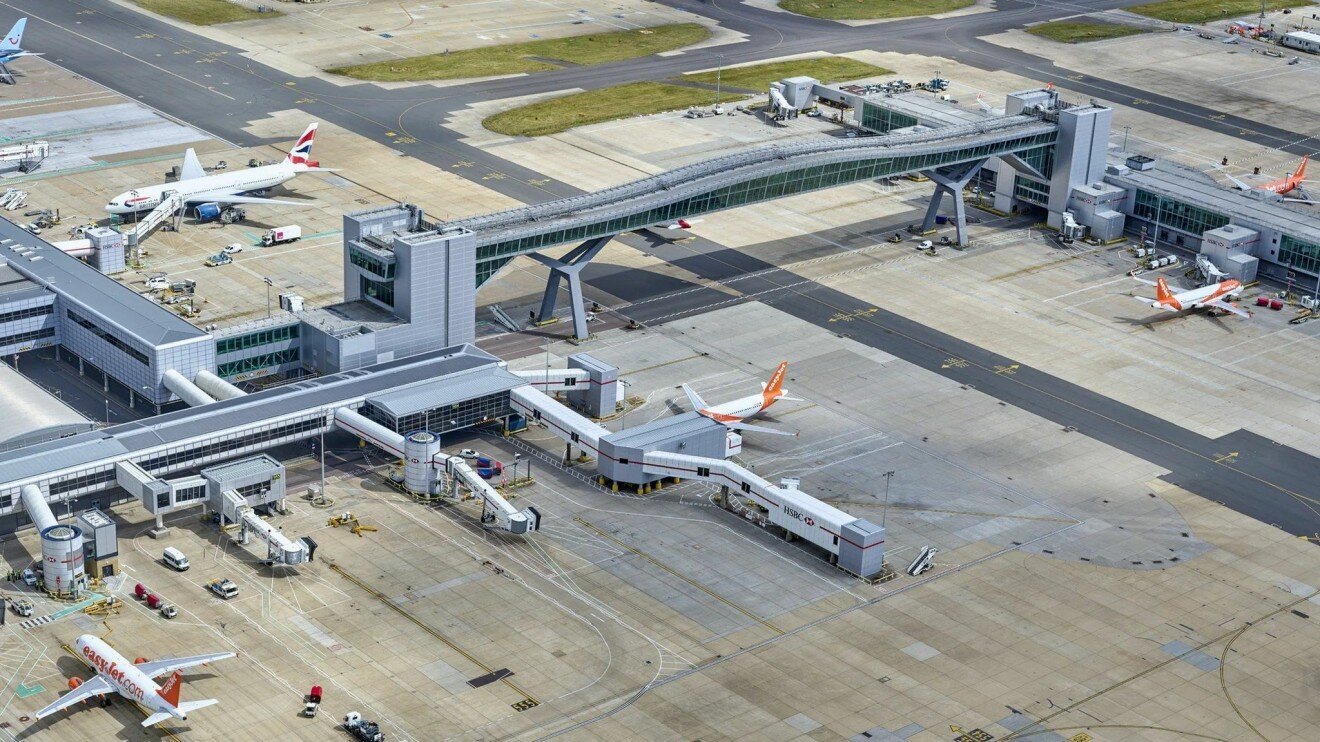
Location and Transport Access
Gatwick Airport (Gatwick, IATA: LGW, ICAO: EGKK), officially London Gatwick Airport, is located in West Sussex, near the town of Crawley, 47.5 kilometers south of central London. This strategic location makes it one of the key transport hubs of southern England.
Of particular relevance to the geographic context is the airport’s proximity to the town of Royal Tunbridge Wells in Kent. The distance between the airport and this historic spa town is roughly 45 kilometers to the northeast. Royal Tunbridge Wells, granted its royal status in 1909, is the administrative center of the borough of Tunbridge Wells and is known for its Georgian terraces, historic springs, and aristocratic atmosphere.
Transport Routes
From Gatwick to Royal Tunbridge Wells, you can drive via the M23, then the M25 and A21, or take the train with a change or two.
Travel Time
The drive takes about an hour under normal road conditions, making Gatwick a convenient airport for residents of Kent.
Historical Development
The history of Gatwick Airport begins in the late 1920s, when an airfield was established on the site. The Air Ministry approved commercial flights from the site in 1933, and the first terminal, called «The Beehive,» was built in 1935. Scheduled air service from the new terminal began the following year.
During the Second World War, the airport was taken over by the military and known as RAF Gatwick. After the war, it returned to civilian use. The modern airport was built in the mid-1950s and opened in 1956. The architectural design of the airport buildings was developed by Yorke Rosenberg Mardall between 1955 and 1988.
Gatwick became one of the world’s first airports with an enclosed pier-type terminal, letting passengers walk under cover to the gate areas next to the aircraft.
Airlines and Development in the 1990s
The 1990s were a turning-point decade for Gatwick Airport. The early part of the decade saw significant changes in the roster of resident airlines. After the collapse of Air Europe and Dan-Air in the early 1990s, British Airways (which had acquired Dan-Air) began turning Gatwick into a secondary hub, supplementing its main base at Heathrow.
These changes meant that, by the end of the millennium, British Airways had become the dominant carrier at Gatwick. But by the late 1990s, BA had already begun reassessing its strategy for the airport, which later opened room for low-cost carriers, especially easyJet, to grow.
| Period | Dominant Airlines | Notes |
|---|---|---|
| 1960s | British United Airways (BUA), Dan-Air | Growth of charter flights |
| 1970s | British Caledonian (BCal) | Dominant in scheduled flights |
| 1990s | British Airways | Developed as a secondary hub |
Transatlantic Traffic
A key feature of Gatwick in the 1990s was its role in transatlantic air travel. From 1978 to 2008, many flights to and from the U.S. used Gatwick because of restrictions on the use of Heathrow set by the Bermuda II agreement between the UK and the U.S. This made the airport an important link in transatlantic air travel.
In 1997, when the events of the novel take place, Gatwick actively served American routes. Passengers could fly direct to major American cities, which was especially convenient for residents of southern England, including the county of Kent, home to Royal Tunbridge Wells.
Technical Infrastructure
Gatwick operates with a single active runway, though it technically has two. The main runway (08R/26L) is 3,316 meters long, able to accommodate wide-body, long-haul aircraft. The northern runway (08L/26R) can only be used when the main runway is unavailable, due to insufficient separation between them (200 meters).
The main runway is equipped with a Category III instrument landing system (ILS), enabling landings under limited-visibility conditions — especially important given Britain’s frequent fog.
Terminal Infrastructure
By the mid-1990s, the airport had two terminals: South (opened in 1958) and North (opened in 1987). The South Terminal was the result of a major 1956–1958 rebuild and was one of the world’s first pier-type structures with enclosed jet bridges to the aircraft.
The North Terminal, construction of which began in the 1980s on land originally earmarked for a second runway, was the largest construction project south of London during the 1980s, costing £200 million.
South Terminal
- Area: 160,000 m²
- 32 jet-bridge gates
- 7 remote gates
- Opened in 1958
North Terminal
- Area: 98,000 m²
- 31 jet-bridge gates
- Including 3 for the A380
- Opened in 1987
Transport Access
An important advantage of Gatwick is its excellent transport connectivity. The airport connects to the M23 motorway via Junction 9A, which links to the main M23 motorway 1.6 kilometers to the east at Junction 9. The M23 meets London’s orbital M25 motorway 14 kilometers to the north, providing access to most of Greater London, the Southeast, and beyond.
For travelers from Royal Tunbridge Wells, the most convenient route is along the A21 to the M25, then the M23 to the airport. An alternative route runs via the A23, which serves Horley and Redhill to the north and Crawley and Brighton to the south.
Rail Service
Gatwick Airport railway station, next to the South Terminal, has served the airport since 1958. The station sits on the main Brighton line and is served by three main operators: Southern, Thameslink, and Gatwick Express.
Gatwick Express provides a direct, non-stop service to London Victoria station, making the trip into central London fast and convenient, taking about 30 minutes. For passengers heading to Kent, including Royal Tunbridge Wells, service is available via London stations with onward connections.
Passenger Traffic in the 1990s
By the mid-1990s, Gatwick was serving more than 20 million passengers a year, making it the UK’s second-busiest airport after Heathrow. Passenger growth had been remarkable: from 368,000 passengers in 1959 to more than 20 million by the late 1980s.
This growth reflected not just the rising popularity of air travel but Gatwick’s strategic position as an alternative to the congested Heathrow, especially for transatlantic and charter flights.
Operational Character
Gatwick is unique among London’s airports in hosting all three major airline business models: full-service, low-cost, and charter. In the 1990s, this variety made the airport appealing to a wide range of passenger types.
Night flights at the airport are subject to restrictions: between 11 p.m. and 7 a.m., noisier aircraft can’t operate. From 11:30 p.m. to 6 a.m., a quota system limits the number of flights and overall noise levels, reflecting an effort to balance commercial needs with environmental protection.
Security and Management
The airport is policed by Sussex Police’s Gatwick division, responsible for the entire airport, including aircraft and, under certain circumstances, planes in flight. The 150 officers assigned to this division include armed and unarmed staff, as well as community officers handling minor offenses.
Access to the airside area is controlled and maintained by a team of airport security staff, regulated by the Civil Aviation Authority. This ensures a high level of security, which mattered especially in the 1990s amid growing international threats.
Economic Significance
By the late 1990s, Gatwick had become an important economic center for the region. Offices of various airlines, including British Caledonian, Virgin Atlantic, and others, were located on and around airport grounds. The City Place Gatwick complex, which includes the original «Beehive» terminal, became a modern office center.
The airport also served as a base for the geophysical services company WesternGeco, which leased an 11,500 m² building on airport property, demonstrating its role not just as a transport hub but as a business center.
Regional Significance
In the 1990s, Gatwick served as an important link between London and continental Europe, as well as transatlantic destinations. For residents of Kent, including Royal Tunbridge Wells, it offered a convenient alternative to the more distant and congested Heathrow.
Future Development
In the late 1990s, the airport was preparing for further expansion. Significant infrastructure investments were planned, including increased capacity at both terminals, improved road connections, and a new baggage-handling system for the South Terminal.
These plans reflected confidence in the continued growth of the aviation industry and Gatwick’s determination to hold its position as the UK’s second most important airport. For travelers from southeast England, including the county of Kent, this meant improved access to international destinations without having to travel through the overcrowded center of London.
So in 1997, Gatwick Airport was a modern, dynamically developing transport hub, playing a key role in providing air links for the people of southern England, including the nearby counties of Sussex and Kent with their historic towns, such as Royal Tunbridge Wells.