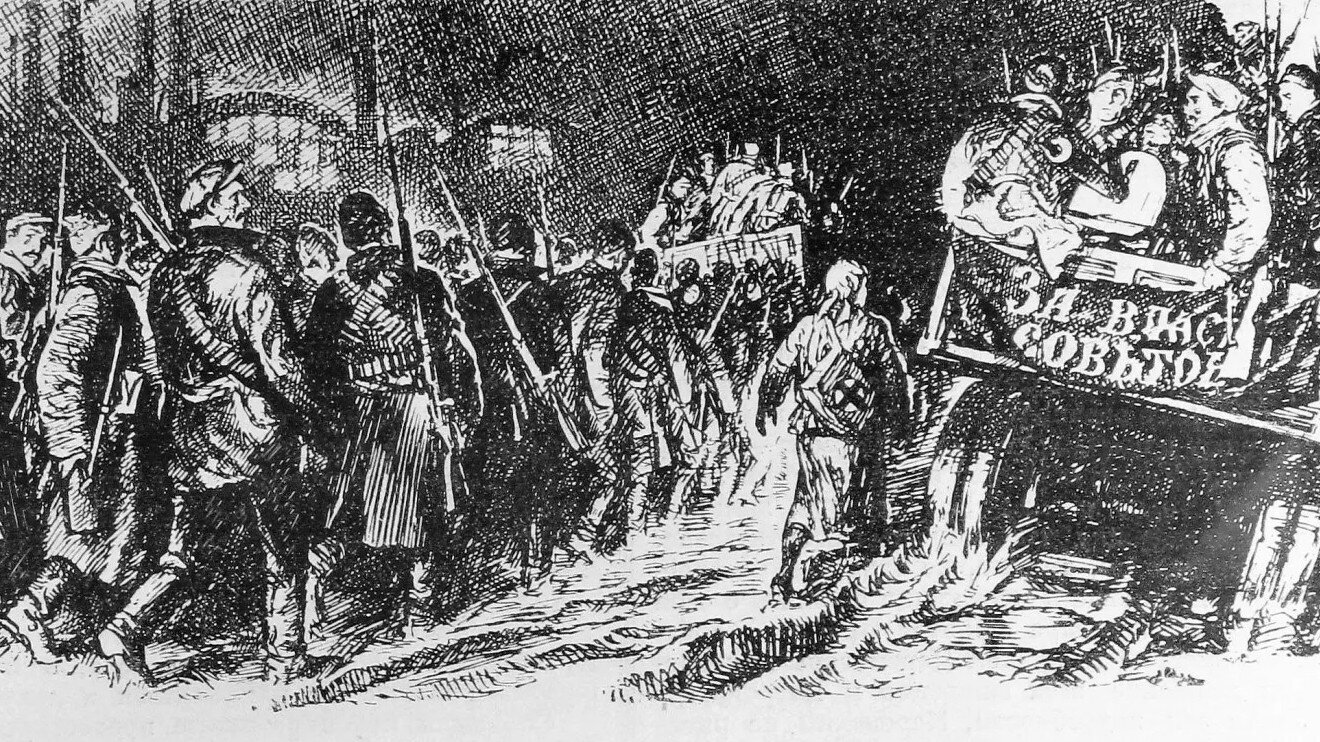
The lines quoted in the novel belong to one of the most significant and controversial works of 20th-century Russian poetry — Alexander Blok's poem "The Twelve," written in January 1918, just two months after the October Revolution.
"There stands the bourgeois, like a hungry dog,
Stands silent, like a question mark.
And the old world, like a mongrel cur,
Stands behind him, tail tucked low."
These lines from the poem's first chapter paint a picture of a representative of the old bourgeois world, bewildered and humiliated by revolutionary events. The metaphor of the dog with its tail tucked becomes a symbol of the defeat of the former social order.
The context of its creation
The poem was created by Blok in a state of "feverish exaltation" in post-revolutionary Petrograd. The poet later recalled: "During and after finishing 'The Twelve' I physically sensed, by hearing, a great noise around me for several days — a continuous roar (probably the sound of the old world collapsing)."
The work became an artistic reflection of the revolutionary chaos of the winter of 1917–1918. Blok captured the atmosphere of the time: "a cutting wind sways enormous political posters, snow, icy streets, gunfire and looting on the streets."
Revolutionary symbolism
The poem's central image is a detachment of twelve Red Guards, patrolling the snow-covered streets of revolutionary Petrograd. The number twelve is no accident — it evokes the twelve apostles of Christ, creating a complex web of religious and revolutionary symbolism.
The most enigmatic and controversial element of the poem is its ending, where the figure of Jesus Christ appears leading the Red Guards forward. Blok himself admitted: "When I finished, I was surprised myself: why Christ? But the more I looked, the more clearly I saw Christ. And at the time I wrote down for myself: unfortunately, Christ."
Artistic features
The poem is written in the style of a "street ditty," close to the work of the popular Petrograd chansonnier Mikhail Savoyarov. Blok deliberately used a coarse, "thieves'-cant" style, the rhythms of the chastushka (a folk ditty), and the intonations of the "cruel romance" (a melodramatic ballad genre). This was a radical departure from his earlier, refined Symbolist poetics.
The critic Viktor Shklovsky observed: "'The Twelve' is an ironic piece. It's not even written in the style of a chastushka — it's done in 'thieves'' style. In the style of a street ditty, like Savoyarov's."
A divisive reception
The poem provoked wildly polarized reactions. Many members of the Russian intelligentsia saw it as a betrayal. Anna Akhmatova refused to attend literary evenings where "The Twelve" was read aloud. Nikolai Gumilyov claimed Blok "had served the cause of the Antichrist."
At the same time, the work found no unqualified approval from the new authorities either. Olga Kameneva, commissar of the Theatrical Department, said: "The verses are a very talented, nearly brilliant depiction of reality... but they should not be read aloud, because they glorify exactly what we old socialists fear most."
Alexander Alexandrovich Blok (1880-1921)
Alexander Blok is one of the greatest Russian poets of the Silver Age, a classic of 20th-century Russian literature, and a leading figure of Symbolism. His creative path reflected the complex spiritual evolution of the Russian intelligentsia at the turn of an era.
Background and education
He was born in St. Petersburg, into the family of jurist Alexander Lvovich Blok and Alexandra Andreyevna, née Beketova, daughter of the rector of St. Petersburg University. His parents' marriage collapsed shortly after his birth, owing to his father's despotic temperament.
The poet's childhood and youth were spent within the cultured Beketov family. Every summer he stayed at his grandfather's estate, Shakhmatovo, outside Moscow, near the estate of chemist Dmitri Mendeleev, called Boblovo.
His early creative period
Blok wrote his first poems at the age of five. In his youth he was drawn to theater, but after early success onstage, he stopped being cast in roles. In 1903 he married Lyubov Dmitrievna Mendeleeva, daughter of the great chemist, who became the heroine of his first book, "Verses About the Beautiful Lady."
Blok's early poetry was steeped in mystical moods, a cult of the Beautiful Lady, and the influence of Vladimir Solovyov's philosophy. The poet perceived the world through the lens of Symbolist aesthetics, in which earthly reality was merely a reflection of higher spiritual essences.
The evolution of his worldview
By the 1910s, tragic motifs were growing more prominent in Blok's work. He felt, ever more acutely, a rift between the ideal and reality. The poet suffered painfully through both the crisis of Symbolism and his own personal spiritual crisis.
The First World War found Blok on military service with the engineering corps in Belarus. His experience at the front deepened his disillusionment with the old world.
Revolution and his final years
Blok greeted the February Revolution with mixed feelings, but refused to emigrate. He initially received the October Revolution with enthusiasm, seeing in it an elemental renewal of the world. It was in this state of mind that "The Twelve" was written.
After the revolution, Blok worked actively with the Soviet authorities, serving on various cultural commissions. Asked in a survey whether "the intelligentsia can work with the Bolsheviks," he answered: "It can, and it must."
By 1919, however, disillusionment had set in. The poet wrote: "under the yoke of violence, the human conscience falls silent." After "The Twelve" and "The Scythians" (1918), Blok fell silent as a poet, answering questions about his silence: "All the sounds have stopped... Can't you hear that there are no sounds left at all?"
The poet's death
The harsh conditions of life in post-revolutionary Petrograd, an overwhelming burden of public work, and his spiritual crisis wore down the poet's health. In the spring of 1921 he requested permission to travel abroad for medical treatment, but was refused.
Blok died on August 7, 1921, of inflammation of the heart valves. According to the recollections of his contemporaries, in his delirium before death the poet was obsessed with the idea of destroying every copy of "The Twelve" — the work he himself called the best thing he had ever written, but which had brought him so much suffering.