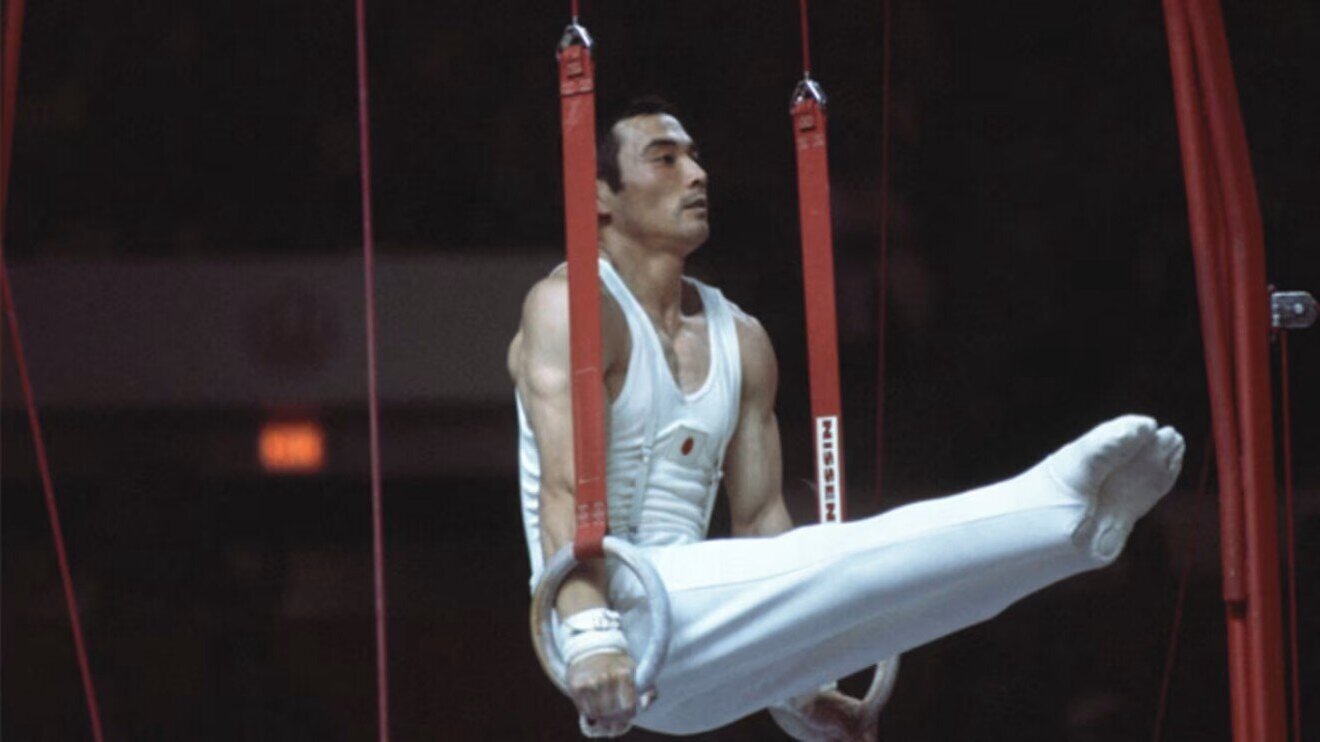
The novel's text mentions "a hunched-over Tsukahara" — a reference to a famous gymnastics element named after Japanese gymnast Mitsuo Tsukahara (born December 22, 1947).
Mitsuo Tsukahara: a legend of Japanese gymnastics
Mitsuo Tsukahara is one of the greatest gymnasts in history, a five-time Olympic champion and four-time world champion. Born in Tokyo, he trained at the Japanese Institute of Sports Sciences and dominated world gymnastics from 1968 to 1978.
His athletic career was truly brilliant:
- 1968 — gold medal at the Mexico City Olympics
- 1970 — two gold and two silver medals at the World Championships
- 1972 — two gold and one bronze medal at the Munich Olympics
- 1976 — two gold, one silver, and two bronze medals at the Montreal Olympics
- 1978 — gold medal at the World Championships
After retiring from competition, Tsukahara served as vice president of the Japan Gymnastics Association. In 2009, the Japanese government awarded him the Medal of Honor with Purple Ribbon. His son Naoya also became a well-known gymnast.
The Tsukahara vault
An entire group of vaulting elements is named after Mitsuo Tsukahara — the "Tsukahara vault." This element was first performed by Tsukahara himself in 1979 and is a complex acrobatic move belonging to Group IV of the vault structure groups.
Technically, a Tsukahara vault is performed as follows: in the first flight phase, the gymnast performs a quarter-turn round-off (a "cartwheel with a 90° turn"), followed by a backward somersault. This element demands exceptional coordination, strength, and technique.
The Tsukahara in the context of the novel
In the novel, set in 1993 Russia, the mention of "a Tsukahara" in the context of the protagonist's dancing is a vivid example of how sports terminology worked its way into everyday speech. By the early 1990s, Tsukahara's name was well known to Soviet and Russian sports fans thanks to broadcasts of international gymnastics competitions.
The phrase "he pulled off a hunched-over Tsukahara" conveys the dynamism and complexity of the character's dance moves, comparing them to a virtuosic gymnastics element. This was typical of the youth slang of the era, when the names of complex sports moves were used to describe any elaborate movement or action.
An interesting fact: In 1976, the Mongolian postal service issued a series of stamps honoring famous gymnasts. One stamp, with a face value of 40 mongo, depicted none other than Mitsuo Tsukahara, testifying to his international fame.