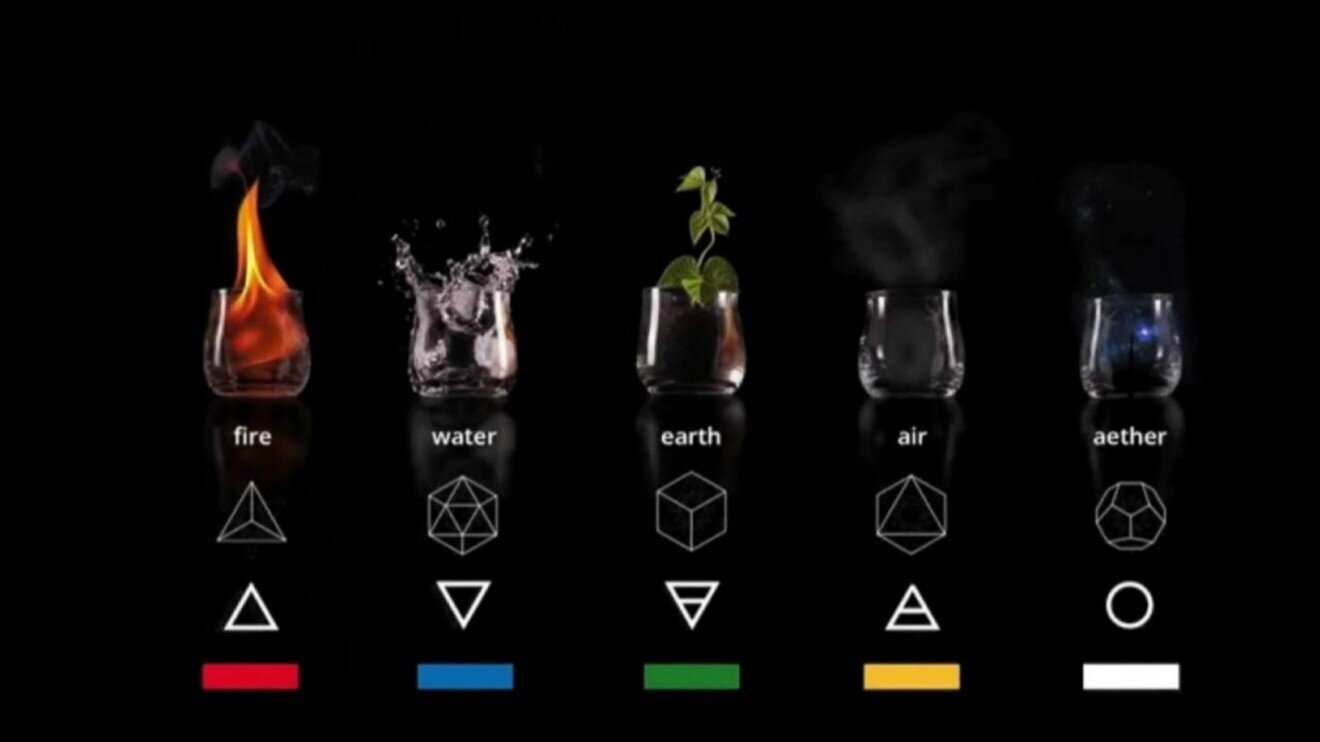
The concept's origin in ancient Greece
In ancient Greek philosophy, ether (αἰθήρ, aither) was considered a fifth element, or quintessence, alongside earth, water, air, and fire. Aristotle described ether as the divine substance from which the heavenly bodies were made. It was a special substance filling the superlunary world — the realm of the fixed stars and planets.
The ancient Greeks regarded ether as the purest form of air, weightless and transparent, present in the upper layers of the atmosphere. The term comes from the Greek word αἴθω (aithō), meaning "to burn" or "to shine," underscoring ether's association with light and celestial phenomena.
Unlike the four earthly elements, subject to decay and corruption, ether was considered eternal, unchanging, and perfect. Plato, in his cosmological theories, also mentioned ether, linking it to the harmony of the cosmos and the movement of the heavenly bodies.
The concept's evolution in the Middle Ages
In the Middle Ages, the concept of ether retained its significance but took on new shades of meaning in keeping with Christian cosmology. Alchemists regarded ether as the highest substance, the quintessence of all the elements, capable of transforming matter.
In medieval medicine, ether was seen as the subtlest of substances, able to permeate all material bodies and transmit vital energy. Paracelsus and his followers used the term "ether" to denote a universal solvent or life-giving substance.
In the works of Isaac Newton, ether was assigned the role of the medium through which the force of gravity propagated. This idea persisted and developed further in 18th- and 19th-century physics, where ether was treated as an invisible but material medium filling all of space.
Ether and the invention of radio
By the late 19th century, physicists assumed that electromagnetic waves, including light, propagated through a special medium — the "luminiferous ether." When Heinrich Hertz experimentally confirmed the existence of radio waves, and Guglielmo Marconi and Alexander Popov subsequently built the first radio transmitters, ether came to be seen as the medium for transmitting radio signals.
The term "ether" (in Russian, "efir") quickly entered common use to denote broadcasting. Phrases like "go out over the ether" or "live on the ether" came to describe the real-time broadcast of radio programs. This metaphor proved so apt that it survives to this day, even though the scientific understanding of ether has changed radically.
The word "ether" became a synonym for broadcasting not only because of the scientific theories of the time, but also thanks to its association with something invisible, all-pervading, and able to cross vast distances — qualities that had been attributed to ether since ancient times.
The difference between the historical and modern understanding of ether
The historical concept of ether as a material medium filling cosmic space was decisively refuted by Albert Einstein's theory of relativity in the early 20th century. The Michelson-Morley experiment failed to detect the Earth's motion relative to the ether, casting doubt on its very existence.
Einstein showed that no special material medium was needed to explain the propagation of electromagnetic waves — they could travel through a vacuum as well. The physical concept of ether as a substance was rejected, replaced by the concepts of spacetime and the electromagnetic field.
In modern scientific understanding, "ether" does not exist as a physical substance. Quantum physics, however, has introduced the concept of the "physical vacuum," which, unlike the classical notion of empty space, is a complex dynamic system full of virtual particles and field fluctuations — something that, in a certain sense, echoes the old idea of ether, but on an entirely different scientific footing.
At the same time, in modern culture the term "ether" survives as a metaphor for radio and television broadcasting. Phrases like "airtime" (literally "ether time"), "live broadcast" (literally "direct ether"), and "go on air" (literally "go out into the ether") have become firmly established in everyday speech, turning into technical terms in the media industry, even though their connection to the original physical concept of ether was lost long ago.
Ether, then, has traveled a remarkable path — from a fundamental element of ancient cosmology, through a central concept in classical physics, to a cultural metaphor in the field of communications.