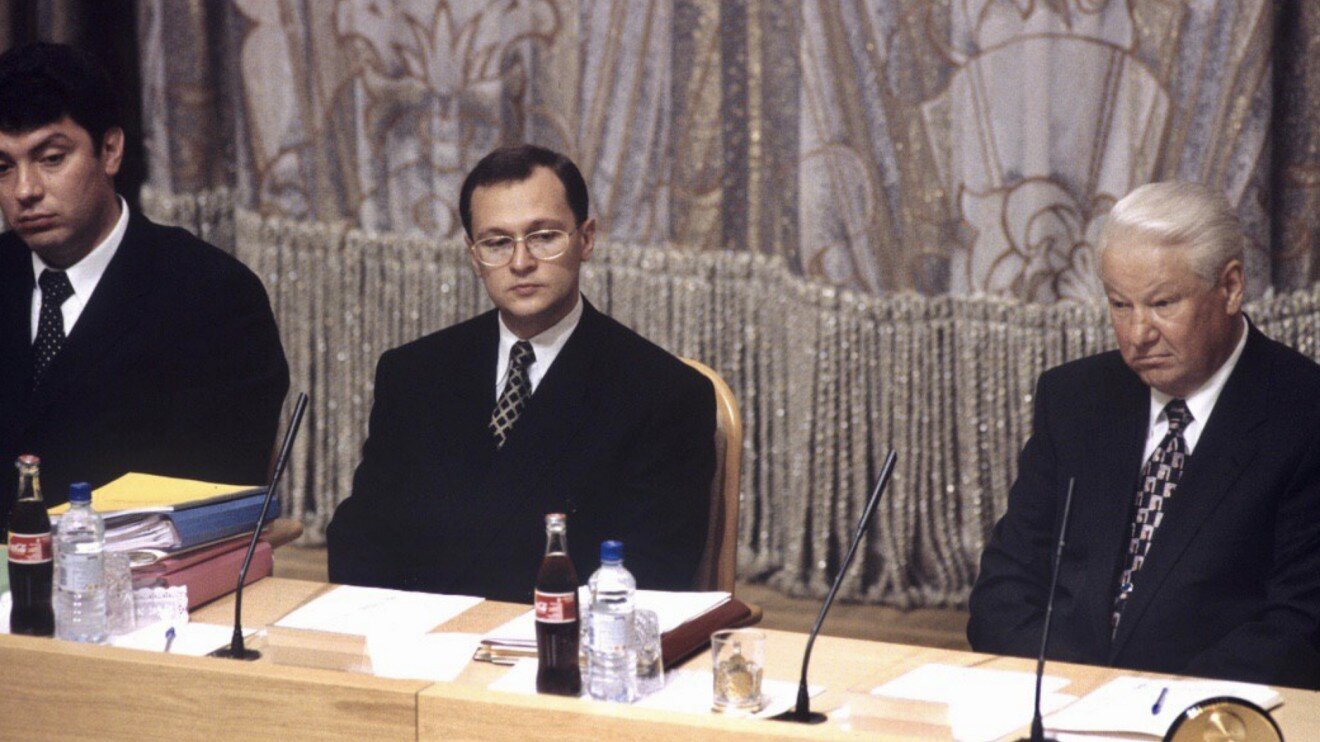
The novel takes place during one of the most dramatic periods in Russia’s recent history – the default of August 17, 1998, when the country plunged into its deepest economic crisis.
Preconditions for the crisis
By the summer of 1998 the Russian economy was in an extremely vulnerable position. The government was pursuing a contradictory macroeconomic policy: a tight monetary policy to curb inflation on one hand, and a loose fiscal policy with bloated spending on the other. The Central Bank was artificially propping up an overvalued ruble within the so-called «currency corridor.»
The main way of financing the budget deficit was issuing short-term government bonds (GKOs) with high yields. In effect, a financial pyramid had been built: new borrowing was used to pay off old debt. By the end of 1997 Russia’s domestic debt stood at 21% of GDP – a relatively modest figure by international standards.
External factors
Two external shocks made the situation worse:
- The Asian financial crisis – the crisis that began in Southeast Asia in mid-1997 drove capital flight from emerging markets, including Russia
- Falling oil prices – a sharp drop in world energy prices, which formed the backbone of Russian exports
The crisis builds
Starting in late 1997 the financial situation deteriorated rapidly. GKO yields rose from 19% in the third quarter of 1997 to 49.2% in the second quarter of 1998. Short-term lending rates jumped from 16.6% to 44.4%.
In July 1998, Prime Minister Sergei Kiriyenko proposed an anti-crisis program to the State Duma, calling for sharp cuts in government spending. But the Communist-controlled Duma rejected the stabilization program.
Political context
Kiriyenko was confirmed as head of government only on the third attempt, on April 25, 1998, receiving the bare minimum of votes needed (251 against a minimum of 226). This showed the sharp standoff between the executive and legislative branches.
August 17, 1998: «Black Monday»
Just three days before the catastrophe, on August 14, President Boris Yeltsin flatly declared: «There will be no devaluation. I’m stating that firmly and clearly.»
Yet on the morning of August 17 the government and the Central Bank were forced to announce:
- A technical default on short-term government bonds
- Abandoning support for the ruble and moving to a floating exchange rate
- Restructuring debt on GKOs and OFZs on terms extremely unfavorable to creditors
The ruble’s collapse
The ruble’s devaluation was catastrophic – within a week the ruble lost 3.2–3.5 times its value.
Consequences of the crisis
Negative consequences
- Collapse of the banking system – many banks declared bankruptcy
- Loss of household deposits in failed banks
- Depreciation of citizens’ ruble savings
- Rising unemployment – the number receiving benefits doubled
- Bankruptcy of small businesses
- Undermined trust in the state and the national currency
Political consequences
- Resignation of Prime Minister Sergei Kiriyenko
- Resignation of Central Bank head Sergei Dubinin
- Appointment of Yevgeny Primakov as the new prime minister
- Appointment of Yuri Maslyukov (a Communist) as first deputy prime minister
- Appointment of Viktor Gerashchenko as head of the Central Bank
Unexpected positive effects
Paradoxically, the crisis also had positive consequences for the Russian economy:
- Increased competitiveness of domestic producers as imports became more expensive
- Growing efficiency of export-oriented enterprises
- Import substitution in a number of industries
- Structural changes in the economy
Already by 1999 the Russian economy was beginning to recover, and the period from 2000 to 2008 became a time of intensive economic growth.
Historical significance
The 1998 crisis became a turning point in Russia’s recent history. It closed out the period of economic experimentation of the 1990s and laid the groundwork for the subsequent stabilization of the Russian economy. Many experts consider it both the end of «wild capitalism» and the beginning of a return to state regulation of the economy.