A Masterpiece Born in an Asylum
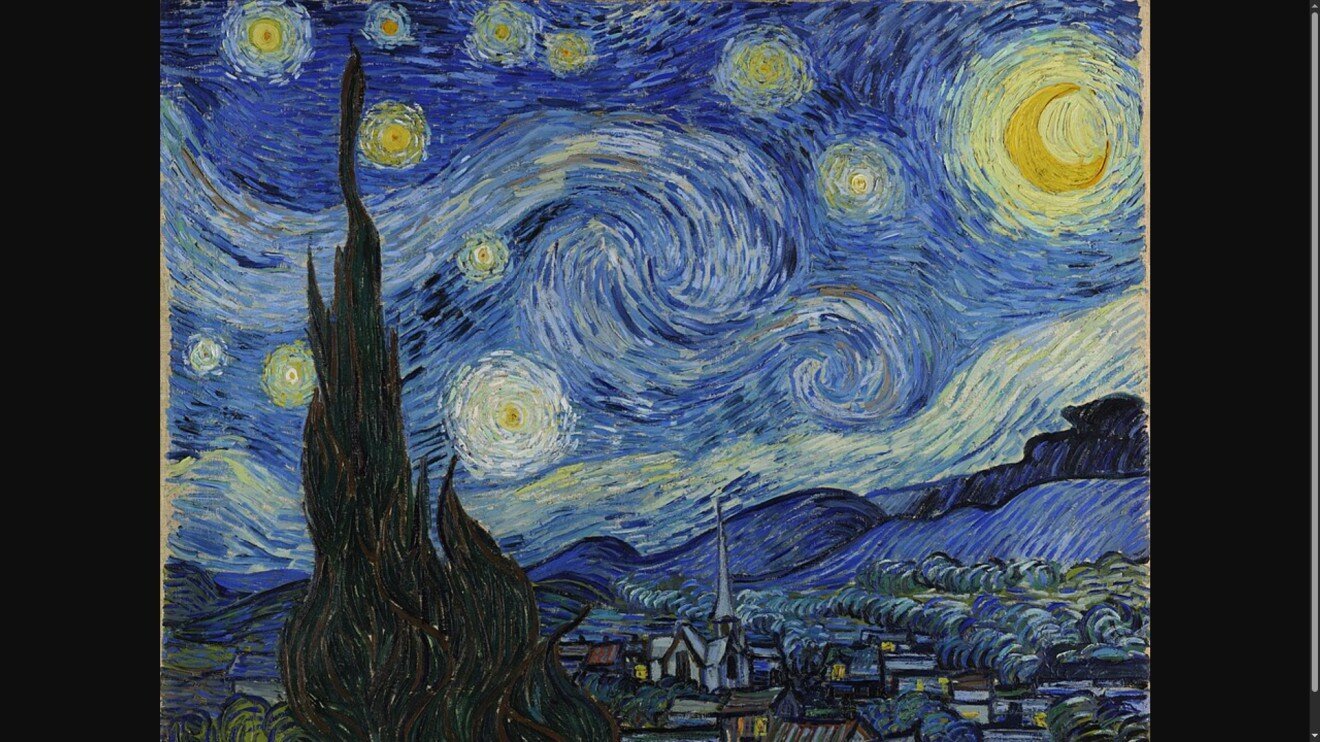
«The Starry Night» is one of the most famous paintings in the history of art, created by the Dutch Post-Impressionist Vincent van Gogh in June 1889. Paradoxically, this masterpiece celebrating the beauty of the night sky was painted within the walls of the Saint-Paul-de-Mausole psychiatric asylum in Saint-Rémy-de-Provence.
The period from May 1889 to May 1890 was one of the artist’s most productive, despite his mental illness. It was during this time that he created «Irises,» his self-portrait in a blue suit, and, of course, «The Starry Night.» The painting depicts the view from the east-facing window of Van Gogh’s bedroom, which he described to his brother Theo: «Through the iron bars I see an enclosed square of wheat... above which, in the morning, I watch the sun rise in all its glory.»
Technical Details
- Title: «The Starry Night» (Dutch: De sterrennacht)
- Date: June 1889
- Medium: oil on canvas
- Size: 73.7 × 92.1 cm
- Location: MoMA, New York (since 1941)
Symbolic Significance
According to astrophysicist Neil deGrasse Tyson, this is the first painting in the history of art in which the sky itself becomes the main subject. Here, the starry sky isn’t just background — it’s the central figure of the work.
Reality and Invention in the Composition
The painting is a remarkable blend of observation and imagination. Though Van Gogh really did watch the night sky from his bedroom window, many elements of the composition were products of artistic invention:
- Venus: The brightest «star,» to the right of the cypress, really does correspond to the position of Venus, which at the time was visible in Provence near the peak of its brightness.
- The moon: Stylized, and not consistent with its actual phase at the time the painting was made.
- The village: No settlement was actually visible from the bedroom window. The village depicted is based on a sketch made on a hillside opposite Saint-Rémy, or perhaps reflects the artist’s memories of his homeland.
- The church spire: Its Gothic shape is more characteristic of northern countries, possibly pointing to Van Gogh’s nostalgic memories of the Netherlands.
Vincent van Gogh: A Life in the Shadow of Genius
A Brief Biography
Vincent Willem van Gogh (March 30, 1853 – July 29, 1890) was a Dutch painter and draftsman, a central figure of Post-Impressionism. In just over a decade of creative work, he produced more than 2,100 works, including around 870 oil paintings.
He was born in the southern Netherlands, the son of Reformed Church pastor Theodorus van Gogh and Anna Cornelia Carbentus. Paradoxically, Vincent was named after an older brother, born a year earlier, who died in infancy — a fact that cast a shadow over his whole life.
Van Gogh’s path to art was long and winding. He first worked at his uncle’s art-dealing firm, then tried his hand at teaching and preaching. Only in 1880, at age 27, did he turn seriously to painting.
Stages of His Artistic Development
The Artistic Character of «The Starry Night»
The painting displays Van Gogh’s singular style, blending observation of nature with an expressionist vision of the world:
Compositional Elements
- The cypress in the foreground — a powerful vertical linking earth and sky, possibly symbolizing human aspiration
- The hilly landscape — the diagonal line of the Alpine foothills, characteristic of every view from the artist’s window
- The village — a peaceful human world, contrasting with the dynamism of the sky
- The sky — the painting’s central figure, full of movement and energy
Technical Mastery
- Spiraling swirls — possibly depicting galaxies, or the mistral wind
- Impasto — thickly applied paint creates a three-dimensional texture
- Contrasting colors — blue and yellow create dramatic tension
- Dynamic brushwork — lends the image energy and motion
Symbolism and Interpretation
«The Starry Night» has inspired countless interpretations. Art historians have found various meanings in it:
A Religious Reading
Art historian Meyer Schapiro sees a connection to the New Testament Book of Revelation. The eleven stars may allude to Joseph’s dream from the Book of Genesis.
A Scientific Reading
Astronomer Charles A. Whitney has noted a resemblance between the central spiral and an 1845 sketch of the Whirlpool Galaxy. The swirls may also depict the mistral wind.
A Psychological Reading
The painting was made on the eve of another attack of his illness — perhaps reflecting the artist’s heightened perception of reality.
The Artist’s Own Opinion of the Painting
A Paradox of Perception
Remarkably, Van Gogh himself didn’t consider «The Starry Night» one of his successes. In a letter to the painter Émile Bernard, he called the painting a «failure,» criticizing himself for straying from painting directly from nature in favor of imagination.
«A dead end lay ahead of me... I ended up there again, trying to depict the big stars. Alas, another failure, and this time I’ve had enough of it,» the artist wrote.
This self-criticism reflected Van Gogh’s internal conflict between his desire to follow Impressionist principles of painting from life, and his drive toward a Symbolist expression of his inner experience.
The Painting’s History After the Artist’s Death
The fate of «The Starry Night» after Van Gogh’s death in 1890 followed a path typical for the work of a genius unrecognized in his lifetime:
The painting was sent to his brother Theo, who died just six months after Vincent
Passed from owner to owner: the poet Julien Leclercq → Émile Schuffenecker → back to Theo’s widow
Belonged to Johanna «Georgette» van Stolk of Rotterdam; it was during this period that the title «The Starry Night» became fixed
Acquired by the Museum of Modern Art in New York, where it remains to this day
«The Starry Night» in the Context of the 1990s
By 1996, «The Starry Night» had already been one of MoMA’s centerpieces for more than half a century. For a Russian visitor of the time, encountering the original was a genuine revelation, for several reasons:
The Richness of Color
Soviet reproductions couldn’t capture the true richness of the original’s colors. The intensity of the blues and yellows, the interplay of light and shadow in the original, made an overwhelming impression.
The Texture of the Paint
Van Gogh’s signature impasto technique — thickly applied paint — created a three-dimensional, almost sculptural surface that no reproduction could convey.
The Era’s Cultural Context
By the mid-1990s, «The Starry Night» was no longer just a painting — it had become a cultural symbol, appearing on posters, postcards, and in advertising, one of the most recognizable works of art in the world. For a Russian viewer, long isolated from the global art world, encountering such icons of world art in the original became a powerful emotional experience.
Influence on World Culture
By 1996, «The Starry Night» had firmly entered popular culture, inspiring:
-
MusicDon McLean wrote the song «Vincent» (1971), dedicated to the artist
-
LiteratureCountless novels and biographies, including Irving Stone’s «Lust for Life»
-
FilmFilms about Van Gogh’s life, in which «The Starry Night» is a key image
-
Mass CultureCountless reproductions, souvenirs, and reinterpretations in advertising
Conclusion: The Masterpiece’s Eternal Pull
«The Starry Night» remains one of the most enigmatic and captivating paintings in the history of art. Created in a moment of the artist’s mental crisis, it paradoxically radiates cosmic energy and optimism. Perhaps the secret of its power lies exactly in that contradiction — between pain and beauty, between reality and vision, between the earthly and the celestial.
For today’s viewer, «The Starry Night» is more than a painting — it’s a symbol of the human spirit’s triumph over circumstance, of an artist’s ability to transform personal tragedy into a work that brings joy to millions. Perhaps that, in the end, is the true greatness of Van Gogh’s art.
At MoMA, the painting hangs in a specially designed gallery, where thousands of visitors stop every day, transfixed by the eternal dance of stars on a canvas measuring just 73 by 92 centimeters — a dance that has now continued for more than a century.