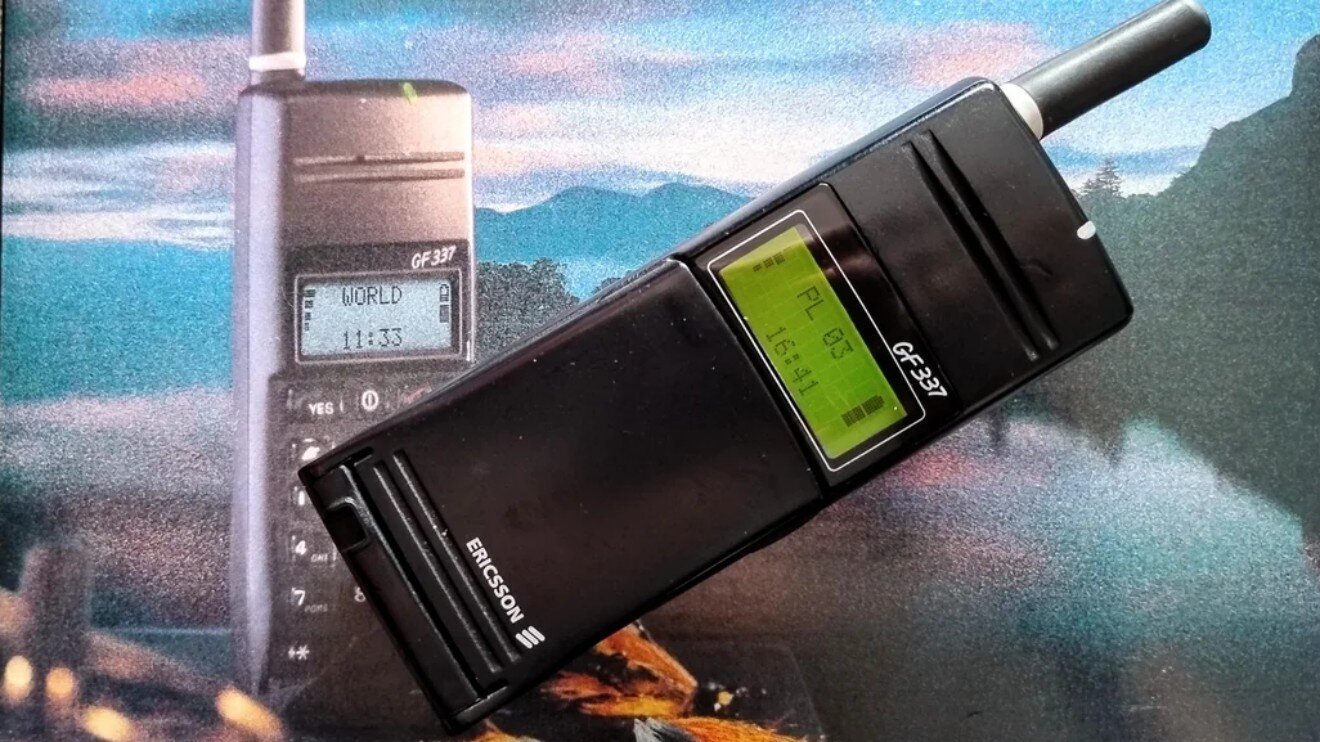
In 1994, an "Ericsson" mobile phone was not just a means of communication, but a symbol of technological progress, business success, and social status. The Ericsson company: a brief history
"Ericsson" was founded in 1876 by Lars Magnus Ericsson as a telegraph-equipment repair workshop. By the 1990s, it had become one of the world's leading telecommunications companies.
Its status in 1994
"Ericsson" ranked third in the world in mobile phone manufacturing, behind only Nokia and Motorola. Its market share was about 11%.
Historical context
By the early 1990s, the Swedish company Telefonaktiebolaget LM Ericsson had grown into one of the world's leading telecommunications equipment manufacturers. Starting out in 1876 as a modest telegraph-repair workshop, the company traveled a long road of technological evolution.
The development of mobile communications was an especially important stage. In 1956, Ericsson built its first mobile phone — a bulky, suitcase-sized device weighing 40 kilograms. By the late 1980s, however, the company was producing portable mobile phones that could be carried in a pocket or bag.
Fun fact
In 1989, Ericsson GE Mobile Communications was formed — a joint venture with General Electric that became the foundation for the development of Ericsson's mobile business.
Ericsson's technology in 1994
By 1994, Ericsson made mobile phones for two main communication standards:
NMT (Nordic Mobile Telephony)
A first-generation analog system, launched in 1981. It operated in the NMT-450 and NMT-900 bands (the latter launched in 1986). This standard was especially popular in Scandinavia and the USSR.
GSM (Global System for Mobile Communications)
A second-generation digital system, commercially launched in 1991. By 1994, GSM was expanding rapidly across Europe.
Ericsson's early-1990s lineup included several popular series:
- GH174, NH97, GH197, GH198, NH237 — early-1990s models for the NMT standard.
- GH337 — one of the smallest, lightest GSM phones of its time.
- GF337 — one of the most elegant GSM phones of its time.
- EH237 — an analog phone that won the "What Cellphone" magazine's prestigious Caesar Award in 1994.
The legendary HotLine series
A special place in Ericsson's history belongs to the famous HotLine advertising campaign and phone series, which ran from 1986 to 1992. This campaign radically transformed the company's image and made the Ericsson brand far more recognizable to the public.
The story of the Harry HotLine character
The ad campaign was built around the fictional character Harry HotLine — a traveler and adventurer who always stayed in touch, thanks to his Ericsson HotLine mobile phone. The name "HotLine" was inspired by the concept of the "hotline" between Moscow and Washington.
The ads featured short stories about Harry's adventures, written in the style of detective novels. This campaign was one of the first to present a mobile phone not merely as a piece of technology, but as a symbol of freedom and mobility.
The HotLine series included several models:
- • Hotline Pocket (1987) — for the NMT-900 standard
- • Hotline Combi — a combined model with a car kit
- • Hotline 900 — a popular late-1980s model
Technical specifications and features
Ericsson mobile phones of the mid-1990s had the following features:
Portable models weighed 200 to 500 grams, a significant achievement compared to earlier generations
Talk time was 30–90 minutes, standby time 8–24 hours, depending on the model
Storing numbers in memory, caller ID, redial function
Ericsson phones were known for their reliability and build quality. The company used its own development platform, internally codenamed "Jane" — continuing a tradition of naming platforms after women (the previous one was called "Curt").
A notable feature
Many mid-1990s Ericsson models had a retractable or removable antenna — a characteristic feature of mobile phones of the era. This was not just a functional choice, but a visual symbol of belonging to the world of high technology.
Ericsson in Russia
Ericsson's connection to Russia has a long history. As far back as the late 19th century, the company took part in telephoning major cities of the Russian Empire:
The pre-revolutionary period
Telephone systems built in Kyiv (1893), Kharkiv (1896), Rostov (1897), Riga, Kazan, and Tiflis (1900)
Production in St. Petersburg
A factory on Bolshoy Sampsonievsky Prospekt, nationalized in 1919
During the Soviet period, Ericsson equipment saw limited use, given the need to adapt it to domestic standards. In the 1960s, the Croatian company "Nikola Tesla" developed interfaces and manufactured equipment under Ericsson license for the USSR.
The 1980 Olympics
An important event was Ericsson's role in providing communications for the XXII Summer Olympic Games in Moscow in 1980. The company installed one of the largest telex stations, the AXB-20, at the Central Telegraph Station.
In 1989, the first digital AXE-10 telephone exchanges made by Ericsson were installed in Leningrad. After the collapse of the USSR, the company opened a permanent representative office in Moscow in 1994, coinciding with the period the novel is set in.
Social and cultural context
In 1994, a mobile phone in Russia was not just a means of communication, but a vivid symbol of belonging to the new class of entrepreneurs and successful people. The cost of a mobile phone and its service plan was so high that only well-off people could afford such a luxury.
Status
Owning an Ericsson mobile phone underscored business success and membership in the elite
Functionality
The ability to stay always reachable opened up new business possibilities
Choosing Ericsson specifically was often driven by the company's reputation as a reliable maker of quality equipment. Unlike cheaper alternatives, Ericsson phones were seen as a symbol of technological superiority and European quality.
Technological innovation
Ericsson pioneered many technical solutions that later became industry standards:
Economic aspects
By 1994, mobile telephony accounted for 85% of the activity of Ericsson's Radio Systems division. This was a time of rapid growth in the mobile market, and Ericsson stood at the forefront of it.
64 of 93
Swedish towns were fitted with telephone systems built by Ericsson in the 1880s
73%
growth in Radio Systems division revenue in 1994
11%
share of the world mobile phone market in 2000
Ericsson's success in mobile telephony was the result of years of investment in research and development, along with skillful positioning of its brand in the international market.
Competition and market positioning
In 1994, Ericsson's main rivals in the mobile phone market were:
Nokia
A Finnish company that, by the late 1990s, became the market leader thanks to its focus on design and user experience
Motorola
An American company, a pioneer of mobile communications, maker of the first commercial mobile phone
Other manufacturers
Panasonic, Siemens, Samsung — companies also competing for a share of the fast-growing market
Ericsson positioned itself as a maker of reliable, quality equipment for professionals and successful businesspeople. The company emphasized technical specifications and reliability, while its rivals paid increasing attention to design and ease of use.
Conclusion
An Ericsson mobile phone in 1994 was the embodiment of technological progress, and a symbol of a new era. For Roman Peskov, buying such a device was an important part of building a successful image and displaying his membership in the emerging class of entrepreneurs.
Choosing Ericsson in particular showed an understanding of the importance of quality and reliability in business. This phone was not just a communication tool — it was an instrument of success, and a symbol of belonging to the new era of Russian entrepreneurship.
Ericsson remained an important player in the mobile market until 2001, when its mobile division merged with Sony to form the joint venture Sony Ericsson. This partnership lasted until 2011, when Sony bought out Ericsson's stake entirely.