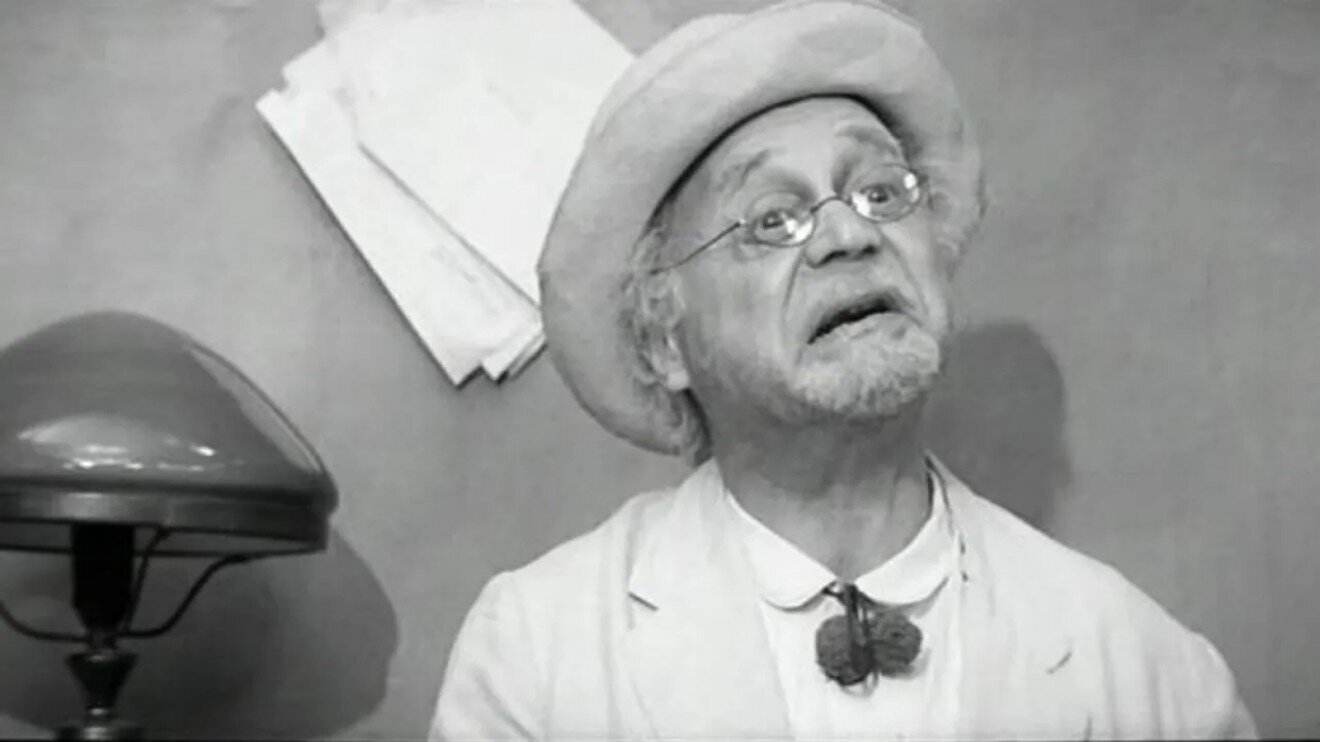
"Zits-predsedatel Funt" ("Sit-In Chairman Funt") is one of the most memorable minor characters in Ilya Ilf and Yevgeny Petrov's novel "The Golden Calf" (1931), whose name became a byword in Russian for a front man or figurehead placed at the head of commercial or political structures.
The origin of the term "zits-predsedatel"
The neologism "zits-predsedatel" is a brilliant piece of wordplay by Ilf and Petrov, blending the words "vitse-predsedatel" ("vice-chairman") and "zits-redaktor" ("sit-in editor"). The prefix "zits-" comes from the German word sitz (seat, place, chair, residence), derived from the verb sitzen, "to sit." Importantly, in German, just as in Russian, the verb "to sit" can also mean "to serve time in prison" — a double meaning the authors play on directly.
The expression "zits-redaktor" (German Sitzredakteur) appeared in Germany in the 1880s, denoting an editor "hired to do time" — the formal head of a publication, ready to bear legal responsibility in the event of a crackdown on the press. The term later migrated to Russia, where it became especially widespread after the Revolution of 1905, when demand for front-man editors surged.
The profession of "sit-in chairman"
Funt's profession was no literary invention — from the early 20th century, an institution of fictitious executives "hired to serve prison sentences" genuinely existed in Russian business practice. The essence of the profession was this: the nominal head of shell companies set up for financial fraud would go to trial and to prison in place of the scheme's actual organizer. In exchange for this service, he was paid double his normal salary for the duration of his sentence.
Such schemes were especially widespread during the NEP period (1921–1928), when private enterprise gained a degree of freedom, while significant legal restrictions and risks remained. Numerous joint-stock companies, limited partnerships, and mixed-capital firms were formed, many of which existed only on paper, or served as fronts for financial dealings of a dubious nature.
The character's biography
In the novel, Funt appears as a man with a rich "professional" history. Born around 1839–1840, he "spent his whole life sitting in for others," beginning his career back under Alexander II "the Liberator," when Chernomorsk (a stand-in for Odessa) was still a free port city. This dates his first stint in prison to sometime between 1855 (the start of Alexander II's reign) and 1858 (the end of Odessa's free-trade status).
Funt continued to "work" under every subsequent regime: under Alexander III "the Peacemaker" (1881–1894), under Nicholas II "the Bloody" (1894–1917), under Kerensky (1917), under the Hetmanate (1918), during the French occupation (1918–1919). The one period he did not go to prison was the era of War Communism (1918–1921), because "pure commerce vanished, there was no work."
NEP was a golden age for Funt — he calls 1921–1928 the best years of his life. In four years, he spent no more than three months at liberty, yet still managed to "marry off his granddaughter, Golkonda Yevseyevna, giving her a concert grand piano, a silver bird, and eighty rubles in gold ten-ruble coins."
The system of fraud involving Funt
The novel describes, in particular detail, a scheme of fraud tied to the "Herkules" company, around which "several private joint-stock companies fed." The mechanism worked as follows: a company would be founded (for example, "Intensivnik"), with Funt installed as chairman. The company would receive a large advance from "Herkules" to procure "something forestry-related" — the sit-in chairman was not required to know exactly what. Once the advance was received, the company would "go bust," someone would "rake in the money," and Funt would go to prison for six months.
The same scheme was used by the limited partnership "Trudovoy Kedr" ("Labor Cedar," an advance for a shipment of seasoned cedar), "Pilopomoshch" ("Sawmill Aid"), and "Yuzhny Lesorubnik" ("Southern Lumberjack"). Each time the script repeated itself: advance — collapse — someone got rich, and Funt "worked off his chairman's fee."
Funt among the "pique waistcoats"
By the time he first appears in the novel, Funt belongs to the company of "pique waistcoats" — a group of idle old men who while away their time debating world politics, dreaming of Chernomorsk's restoration to free-port status. The phrase "pique waistcoats," coined by Ilf and Petrov, became a Russian catchphrase, used to describe people who know little but hold forth loudly on global political and economic questions.
Funt finds himself in extremely reduced circumstances — so poor that he must wear his "Easter" trousers every single day, since he has no others and can't earn money for new ones. The winding-down of NEP cost him his usual source of income: "Where is private capital? Where is the first mutual credit society? Where, I ask you, is the second mutual credit society? Where is the limited partnership? Where are the mixed-capital joint-stock companies? Where has it all gone? It's an outrage!" he exclaims upon meeting Ostap Bender.
His role in the plot of "The Golden Calf"
In the novel, Funt is first mentioned in Chapter XIV, "The First Meeting," among the pique waistcoats outside the "Florida" cafe, but doesn't appear in person until the following chapter, showing up at the door of the "Horns and Hooves" office, intending to become its chairman. Bender, at first baffled, soon realizes he is looking at a professional front man.
Funt names his price: "one hundred twenty rubles a month at liberty, and two hundred forty in prison. A hundred percent hazard pay." Bender hires him, realizing Funt had served in front of numerous Koreiko schemes involving government contracts, and might have valuable information about the millionaire's past. Little could be pried out of him, however, since "everything was kept from Funt. I am only required to sit. That is my profession."
In Chapter XXIII, "The Chauffeur's Heart," Funt is arrested once again when the "Horns and Hooves" office is shut down, a fitting conclusion to his role in the story.
The literary significance of the character
According to the literary scholar and writer Alexander Zholkovsky, the character of Funt is used in the novel to bring out "peripheral" traits of the protagonist, connected to the archetype of the "Old Man." In doing so, the authors show, on one hand, the character's dependency on the state, and on the other, his ties to a "pre-utopian" past.
Funt embodies a type of person who adapts to any political and economic system, finding his niche within each one. His professional longevity (working under every regime from the 1850s to the 1930s) demonstrates the persistence of certain social mechanisms and human types, regardless of changes in the social order.
Its influence on the Russian language
After the novel's publication, the surname "Funt" became a byword in Russian speech for a front man. In modern Russian, the term "zits-predsedatel" is used when describing an official who formally occupies a post but has no real authority to make consequential decisions. The word has become firmly embedded in political and economic vocabulary, retaining its relevance well into the post-Soviet era.
Interestingly, the character's surname has a basis in reality: according to the recollections of poet Taya Lishina, in 1920 that name appeared on the nameplate of an Odessa building Ilf often walked past. The character's first name and patronymic are never given in the novel's text, underscoring his functional rather than personal role.
Conclusion
Sit-in chairman Funt is a striking example of how literary characters can cross over from fiction into real life, becoming part of language and culture. The image Ilf and Petrov created proved so precise and recognizable that the word "zits-predsedatel" came to be used to describe a genuine social phenomenon.
This character showcases the authors' skill at creating types that, though products of a specific historical era, take on universal meaning. Funt is not merely a comic figure, but a social type, embodying particular mechanisms of survival and adaptation to constantly shifting social systems.