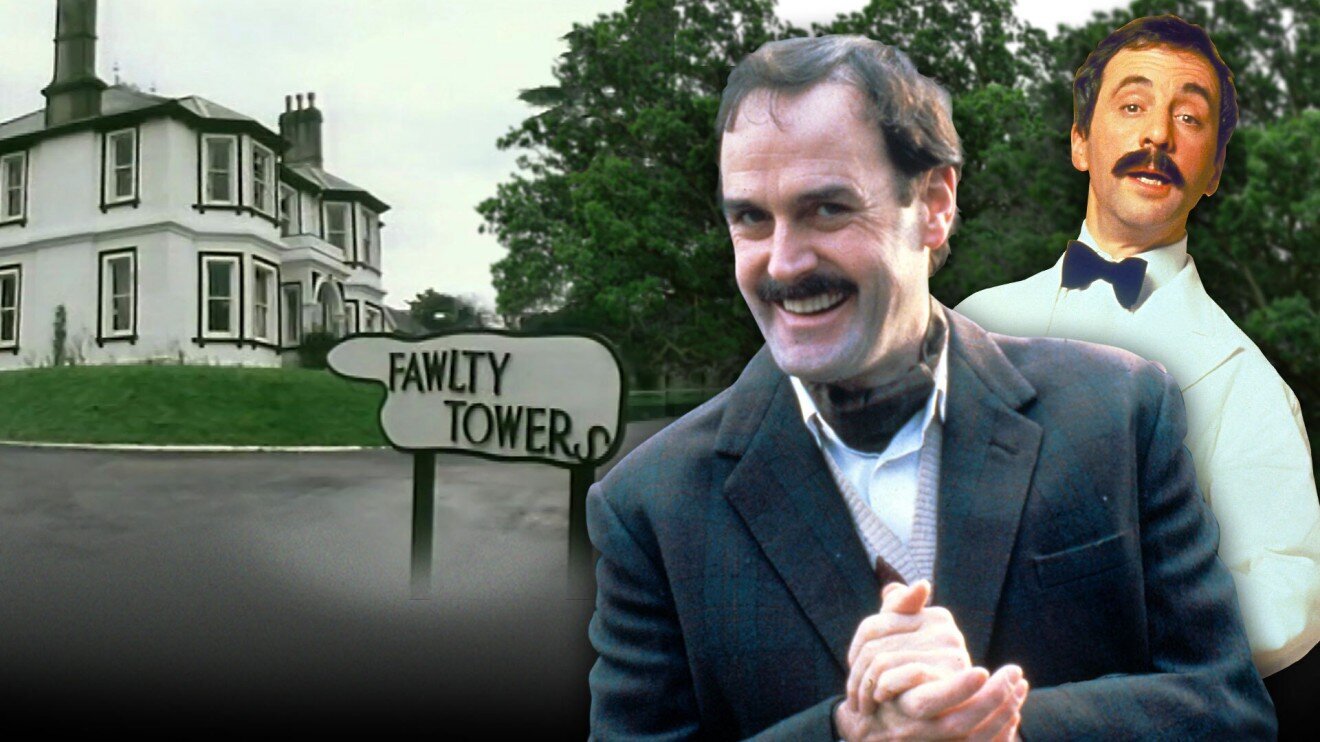
«Fawlty Towers» is a legendary British sitcom created by John Cleese and Connie Booth. Made up of just twelve episodes across two seasons (1975 and 1979), it became a cult phenomenon not only in British but in world television.
Origins and Real-Life Inspiration
The idea for the show grew out of the personal experience of John Cleese and his Monty Python colleagues. In May 1970, while filming near Paignton, the comedy troupe stayed at the Gleneagles Hotel in Torquay. One of the hotel’s co-owners, Donald William Sinclair (1909–1981), displayed such outlandish behavior that he became the model for the show’s central character, Basil Fawlty.
Sinclair had initially objected to housing the actors at his hotel, but his wife Beatrice insisted on taking them in. The owner’s behavior was so absurd that every member of the troupe except Cleese and his wife Connie Booth chose to move to another hotel. Sinclair criticized Terry Gilliam’s table manners and threw Eric Idle’s suitcase out the window, suspecting it held a bomb.
The Wordplay in the Title
The show’s title contains a distinctly British pun. The hotel owner’s surname, «Fawlty,» is a homophone of the English word «faulty,» meaning «defective, broken.» So «Fawlty Towers» can be read as «faulty towers» or «defective towers» — a perfect match for the establishment’s chaotic atmosphere.
Setting and Characters
The action unfolds at the fictional Fawlty Towers hotel in the resort town of Torquay, on the so-called English Riviera — a popular domestic tourist destination in Britain. The main characters form a vivid gallery of types:
Basil Fawlty — the gruff, high-strung, arrogant hotel owner, brilliantly played by John Cleese himself. The character is defined by his snobbery, his inability to communicate normally with guests, and his tendency toward hysterics.
Sybil Fawlty — Basil’s domineering wife, who effectively runs the hotel and keeps her husband in check. Her lines often begin with a characteristic «Oh, Basil!»
Manuel — an unlucky waiter from Barcelona who speaks poor English. His catchphrase, «I know nothing!», became famous.
Polly — the sensible chambermaid and art-college student, the only reasonably competent member of the hotel staff.
Cultural Significance
In 2000, a British Film Institute poll (the BFI TV 100) named «Fawlty Towers» the greatest British television series of all time. That recognition speaks not only to the quality of the comedy but to the precision of its social satire.
The show became a kind of encyclopedia of British humor, built on social awkwardness, class prejudice, and the absurdity of everyday situations. Every episode is a carefully constructed chain of misunderstandings, which Basil only makes worse in his attempts to fix things.
English Country Hotels: Tradition and Reality
«Fawlty Towers» was no accidental mirror of the British hotel industry of the mid-1970s. English country hotels of the era, especially small family-run establishments, really were famous for their «quirks» — quirks foreign tourists took as flaws, while the British themselves saw them as an inseparable part of national character.
Architectural and Everyday Features
A typical English country hotel of the 1970s–90s was a Victorian or Edwardian building with distinctive architectural features. Rooms were small, with low ceilings and small windows. The furniture, often family heirlooms or antiques, was considered «traditional» and «authentically English,» though many guests found it outdated and uncomfortable.
Especially notorious was the plumbing system with two separate taps — one for hot water, one for cold. This setup, which persisted in most old hotels until the mid-1990s, baffled continental Europeans and Americans used to mixer taps. Guests were forced either to scald their hands with boiling water, wash in ice-cold water, or plug the sink and mix the two by hand.
Culinary Traditions
The cuisine of English country hotels deserves its own mention, and often became a subject of complaint. Breakfast was usually served at strictly fixed hours and consisted of the traditional «full English breakfast»: fried eggs, bacon, sausages, grilled tomatoes, baked beans, and black pudding. The quality of preparation often left something to be desired — eggs overcooked, bacon swimming in grease, toast served cold.
The dinner menu in the mid-1990s was often limited to traditional British dishes: roast beef with Yorkshire pudding, fish and chips, shepherd’s pie. Vegetables were typically boiled to a mush, which especially shocked guests from countries with a more developed culinary culture. Wine was a rarity at such establishments — the main drinks on offer were tea, instant coffee, and warm beer.
Service and Atmosphere
Service at family-run hotels often had a very particular character. Owners, much like Basil Fawlty, frequently showed a degree of snobbery toward guests, especially foreign ones. There was an unspoken hierarchy: British guests from the upper classes received better treatment than working-class Britons or tourists from other countries.
Rules at such hotels were strict and numerous. Breakfast, lunch, and dinner times were rigidly enforced. After a certain hour (usually 10 or 11 p.m.), the front door was locked, and late-arriving guests had to ring a bell, risking the owners’ displeasure. The television, if there was one, sat in a shared lounge, and the owners decided what to watch.
Central Heating and Amenities
Many English hotels of the period were famous for their spartan living conditions. Central heating ran on a fixed schedule, or didn’t run at all; rooms had gas or electric heaters that required a steady supply of coins to operate. Bathrooms were often located at the end of the hallway, shared among several rooms.
Bedding was changed once a week, towels even less often. Soundproofing in old buildings was minimal, adding further discomfort. Elevators in three- or four-story buildings were rare, leaving guests to haul their own luggage up narrow staircases.
Attitudes Toward Foreign Guests
By the mid-1990s, English country hotels still hadn’t fully adapted to international tourism. Staff rarely spoke foreign languages, menus went untranslated, and local customs went unexplained. This created plenty of comic, and sometimes tense, situations — masterfully skewered in «Fawlty Towers.»
Foreign guests often ran into a lack of understanding of their needs. Requests for extra towels, a change in breakfast times, or help with luggage were treated as caprices. The language barrier made things worse — many hotel owners spoke in local dialects, barely comprehensible even to other Britons.
The Show’s Legacy
«Fawlty Towers» had an enormous influence on British comedy and culture at large. Lines from the show became part of everyday speech, and the image of Basil Fawlty became shorthand for a hapless, arrogant manager.
The show also helped push reforms in the British hospitality industry. Many hotel owners, recognizing themselves in Basil’s caricature, began rethinking their approach to customer service. By the late 1990s, service standards had improved considerably, though some «traditional» quirks survived into the present day.
International Recognition
The show earned recognition far beyond the United Kingdom. It aired in dozens of countries, was translated into numerous languages, and was adapted for various cultures. Some countries created their own versions, but none achieved the popularity of the original.
Critics note that the success of «Fawlty Towers» lies in the universality of the situations it depicts. Though set in a specifically British milieu, its themes of social awkwardness, family conflict, and professional incompetence resonate with audiences of any nationality.
Influence on Contemporary Culture
Even decades after it ended, «Fawlty Towers» remains relevant. The show regularly appears on lists of the greatest comedies, is quoted by other writers, and is parodied in contemporary works. John Cleese has returned to the image of the eccentric hotelier in various films and productions over the years.
In an era of globalized, standardized hospitality, «Fawlty Towers» stands as a reminder of a time when every hotel had its own unrepeatable, if not always pleasant, character. The show became a kind of historical document, capturing a vanishing era of British hospitality in all its virtues and flaws.
Conclusion
«Fawlty Towers» is more than a comedy series — it’s a cultural phenomenon that captured an entire era in the history of British society. The combination of brilliant acting, subtle humor, and precise social satire produced a work that remains relevant and funny half a century after it was made.
For foreign guests who found themselves in English country hotels of the 1990s, the show served as a kind of guide through the labyrinth of British tradition and prejudice. Many situations that seemed absurd on screen turned out to be reality for anyone who dared to experience genuine English hospitality in its unfiltered form.