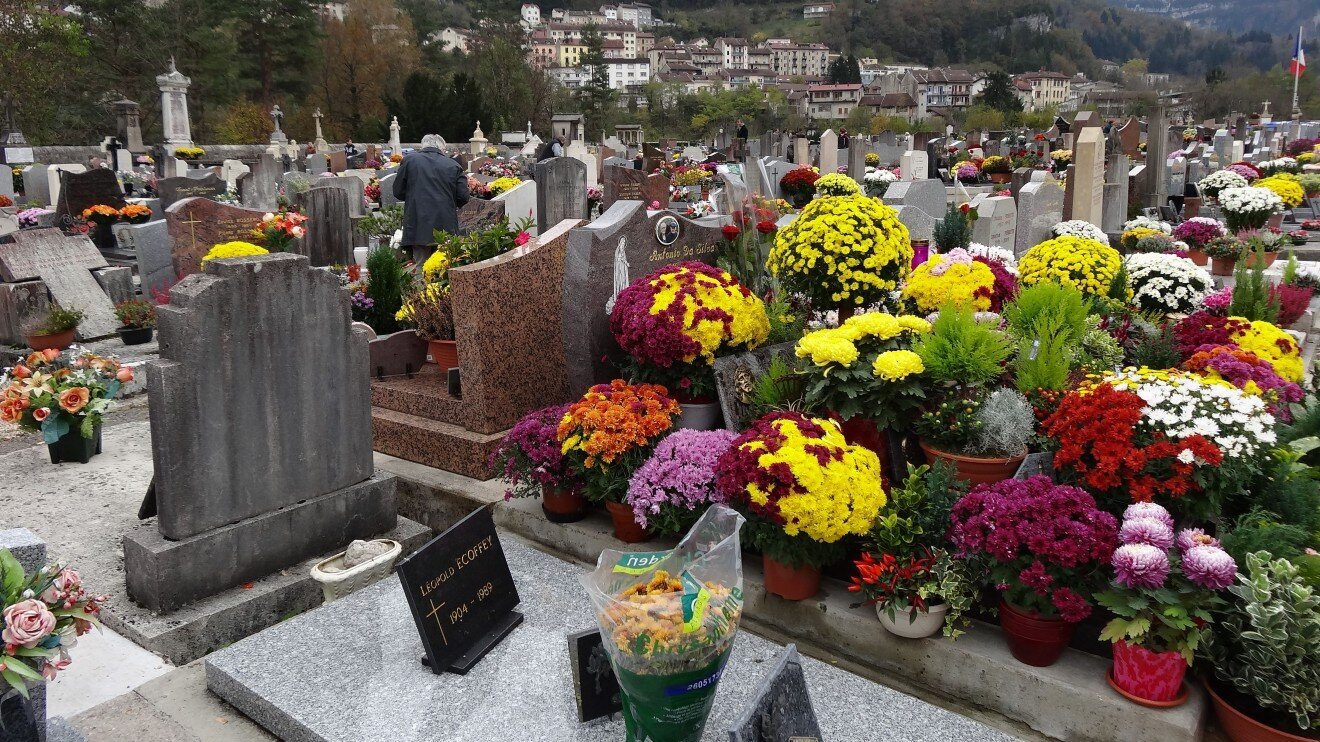
La Toussaint (French: La Toussaint, Latin: Sollemnitas Omnium Sanctorum) is one of the most important Catholic feasts, dedicated to honoring all the saints, both those canonized by the Church and those unknown. This ancient Christian feast has centuries of history and deep theological significance, and in modern France it is an official public holiday and an important part of the country’s cultural tradition.
Date and liturgical features
In the Roman Catholic Church of the Western rite, La Toussaint is celebrated on November 1. The liturgical observance begins with vespers on October 31 and continues through the end of November 1. The feast is followed by the Commemoration of All the Faithful Departed (French: Commémoration de tous les fidèles défunts), observed on November 2.
In the Orthodox Church and the Eastern Catholic churches of the Byzantine rite, the equivalent feast – the Sunday of All Saints – is celebrated on the first Sunday after Pentecost. Some Lutheran churches and the Anglican Church also mark All Saints’ Day on November 1, even though Protestantism as a whole does not generally practice the veneration of saints.
Historical development of the feast
Early Christian roots
The tradition of honoring all martyrs dates back to the fourth century, when the Eastern churches already held feasts in honor of all martyrs on the Sunday after Pentecost. Fifth-century Rome likewise had a feast honoring saints and martyrs, observed on the Sunday after Pentecost.
A major milestone came with the consecration of the Roman Pantheon by Pope Boniface IV. On May 13, 610, he dedicated the former pagan temple to the Virgin Mary and all martyrs, under the name of the Church of St. Mary and the Martyrs (Latin: Sancta Maria ad Martyres). The feast of All Saints was originally celebrated on precisely May 13, the anniversary of that consecration. The choice of that date may also have been meant to replace the pagan festival of Lemuria, held at that time to drive away evil spirits.
The move to November 1
The celebration of La Toussaint on November 1 emerged in Western Europe in the eighth century. According to church tradition, this happened under Pope Gregory III, who dedicated one of the chapels of St. Peter’s Basilica in Rome to all the saints. The date was finally fixed under Pope Gregory IV, who around 835 decreed that the feast be observed throughout the Christian world on November 1.
On Pope Gregory IV’s advice, Emperor Louis the Pious established the observance of All Saints’ Day across the entire Carolingian Empire, helping the feast spread throughout Western Europe.
Ties to the commemoration of the dead
Already by the ninth century, the celebration of La Toussaint had come to be accompanied by local services for the dead. In 998 the monks of Cluny established a day of commemoration for all the departed on November 2, which entered the Roman liturgy in the thirteenth century as the Commemoration of All the Faithful Departed.
Despite this liturgical separation, in the popular imagination the cult of the dead remained largely associated with November 1, which explains the modern tradition of visiting cemeteries specifically on the day of La Toussaint.
Theological significance
The feast of All Saints is not grounded in specific biblical texts or in the Jerusalem liturgy, but it carries deep theological weight. According to Catholic teaching, the feast honors not only the canonized saints, whose presence in God’s glory the Church has officially attested, but all those who in truth dwell in divine blessedness.
As Bishop Robert Le Gall explains, the feast embraces all people, canonized or not, who were sanctified through the practice of love, the acceptance of mercy, and the gift of divine grace. La Toussaint, in this sense, reminds all believers of the universal calling to holiness.
The Gospel of the Beatitudes
At Mass on La Toussaint, the Beatitudes are read from the Gospel of Matthew (5:3–12). This text emphasizes that holiness is open to all who choose to follow in Christ’s footsteps by accepting the Word of God, remaining faithful and trusting toward him, and practicing kindness, justice, love, forgiveness, and peace.
The feast’s standing in the Catholic Church
In 1484, Pope Sixtus IV raised the solemnity of the feast, granting it an octave (an eight-day observance). In 1914, Pope Pius XI made La Toussaint a feast of obligation (Latin: festum de praecepto), meaning all Catholics were obliged to attend Mass on that day.
La Toussaint in modern France
Official status
November 1 is an official public holiday in France and in most Catholic countries in Europe. It’s one of the few religious holidays to retain official status in the secular French Republic, evidence of how deeply it’s rooted in the national culture.
Popular traditions
Although the liturgical Commemoration of the Dead falls on November 2, France and Belgium have developed a tradition of commemorating the dead specifically on November 1, since that day is the public holiday. The centuries-old tradition includes lighting candles at cemeteries and, since the nineteenth century, decorating graves with chrysanthemums. These gestures symbolize a happy life after death.
The French painter Émile Friant captured this tradition in his painting «La Toussaint» (1888), depicting families visiting a cemetery on that day.
Halloween and La Toussaint
The name «Halloween» comes from the English «All Hallows’ Eve,» meaning «the eve of All Saints’ Day,» or the eve of La Toussaint. This folk holiday, rooted in Anglo-Celtic tradition, is observed on the evening of October 31, the night before the Catholic feast of All Saints.
Despite their shared historical roots, Halloween and La Toussaint are quite different cultural phenomena: the former is a largely secular, entertainment-oriented holiday, while the latter is a solemn religious observance with deep spiritual content.
Regional lore and sayings
French folk tradition preserves many sayings about the weather around La Toussaint. These bits of lore reflect the day’s importance in the agricultural calendar:
- «From St. Michael’s to Toussaint, plow on» – on wrapping up fieldwork
- «At Toussaint, mittens on the hands, gloves on the fingers» – on the onset of cold weather
- «As Toussaint goes, so goes Christmas» – a way of forecasting the winter weather
- «From Toussaint to the end of Advent, there’s never too much rain or wind»
Administrative quirks in France
In the context of the novel, it’s worth noting a few features of the French administrative system around the time of La Toussaint. As the character Zhora rightly observes, French bureaucracy, unlike some other systems, doesn’t deal in outright bribery – especially not with foreign investors of murky origin.
Instead, the standard tactic is freezing permit approvals. The French administrative calendar creates natural obstacles to getting things done:
- August – the traditional vacation period for most French civil servants
- September – a slow restart, with paperwork moving at a leisurely pace
- October – it’s highly unlikely that complex cases opened in September will be resolved
- November 1 (La Toussaint) – an official holiday with long weekends and roughly two weeks of school holidays (vacances de la Toussaint)
- December – the pre-Christmas period, with a reduced pace of work
So, as the character Zhora rightly points out, papers filed in summer will logically only be ready after the New Year. The system effectively weeds out casual investors, leaving only those prepared for lengthy administrative procedures and genuinely serious about their intentions.
For foreign businesspeople, especially those from countries with a different administrative culture, this can prove a serious obstacle, since obtaining the necessary documents can drag on for months. French officials favor thorough document review and strict adherence to formalities, which, absent any way to «speed things up,» results in lengthy delays.
Conclusion
La Toussaint remains one of the most important holidays on the French calendar, blending deep religious tradition with modern social practice. For understanding French culture and its administrative system, this feast is of particular interest, since it shows how historic religious traditions continue to shape everyday life even in a secular society.
In a business context, knowing the particulars of this period is critical for anyone planning administrative procedures in France, since underestimating how the traditional calendar affects the operation of government agencies can lead to significant project delays.