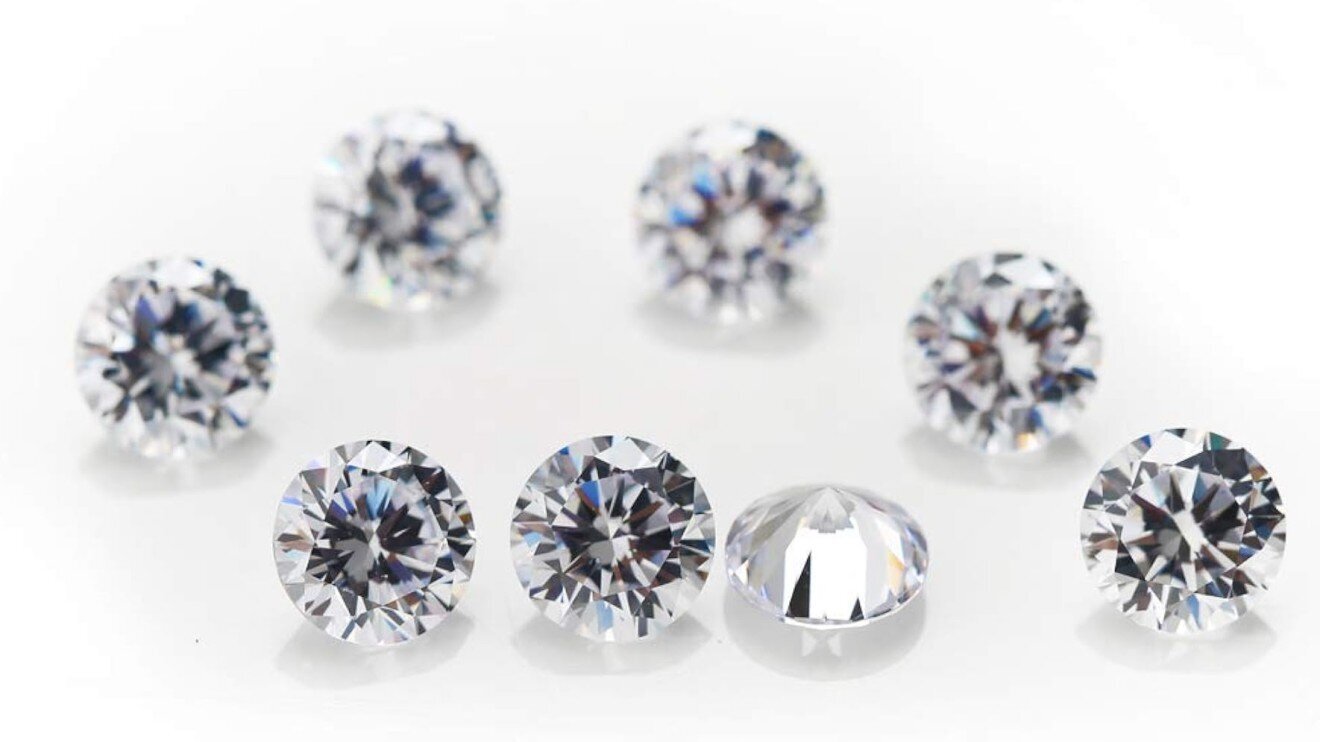
Cubic zirconia (Russian: fianit) is a synthetically produced mineral, crystals of zirconium dioxide (ZrO₂) in cubic crystal form. It is widely used in jewelry as an affordable imitation of diamonds and other precious stones.
History and Name
The Russian name «fianit» comes from the acronym FIAN — the Lebedev Physical Institute of the USSR Academy of Sciences, where the material was first synthesized in 1970. Interestingly, this name is used mainly in the territory of the former USSR and in Eastern Europe. Internationally, the material is more often called «cubic zirconia,» or CZ for short.
It's important not to confuse cubic zirconia with zircon (a natural zirconium silicate mineral) or metallic zirconium (a chemical element). These are entirely different materials, despite the similarity in names.
Properties
Cubic zirconia has several notable characteristics:
- Refractive index: 2.15-2.25 (close to diamond's 2.417-2.419)
- Luster: adamantine
- Hardness on the Mohs scale: 7.5-8.5
- Density: 6.5-10 g/cm³
- Cleavage: none
- Fracture: irregular
- Dispersion: 0.01
Thanks to its high refractive index, cubic zirconia is visually difficult to distinguish from a genuine diamond without specialized equipment, making it a popular and affordable alternative to expensive gemstones.
Production and Variants
Cubic zirconia is produced by crystallization under laboratory conditions on special seed crystals as a melt cools. Crystal growth rates reach up to 8-10 mm per hour. Zirconium dioxide is not stable in its cubic form under normal conditions on its own, so it's stabilized with additives of magnesium, calcium, or yttrium oxide.
The chemical formula of stabilized cubic zirconia is Zr₀.₈Ca₀.₂O₁.₉₂, though it can vary depending on the additives used.
Cubic zirconia's ability to take on different colors when specific metal oxides are added is especially prized:
- Y₂O₃ (yttrium oxide) — colorless crystals
- CeO₂ (cerium oxide) — straw-yellow
- Nd₂O₃ (neodymium oxide) — bluish-violet
- Pr₂O₃ (praseodymium oxide) — green
- Er₂O₃ (erbium oxide) — pink
Use
In the context of the novel, set in 1993 Russia, the mention of cubic zirconia is particularly telling. During the «wild nineties,» cubic zirconia was often used to imitate diamonds in jewelry, and unscrupulous sellers frequently passed the stones off as genuine gems. A situation where a police captain suspiciously identifies a stone as cubic zirconia rather than a real gem was typical of the era.
Main applications of cubic zirconia:
- Jewelry — as an imitation of diamonds and other gemstones
- Accent stones set into gold pieces
- Used for contrast against a piece's main stone in a jewelry composition
- Laser and optical-filter manufacturing
- Dentistry
- Ceramic coatings
- The chemical industry
In 1990s Russia, cubic zirconia gained particular popularity thanks to its affordability and its visual resemblance to diamonds, allowing people to create striking, eye-catching jewelry for far less money — a status symbol of the era's «New Russians» and criminal figures alike.