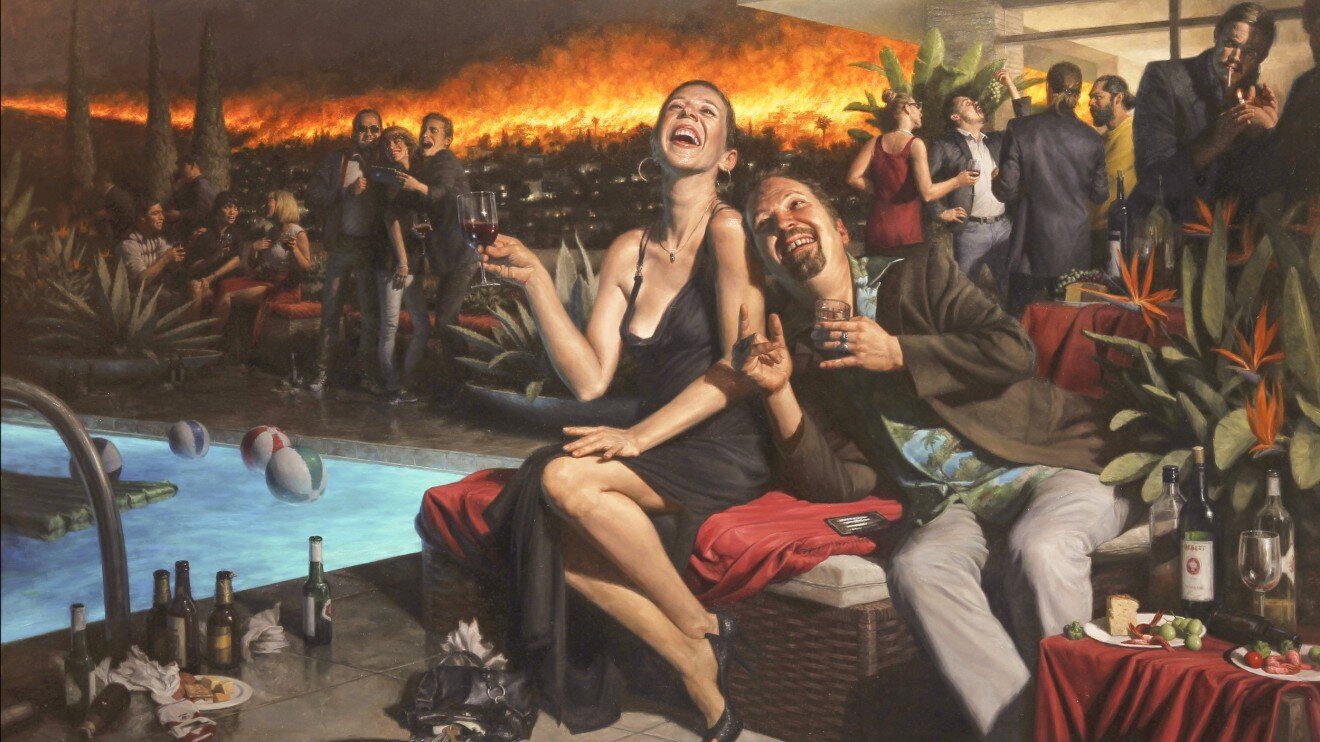
In the early 1990s, postmodernism became a fashionable term in Russia, making its way into intellectual circles along with a wave of Western cultural influences after the fall of the Iron Curtain. But the phenomenon itself had begun taking shape much earlier.
Postmodernism arose as a reaction to modernism and its faith in rationality, progress, and universal truths. It's a movement in art, philosophy, and social thought that proclaimed a crisis in our conception of reality — a deep loss of faith in our ability to accurately represent the world.
The term «postmodern» first appeared as far back as 1870, but only became widespread in the 1950s-60s. In 1979, French philosopher Jean-François Lyotard defined the postmodern condition as «incredulity toward metanarratives» — the all-encompassing explanatory frameworks that claim universality (for example, Christianity, Marxism, or the Enlightenment faith in progress).
The main features of postmodernism:
- Irony and play — in contrast to modernism's seriousness
- Eclecticism of styles — freely mixing different artistic forms
- Erasing boundaries between high and mass culture
- Intertextuality — dense with references and quotations
- Fragmentation instead of wholeness
- Skepticism toward authority and established norms
In 1993 Russia, postmodernism took on special significance. After the collapse of Soviet ideology and its faith in the communist metanarrative, society found itself in an ideological vacuum. The postmodern worldview, with its rejection of universal truths and its blending of different styles, became, for many intellectuals, a way of making sense of what was happening.
In the literature of this period, prominent representatives of postmodernism included Viktor Pelevin, Vladimir Sorokin, and Tatyana Tolstaya. In art — Ilya Kabakov, Erik Bulatov, the group "Medical Hermeneutics." In mass culture, elements of postmodernism showed up everywhere — from advertising to architecture.
Russian "postmodernists" of the early 1990s were marked not just by borrowing Western concepts, but by a distinctive reworking of the Soviet experience, playing with Soviet symbols and myths, and ironically inverting ideological cliches.
That's precisely why a toast «to postmodernism» in 1993 Russia isn't just a nod to intellectual fashion, but a manifestation of a new worldview, born on the ruins of a collapsed world of certainty and clear meaning.