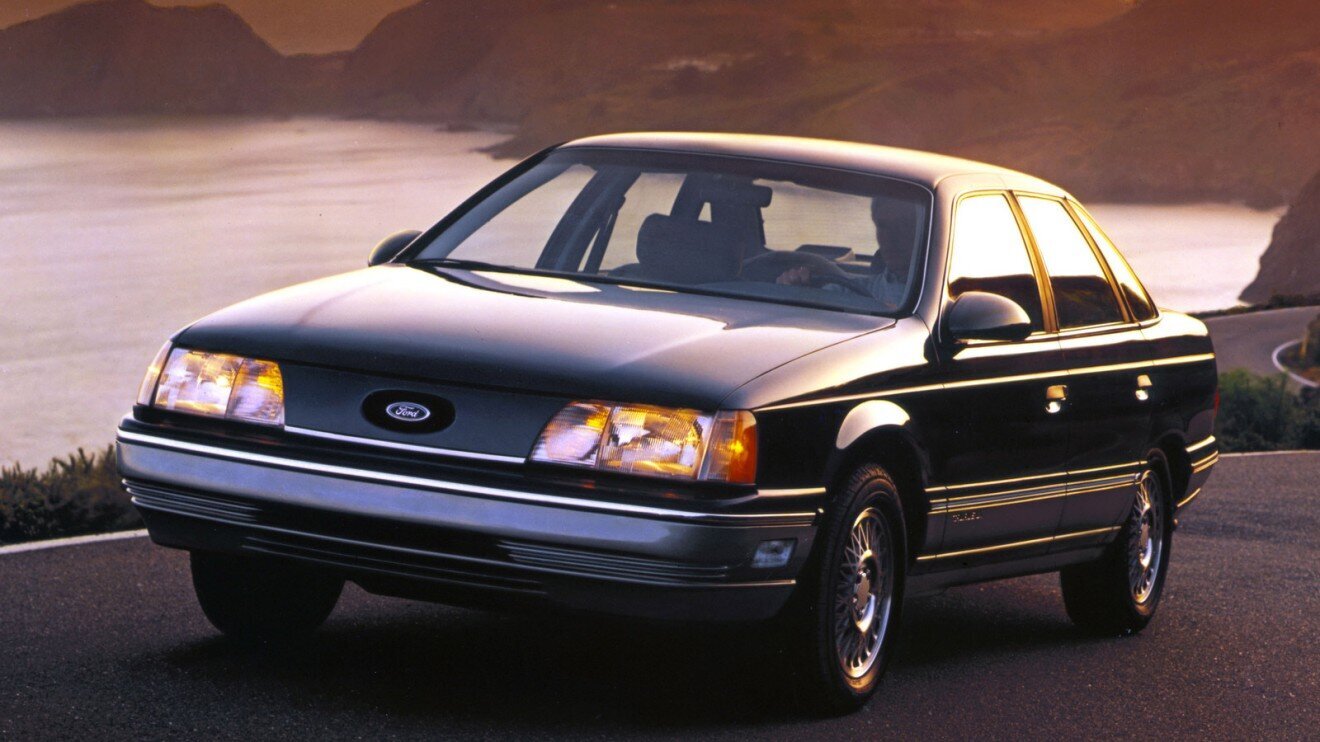
The Ford Taurus was an American car that, in the early 1990s, symbolized a level of Western automotive luxury and technological achievement out of reach for most Russians.
By 1993, the Ford Taurus was at the peak of its fame in the United States. Launched into production in 1985 as a 1986 model, this car revolutionized American automaking. Its sleek, aerodynamic design was radically different from the boxy shapes that had dominated the American auto industry in the 1970s and early 1980s.
By 1993, the second generation of the Taurus (1992–1995) was in production, with a more refined appearance featuring distinctive narrow headlights and larger overall dimensions. Every model in this generation came exclusively with an automatic transmission and a six-cylinder engine, either 3.0 or 3.8 liters — an unthinkable luxury for the Soviet auto industry of the time.
Contrast with Russian reality
For a Russian reader, it's important to understand that in 1993 the domestic auto industry was in deep crisis. The bulk of the country's vehicle fleet consisted of various modifications of the Zhiguli, the Moskvich, and the Volga. Against this backdrop, the Ford Taurus stood as a showcase of Western technology and comfort.
The car had front-wheel drive (considered a progressive feature at the time), a spacious cabin with an ergonomic instrument panel designed on the "cockpit" principle. Starting in 1994, every Taurus model came standard with two airbags — for the driver and front passenger — making it the world's first mass-production car with such equipment.
A symbol of the American dream
From 1992 to 1997, the Ford Taurus was the best-selling car in the United States, making it not just a means of transport but a symbol of the American middle class. For Russians in the early 1990s, encountering Western goods and lifestyles en masse for the first time, such a car embodied an unattainable level of prosperity.
A new Taurus cost around $15,000–$18,000 in the US in 1993 — more than the annual salary of most Russian citizens. Even used examples, which occasionally appeared on the Russian market through "gray" import schemes, remained out of reach for ordinary buyers.
A technical revolution
The Taurus's debut in 1986 marked Ford's shift from a traditional rear-wheel-drive layout to front-wheel drive, providing better fuel economy and handling. The car's aerodynamic coefficient was significantly better than its rivals', reflecting the growing demand for environmental and fuel efficiency.
The Taurus's interior became a model for others to follow: all controls were grouped in the center of the dashboard for the driver's convenience, and a wide range of trim levels was offered, from "spartan" to fully loaded luxury. This stood in stark contrast to the uniform interiors of Soviet cars, where the only real choice was the color of the upholstery.
Cultural significance
In the context of Russian reality in 1993, mentioning a Ford Taurus in a work of literature carries real meaning. It was the car of the "New Russians," a symbol of business success or connections to the West. The owner of such a car was automatically seen as someone who had managed to adapt to the new economic realities of the post-Soviet period.
It's notable that in Russia the model's name was often pronounced "Taurus" (by analogy with the zodiac sign), even though the correct American pronunciation is closer to "Torres." This linguistic distortion reflected the cultural distance between the Russian consumer and the American product.
Historical note: By 1993, more than 3 million Ford Tauruses had been sold worldwide, making it one of Ford Motor Company's most successful projects. In Russia, however, this car remained a rarity and a symbol of belonging to the new economic elite.