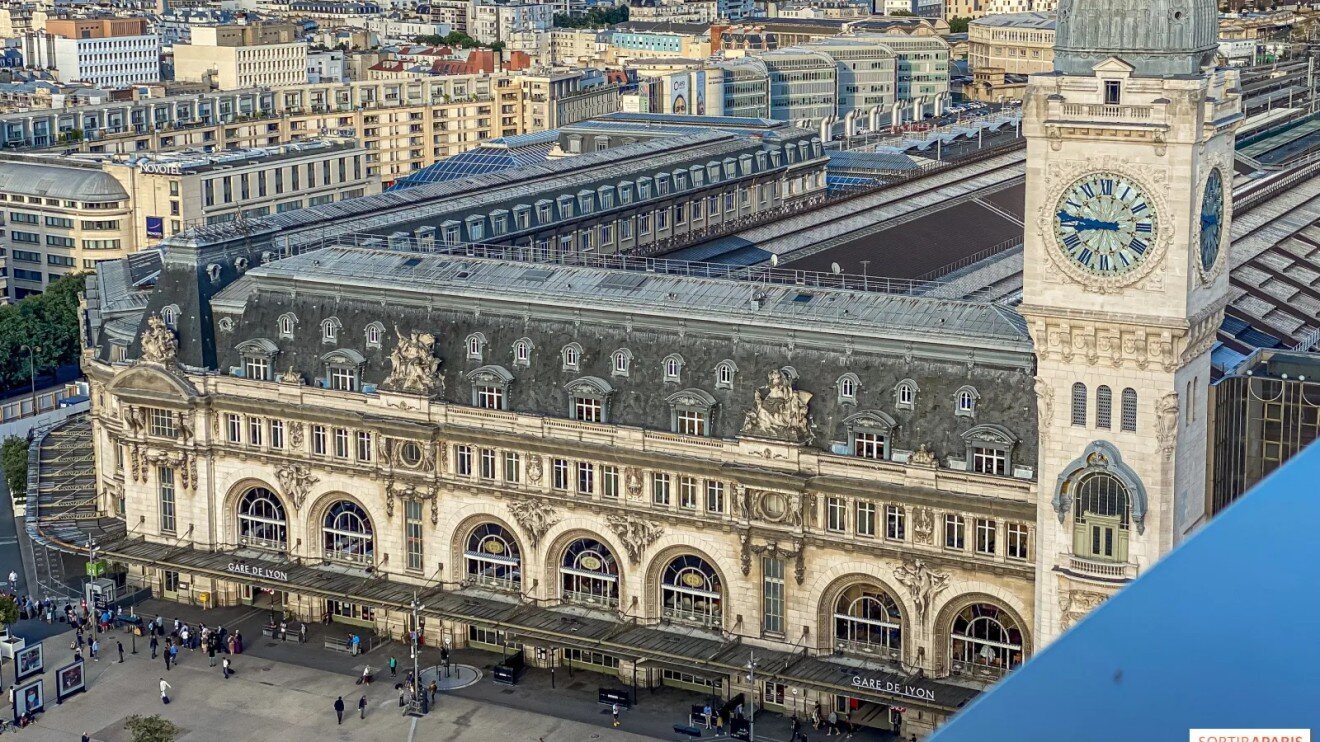
Gare de Lyon is one of Paris’s seven major railway terminals, located in the 12th arrondissement on the Seine’s right bank. In the context of the 1996 events depicted here, this station was a crucial transport hub, linking the French capital to the south of the country and the Mediterranean.
A Brief History
By the mid-1990s, Gare de Lyon already had nearly a century and a half of history behind it. The first station opened here in 1849 under the name «Railway Station from Paris to Montereau.» The current station building was constructed for the 1900 World’s Fair, designed by architect Marius Toudoire, and formally opened on April 6, 1901, by President Émile Loubet.
The station’s architectural centerpiece is its famous 64-meter clock tower, topped with a zinc dome. The monumental clock, built by Paul Garnier, features four faces 6.4 meters in diameter and became a symbol not just of the station but of the entire 12th arrondissement of Paris.
Its Role in the 1990s
In 1996, Gare de Lyon was the main gateway for travelers heading to the French Riviera, Nice in particular. This was where the famous night trains to the Côte d’Azur departed from — especially popular with wealthy travelers and businessmen.
The Paris–Nice night train was one of the most prestigious routes in the French rail system. The trip took about 11–12 hours, letting passengers leave Paris in the evening and wake up on the shores of the Mediterranean the next morning — an ideal solution for businesspeople who didn’t want to burn a full day on travel.
Architectural Features
The station building is a classic example of turn-of-the-century architecture. Its facade is decorated with a large fresco by the Marseille painter Jean-Baptiste Olive, depicting the cities reachable from the station — a kind of visual map of destinations.
A particular landmark within the station is the restaurant Le Train Bleu, in operation since 1901. Its Orientalist interiors, with gilded ceilings and painted walls, evoke the atmosphere of luxury travel from the Belle Époque.
Transport Connections
By the mid-1990s, Gare de Lyon was a crucial hub not just for long-distance travel but for suburban transit as well. RER (the express regional rail network), the metro, and intercity trains all converged here, making it a convenient starting point for journeys across France and beyond.
Trains departed Gare de Lyon for southern and eastern France, Switzerland, and Italy. High-speed TGV trains already ran from here in those years, though their network was less developed than it is today.