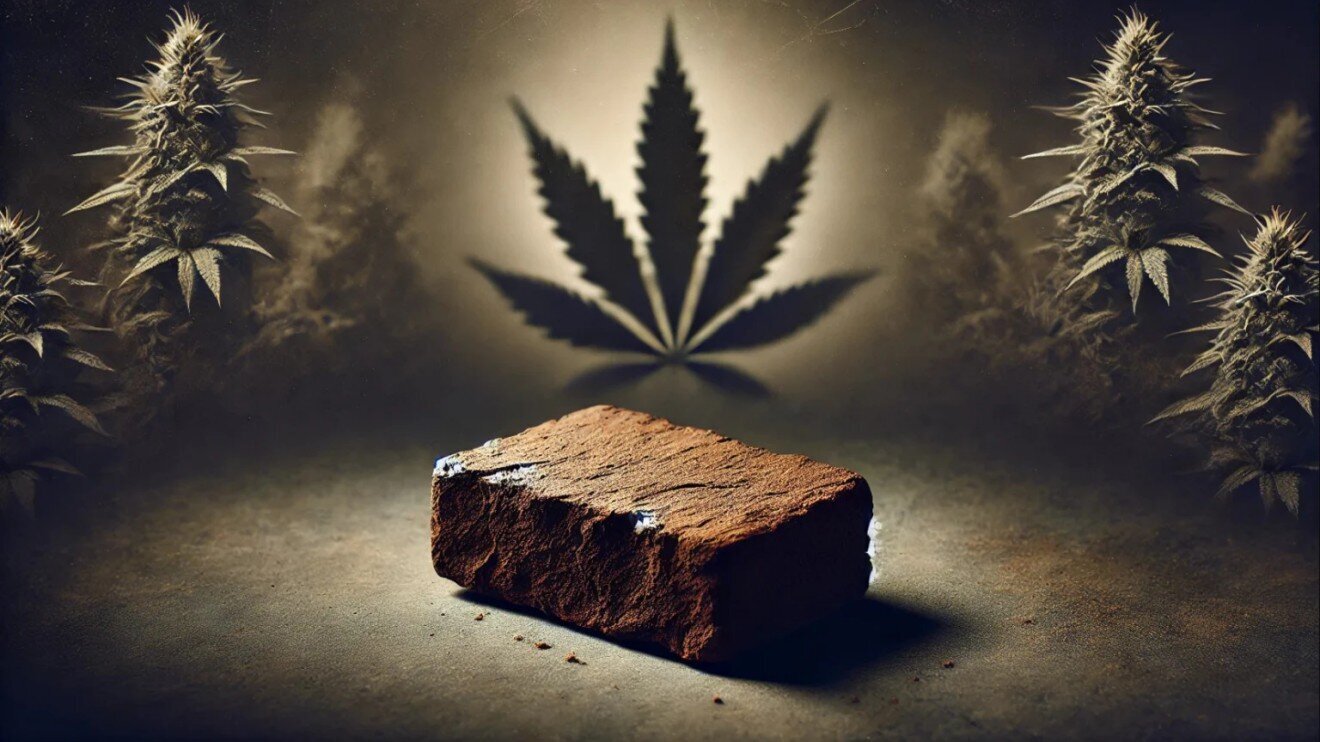
What Is Hashish
Hashish (from the Persian حشیش; slang names include hash, garik, «the rock,» «hard,» «soft,» khimka) — a concentrated psychoactive substance produced from the resin of the Cannabis sativa plant. It is an extracted and compressed cannabis essence with a high concentration of tetrahydrocannabinol (THC), the plant’s primary psychoactive component.
In appearance, hashish can range from light green to dark brown or black, depending on the production method and source material. Its consistency can be either solid (pressed) or soft (chemically extracted).
Methods of Production
Traditional Methods
Historically, an ancient method was used in India: the upper parts of the plant were placed inside a sheepskin, which was buried in the ground with a container underneath to collect the resin. The resin trickled down through an opening in the skin into the prepared container.
The classic sieving method involves shaking fine dust (pollen and leaf particles) off the cannabis plants and then sifting it through a series of sieves with progressively finer mesh (from 5 to 10 sieves). The finest fractions are pressed into bricks. Depending on the fraction size and concentration of psychoactive compounds, five grades of hashish are distinguished.
Chemical Extraction
So-called «chemical hashish,» or «khimka,» is produced by soaking ground, dried cannabis in organic solvents (ethyl alcohol, diethyl ether). The mixture is heated without being brought to a boil, then pressed and evaporated. The residue left at the bottom of the container hardens over the course of several hours, forming hashish.
Legal Status in Russia
Historical Development of the Legislation
The first legal provisions against narcotics trafficking appeared in the RSFSR Criminal Code of 1926. Article 104 established liability for «the production and storage, for purposes of sale, and the sale itself, of cocaine, opium, morphine, ether, and other intoxicating substances without proper authorization.»
On December 1, 1934, Article 179a was introduced, establishing liability for «the cultivation of opium poppy and Indian hemp without proper authorization.» This provision was introduced under the influence of the international opium conventions of 1925 and 1931.
Current Legislation
The current 1996 Criminal Code of the Russian Federation establishes criminal liability for offenses related to narcotic drugs and psychotropic substances. The main articles include:
- Article 228 — unlawful manufacture, acquisition, storage, transport, shipment, or sale
- Article 229 — theft or extortion of narcotic substances
- Articles 230, 231, 232, 233 — other related offenses
Quantities and Penalties
Under Russian Government Decree No. 1002 of October 1, 2012, the following thresholds are established for hashish:
| Threshold | Amount | Liability |
|---|---|---|
| Below the minor threshold | Up to 2 grams | Administrative (Code of Administrative Offenses, Art. 6.8) |
| Significant | Over 2 up to 25 grams | Criminal (Criminal Code, Art. 228) |
| Large | Over 25 grams up to 10 kg | Criminal (Criminal Code, Art. 228.1) |
| Especially large | Over 10 kg | Criminal (Criminal Code, Art. 228.1) |
Administrative Liability
For possession of hashish weighing less than 2 grams without intent to sell, administrative liability is prescribed under Article 6.8 of the Code of Administrative Offenses. The penalty is a fine of 4,000 to 5,000 rubles or administrative arrest of up to 15 days.
Criminal Liability
For the acquisition and possession of hashish in a significant amount (over 2 grams) without intent to sell, liability is prescribed under Part 1 of Article 228 of the Criminal Code. For selling hashish in a significant amount, clause «b» of Part 3 of Article 228.1 of the Criminal Code applies.
Particularly harsh punishment is prescribed for selling in a large amount (over 25 grams) — under clause «g» of Part 4 of Article 228.1 of the Criminal Code, the penalty is imprisonment for 10 to 15 years in a strict-regime penal colony.
The Problem of Measurement Accuracy
Under the Federal Law «On Ensuring the Uniformity of Measurements» and GOST standard 8.315-97, a rounding rule applies to measurement results: if the digit following the last significant digit is 5 or greater, the last digit is rounded up by one.
This means an amount of 2.1 to 2.4 grams must be rounded down to 2 grams and cannot be treated as «over 2 grams» for purposes of criminal law. Likewise, an amount of 25.1 to 25.4 grams rounds down to 25 grams.
International Context
Morocco is the world’s largest producer and exporter of hashish. As of the early 2000s, more than 800,000 Moroccans (2.7% of the population) were involved in hashish production. In 2003, Morocco produced more than 47,400 tons of marijuana and 3,080 tons of hashish.
The economic efficiency of growing cannabis in Morocco runs from $16,000 to $30,000 per hectare, against roughly $1,000 for growing wheat. A kilogram of low-quality Moroccan hashish in the United Kingdom cost £500 in 2005.
Statistical Patterns
An analysis of crime statistics reveals a suspicious regularity in the amounts of narcotic substances found — amounts that hover just above the thresholds for «significant» quantities. Particularly common are seizures of 0.54 grams of heroin, 1.02 grams of amphetamine, and 6.1 grams of marijuana.
The Case of 30 Grams of Hashish
A quantity of 30 grams of hashish falls into the «large» category (over 25 grams), triggering especially harsh criminal liability. Quantities like this, especially when «coincidentally» discovered in a car trunk, can point to deliberate action by law enforcement officers aimed at strengthening the charges.
It’s worth noting that the shift from a significant amount (up to 25 grams) to a large one (over 25 grams) radically changes the legal consequences — from a relatively mild penalty to lengthy imprisonment in a strict-regime colony.
Conclusion
Hashish remains one of the most widespread narcotic substances, strictly controlled under Russian law. Understanding the legal aspects of its circulation is critically important, especially given that even small differences in quantity can radically change the legal consequences for the accused.
The development of anti-narcotics legislation in Russia reflects international trends in the fight against drugs, but the practice of its enforcement raises questions about the fairness and objectivity of the law-enforcement system.