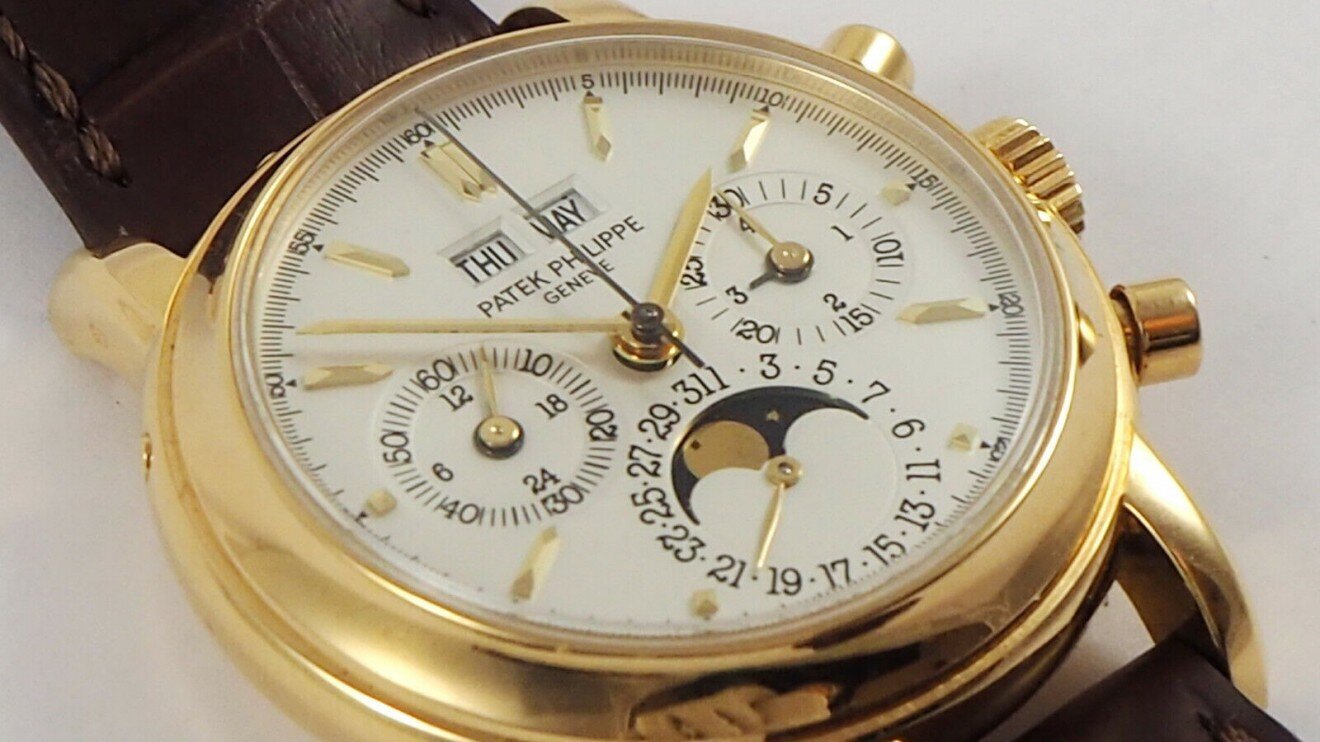
What the Patek Philippe Perpetual Calendar is
The Patek Philippe Perpetual Calendar is one of the most prestigious and technically complex collections from the Swiss manufacturer Patek Philippe. A perpetual calendar is a mechanical complication that automatically accounts for the varying length of months, including February in leap years, and correctly displays the date, day of the week, month, moon phases, and year through the year 2100 without needing manual adjustment.
Patek Philippe’s first perpetual calendars appeared back in the nineteenth century for pocket watches, but the revolutionary moment came in 1925 with the creation of the world’s first perpetual-calendar wristwatch (model No. 97975). That technical achievement laid the foundation for every subsequent model in the collection.
History of its creation and development
Patek Philippe was founded in 1839 by the Polish watchmaker Antoni Patek and his Czech partner Franciszek Czapek. After the two partners split in 1845, Patek was joined by the French watchmaker Adrien Philippe – inventor of the keyless winding mechanism. From 1851 the company has officially been known as Patek Philippe & Cie.
In 1932, during the Great Depression, the company was acquired by the Swiss Stern family, who still own it today. That makes Patek Philippe the last independent family-owned watchmaker in Geneva.
Technical features of the Perpetual Calendar
The perpetual calendar mechanism consists of hundreds of tiny components interacting with mathematical precision. Its main functions include:
- Date: correctly displaying the day of the month, accounting for 30- and 31-day months
- Day of the week: automatically switching between days
- Month: displaying the current month
- Leap year: accounting for leap years, including the complex century rule
- Moon phases: precisely displaying the phases of the moon
- 24-hour indication: an additional time display
Modern models, such as the 5327R-001 described in the source document, are fitted with the caliber 240 Q, just 3.88 mm thick – remarkably slim for such a complex mechanism.
Cost in the 1990s and today
In the mid-1990s, when the novel’s events take place, the Patek Philippe Perpetual Calendar really was a symbol of exceptional status. Such a watch cost between $80,000 and $150,000, putting it within reach only of the very wealthy.
For comparison, the average salary in Russia in 1997 was around $100 a month, and an apartment in Moscow cost $30,000–50,000. That watch, in other words, cost as much as two or three Moscow apartments.
The most expensive watches in history
Patek Philippe dominates the ranks of the most expensive watches ever sold at auction. As of 2025, nine of the ten most expensive watches in the world are Patek Philippe pieces.
Record holders by price
| Model | Year sold | Price (USD) | Notes |
|---|---|---|---|
| Grandmaster Chime Ref. 6300A-010 | 2019 | $31,000,000 | The most expensive watch in history, 20 complications |
| Henry Graves Supercomplication | 2014 | $23,980,000 | A pocket watch with 24 complications |
| Ref. 1518 (steel) | 2016 | $11,140,000 | The first series-produced perpetual-calendar watch |
| Ref. 2499 (rose gold) | 2022 | $7,680,000 | A rare model signed by Gobbi |
| Nautilus Ref. 5711 Tiffany | 2021 | $6,500,000 | An online-auction record |
Cultural significance and status
«You never actually own a Patek Philippe. You merely look after it for the next generation.»
That slogan captures the brand’s philosophy precisely: a Patek Philippe watch isn’t just a timepiece, but a family heirloom passed from generation to generation. In the context of the novel, the switch from a Breitling to a Patek Philippe symbolizes not merely an improvement in material circumstances, but entry into an elite circle where tradition, exclusivity, and long-term thinking are prized.
In the 1990s, owning a Patek Philippe in Russia carried particular weight, since these were the years when a new class of entrepreneurs and oligarchs was taking shape. Such a watch served as a kind of «passport» into the highest circles of society, signaling not just wealth but an understanding of genuine value.
Production and exclusivity
One reason for the Patek Philippe Perpetual Calendar’s high price and status is its extremely limited production. The company makes only about 60,000 watches a year (as of 2018), of which perpetual-calendar models make up only a small share.
Every perpetual-calendar watch is hand-assembled by highly skilled craftsmen. Building a single movement can take several months, and some models are made in only a few units per year.
Technical innovation
Patek Philippe is constantly refining its movements. In 2009 the company introduced its own quality standard – the Patek Philippe Seal – which exceeds even the highest industry benchmarks:
- Accuracy: –3/+2 seconds a day for diameters of 20 mm and up
- Accuracy: –5/+4 seconds a day for diameters under 20 mm
- Use of innovative materials: Silinvar silicon components
- Power reserve: 38 to 48 hours
Investment appeal
The Patek Philippe Perpetual Calendar has shown remarkable results as an investment asset. Over the last 25 years (1997–2025), the value of rare models has grown 10 to 20 times over, far outpacing the growth of most traditional investments.
Factors influencing investment appeal include:
- Limited production: scarcity keeps prices rising steadily
- Historical significance: models with a particular history are worth considerably more
- Technical mastery: unique complications increase value
- Condition: original parts and documentation are critically important
- Provenance: famous previous owners raise the price
Competitors in the ultra-luxury watch segment
Although Patek Philippe dominates the segment of the most expensive watches, several brands also produce exceptionally expensive models:
- Vacheron Constantin: the Référence 57260, the most complicated watch in the world, with 57 complications
- Audemars Piguet: the Royal Oak and other heavily complicated models
- A. Lange & Söhne: German watches of the highest quality
- Jaeger-LeCoultre: masters of complex complications
- Richard Mille: modern sports watches with innovative materials
Even so, in terms of prestige, technical mastery, and investment appeal, Patek Philippe remains an unrivaled leader.
Conclusion
In the context of the novel, the hero’s choice of a Patek Philippe Perpetual Calendar was entirely justified as a way of displaying status in 1990s Russian society. That watch not only cost as much as several Moscow apartments, but also served as a universal language of success, understood in any country in the world.
Today the Patek Philippe Perpetual Calendar remains one of the most prestigious and expensive watch complications, blending centuries of Swiss watchmaking tradition with cutting-edge technology. Owning such a watch remains a mark of belonging to the elite, and its value keeps rising, confirming the wisdom of investing in genuine craftsmanship.