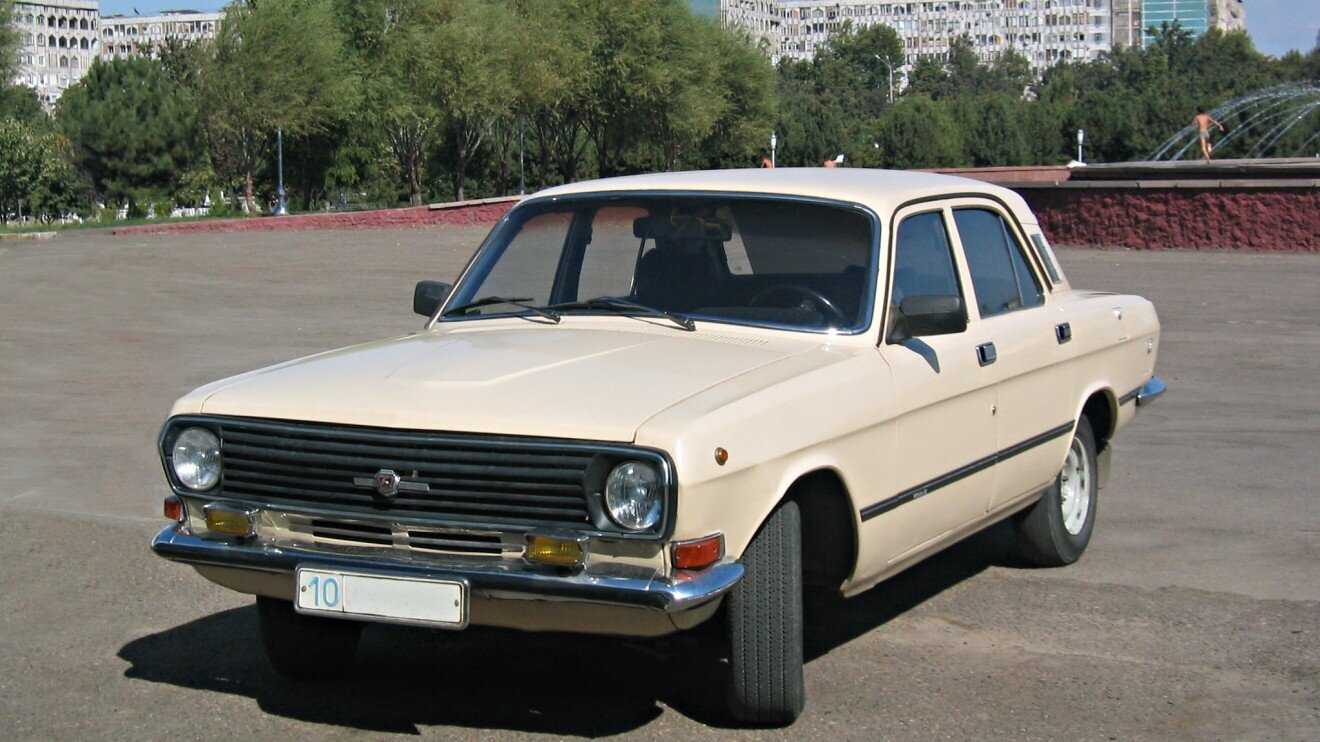
In 1993, the GAZ-24-10 «Volga» was one of the most prestigious and coveted cars across the former USSR. Even though the model was nearing the end of its production run by then, it still symbolized status, reliability, and the technical accomplishment of Soviet automobile manufacturing.
History of Development and Production
The GAZ-24-10 «Volga» was produced by the Gorky Automobile Plant from late 1985 through 1993. The car was a deep modernization of the legendary GAZ-24, which debuted in 1968 and entered series production in 1970. By the mid-1980s it had become clear that the base GAZ-24 model was outdated and needed a serious overhaul.
The GAZ-24-10's emergence was shaped by the complicated political circumstances of the time. Originally, plans called for the GAZ-24 to be replaced by 1980 with an entirely new car, the GAZ-3102, which had already been ready since the late 1970s. However, a deliberate political decision not to let the GAZ-3102 into wide production forced a compromise: a car with the technical guts of the GAZ-3102, wrapped in the proven body of the GAZ-24.
As Vladimir Nikitich Nosakov, former head of GAZ's passenger-car production, recalled: «And then our minister was told, in no uncertain terms, at the very top: 'We won't allow a car that officials and generals ride in to also be running around as a taxi.' So the 31st model got held back in numbers. But the production capacity was already in place, the experience accumulated, the momentum built up. And so the 2410 was born: 3102 guts, under the old body.»
Technical Achievement
The Engine — the Car's Heart
The main technical novelty of the GAZ-24-10 was its modernized ZMZ-402.10 engine, an adaptation of the advanced technology developed for the GAZ-3102. The base version of this engine — the ZMZ-4022.10 — featured a torch-ignition prechamber system, revolutionary for its time, in which a spark plug ignited a rich mixture in a separate prechamber, which then torched through narrow nozzles to ignite the lean mixture in the main combustion chamber.
Though the complex torch-ignition system was dropped for mass production of the GAZ-24-10 in favor of a simpler, more reliable solution, the engine received many other improvements. Output rose to 90 horsepower, up from 85 in the predecessor ZMZ-2401, delivering noticeably better acceleration.
The cooling system was fundamentally reworked: the water pump was moved from the cylinder head to the block itself, providing more efficient coolant circulation. The cylinder block was produced using permanent-mold (gravity die) casting, improving its strength and durability compared to earlier pressure-cast versions.
Contactless Ignition System
In 1984, GAZ introduced another breakthrough — a contactless ignition system. In place of the traditional mechanical breaker-distributor («trambler») with contact points prone to wear and burning, an electronic system with a magnetoelectric sensor was introduced.
The new system was built around a B-116 ignition coil with a series-connected resistor, a 13.3734 switching unit, and a 19.3706 distributor with a contactless sensor. A rotating magnet induced a pulse in the stationary sensor coil, entirely eliminating mechanical wear on contact points and significantly boosting engine reliability, especially at high RPMs.
An Improved Braking System
One of the GAZ-24-10's key advantages over its predecessor was a thoroughly modernized braking system, borrowed from the GAZ-3102. In place of the outdated hydrovacuum booster, a simple, reliable vacuum booster was fitted, paired with a dual-chamber master cylinder.
The new system gave the two brake circuits independence, dramatically improving vehicle safety. System pressure was increased by shrinking the brake-line diameter from 6 to 5 mm, and outdated BSK brake fluid was replaced with more advanced fluids like «Tom'» and «Neva.»
To prevent the rear wheels from locking up under emergency braking, a brake-force regulator (nicknamed the «sorcerer» by the public) was added to the system, automatically reducing pressure in the rear brake cylinders as the car's center of mass shifted forward under braking.
Comfort and Features
A Modern Interior
The GAZ-24-10's cabin was significantly upgraded compared to the base GAZ-24. Its interior architecture was borrowed from the GAZ-3102, including adjustable orthopedic seats with headrests and a lowered-profile rear bench for better visibility.
The car gained many comfort-oriented features: electric rear-window defrosting in place of a complex blower system, a hanging accelerator pedal instead of a floor-mounted one, and steering-column stalks for turn signals and windshield washers. The instrument panel featured a separated instrument cluster and speedometer with distinctive cone-shaped glass.
Base versions used quality fabrics with vinyl trim, while the upgraded GAZ-24-10-051 could be fitted with velour upholstery and the «tall» dashboard borrowed from the GAZ-3102.
An Updated Exterior
Externally, the GAZ-24-10 was set apart from its predecessor by several distinctive details. The chrome strip on the trunk lid and the «Volga» badges on the front fenders were removed, giving the car a more austere, modern look. The front door vent windows were dropped, and the exterior door handles were injury-safe designs borrowed from the GAZ-3102.
A defining feature of the model was its black plastic radiator grille, replacing the traditional chrome one. The side mirrors, wipers, and other trim were also finished in black, matching the fashion of the time.
The car was fitted with modern tubeless radial tires, size 205/70R14, replacing the outdated diagonal 7.35-14 tires, improving handling and ride comfort.
A Wide Range of Variants
The GAZ-24-10 was produced in numerous specialized versions, underscoring the platform's versatility and demand:
- GAZ-24-10 — the base sedan for official and private use
- GAZ-24-10-051 — an upgraded sedan with the GAZ-3102 interior
- GAZ-24-11 — a taxi version with corresponding equipment
- GAZ-24-12 — a station wagon, replacing the GAZ-24-02
- GAZ-24-13 — a wagon-based ambulance
- GAZ-24-14 — a cargo-passenger taxi
- GAZ-24-17 — a taxi version running on liquefied gas
- GAZ-24-34 — a special high-speed version (unofficially nicknamed the «chaser»)
Social Status and Prestige
In the Soviet system, a car served not only as transportation but as an important status symbol. The GAZ-24-10 «Volga» held a special place in that hierarchy, standing well above mass-market models like the Zhiguli and Moskvich, but still more accessible than the elite GAZ-3102 or the representative-class ZiL.
Owning a «Volga» in the USSR, and in the first years after its collapse, was a mark of belonging to the Party nomenklatura, the intelligentsia, or the successful ranks of the shadow economy. The car was associated with solidity, reliability, and a certain social standing for its owner.
Private owners especially prized the upgraded GAZ-24-10-051, whose level of equipment and comfort approached the elite GAZ-3102 while remaining more accessible and less «exclusive.»
Technical Reliability and Repairability
One of the GAZ-24-10's key advantages was its exceptional reliability and ease of maintenance. The car was renowned for its ability to operate under harsh conditions with minimal upkeep. Its design was built for domestic roads, climate conditions, and fuel quality.
Repair and maintenance required no specialized tools or scarce parts. Most components and assemblies were standardized across other GAZ models, ensuring parts were readily available. The simplicity of its design allowed many repairs to be handled in an ordinary garage.
The car offered strong off-road capability thanks to its high ground clearance, split rear-axle design, and rear leaf springs, which adapted well to uneven road surfaces.
Economics of Ownership
In the shortage economy of the USSR and the transitional period of the early 1990s, the GAZ-24-10 was not only a prestigious car but a sound investment. Cars of this model held their value well and enjoyed steady demand on the secondary market.
Fuel consumption, around 11-13 liters per 100 kilometers in mixed driving, was considered acceptable for a car of its class. The engine could run on AI-93 gasoline, which was more readily available than the higher-octane fuels required by some foreign cars.
Production Achievements
Over its entire production run, from 1985 to 1993, 417,481 units of the GAZ-24-10 in its various configurations were built — an impressive figure for a car originally conceived as a stopgap solution.
Build quality on the GAZ-24-10 was considered high by Soviet automotive standards. Despite its outdated underlying design, the car retained a reputation as a reliable, long-lasting vehicle.
A Place in the History of Russian Automaking
The GAZ-24-10 was the last representative of the storied classic «Volga» family, tracing its lineage back to the GAZ-21. In 1992-1993 it was replaced by the GAZ-31029, itself another hybrid solution built on GAZ-3102 engineering.
The car demonstrated the ability of Soviet engineers to produce competitive products even under limited resources and political constraints. Many of the technical solutions first applied to the GAZ-24-10 were later carried forward into subsequent models from the Gorky plant.
By 1993, the GAZ-24-10 «Volga» remained a symbol of a bygone era, yet continued to enjoy well-earned respect as a reliable, comfortable, and prestigious car. For many of its contemporaries, it embodied the best achievements of Soviet automaking and served as a kind of bridge between the country's socialist past and its capitalist future.