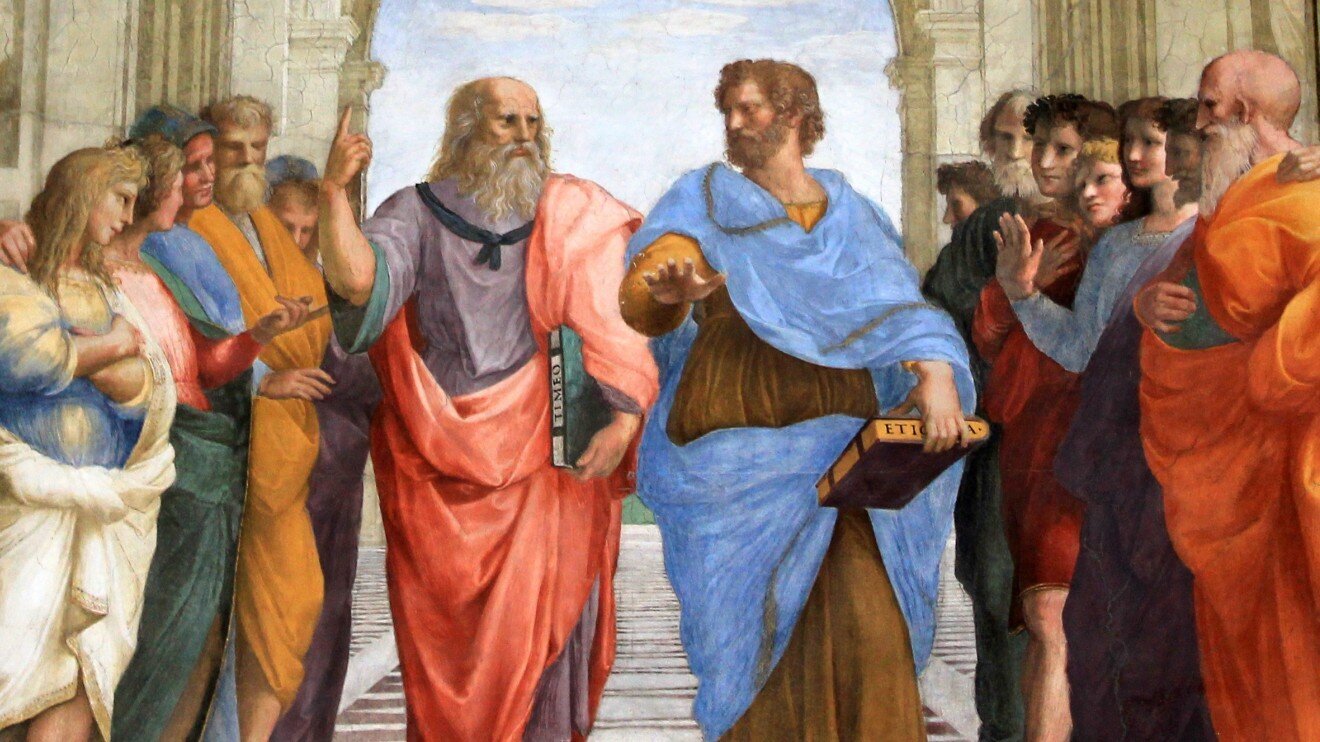
The ancient Greek sophist Gorgias (c. 483-376 BC) formulated one of the most radical philosophical positions in the history of thought. His famous three theses, from the treatise "On Non-Being, or On Nature," challenged the very foundations of human knowledge, and remain a subject of philosophical debate to this day.
Gorgias and the context of his era
Gorgias of Leontini, in Sicily, was one of the most influential figures in the fifth-century-BC sophist movement. It was a time of intellectual revolution in ancient Greece, when traditional views of the world were being critically reexamined. The sophists — "masters of wisdom" — were paid teachers of rhetoric and philosophy, who instructed young aristocrats in the art of persuasion and logical reasoning.
Unlike the natural philosophers, who studied nature, the sophists focused on man and society. They questioned whether objective truth could be attained at all, and emphasized the relativity of human knowledge. "Man is the measure of all things," proclaimed Gorgias's contemporary Protagoras, expressing the general spirit of the age.
What sophistry is
Sophistry as a philosophical movement arose in the fifth century BC in Athens and other Greek city-states. Originally, the word "sophist" (from the Greek σοφιστές — "wise man") carried no negative connotation, and denoted an educated person possessing wisdom and the ability to teach others.
The main features of sophistry included:
- Relativism — a denial of absolute truth and the claim that all knowledge is relative
- Skepticism — doubt about the possibility of reliably knowing the world
- A practical orientation — an emphasis on the usefulness of knowledge rather than its truth
- Rhetorical mastery — command of the art of persuasion regardless of content
- Criticism of tradition — a reexamination of established religious and moral views
The sophists were the first in the history of European thought to charge for teaching, which drew criticism from traditionalists. They taught how "to make the weaker argument the stronger" — to find convincing arguments in favor of any position.
Sophistry's negative reputation formed later, owing largely to Plato's criticism, which set the sophists against "true philosophers." Plato accused the sophists of unscrupulousness, a love of wordplay, and indifference to truth.
The treatise "On Non-Being, or On Nature"
Gorgias wrote his famous treatise around 444 BC, in response to the teaching of the Eleatic philosophers, especially Parmenides, who held that "being is, and non-being is not." The title of Gorgias's treatise is a direct parody of the Eleatic Melissus's work "On Nature, or On What Is."
Unfortunately, the original text of the treatise has not survived. We know its content thanks to two paraphrases — retellings by Sextus Empiricus and by the unknown author of the work "On Melissus, Xenophanes, and Gorgias." These sources convey the main thrust of Gorgias's argument, though in abridged form.
Gorgias's three theses
Gorgias's philosophical system is built on three successive theses, each representing a further stage of radical skepticism:
1. Nothing exists
Gorgias's first and most radical thesis asserts that no being exists at all. This directly contradicts the Eleatics' core position that "being is." Gorgias uses reductio ad absurdum, showing that any attempt to assert the existence of anything leads to logical contradictions.
Gorgias's argument runs as follows:
If being is eternal, it must be unbounded (for the eternal has no beginning or end). But if it is unbounded, it exists nowhere, since to exist somewhere means to be limited by that place. And if being is nowhere, it simply does not exist.
If being is not eternal, it must have come into existence. But it could have arisen either from being or from non-being. Arising from being is impossible, since then being would have existed before itself. Arising from non-being is also impossible, since nothing comes from nothing.
Furthermore, Gorgias shows that being can be neither one nor many. If it is one, then it is divisible (since it has magnitude), and therefore not one. If it is many, then it is made up of units, but we have already shown that no such unit exists.
2. Even if something exists, it is unknowable
The second thesis grants — purely hypothetically — that something might still exist, but asserts the fundamental impossibility of knowing it. Gorgias turns to analyzing the relationship between thought and being.
The key argument is that what is thought is not identical to what exists. We can think of centaurs, chimeras, flying chariots, and other fantastical creatures, but that does not mean they really exist. If whatever is thought automatically existed, the world would be in complete chaos — every fantasy and dream would materialize into reality.
On the other hand, if not everything thought exists, there is no basis for assuming that everything that exists is necessarily thinkable. Perhaps there are aspects of reality that are, in principle, inaccessible to the human mind.
This argument represents one of the first attempts in the history of philosophy to separate subjective and objective reality, and to show the gulf between consciousness and being.
3. Even if something is knowable, it is inexpressible to another
The third thesis moves from questions of ontology and epistemology to problems of communication. Even granting that we can know something about reality, there remains the unsolvable problem of conveying that knowledge to others.
Gorgias points to a fundamental difference between the thing and the word. When we speak of a color, a sound, or a taste, we use words, but words are not colors, sounds, or tastes. The word "sweet" is not itself sweet; the word "red" has no red color.
Moreover, the process of communication is paradoxical: we explain words by pointing to things, but we can only show a thing to another person by means of words. This creates a closed loop: words are explained by things, things by words, yet an unbridgeable gap lies between them.
Every person perceives the world through the lens of their own individual experience. What one person calls "red," another may perceive quite differently. We have no way to verify whether we experience the same phenomena in the same way.
Interpretations of Gorgias's treatise
Over the centuries, philosophers have interpreted the meaning and significance of Gorgias's treatise in various ways. Several main interpretations can be identified:
The parodic interpretation
According to this view, Gorgias's treatise is an elaborate parody of Eleatic philosophy. Gorgias supposedly wanted to show that sophistic methods could "prove" anything, even complete nonsense. This interpretation was popular in the 19th and early 20th centuries.
Modern researchers, however, point to serious flaws in this approach. If the treatise is merely a joke, it is unclear why Gorgias would spend time developing such a complex argument on such a specialized question, far removed from the interests of the general public.
The nihilistic interpretation
Another interpretation sees Gorgias as a radical nihilist, who truly denied the existence of anything at all. According to this view, Gorgias preached a philosophy of total negation, anticipating some ideas of modern nihilism.
This interpretation also has its weaknesses. It fits poorly with Gorgias's other works, in which he appears as a practical teacher of rhetoric rather than a destroyer of philosophy.
The critical interpretation
The most persuasive interpretation is that Gorgias acts as a critic of a certain type of philosophizing. His target is not being in general, but the Eleatics' "pure being" — abstract being stripped of concrete qualities, being as such.
Gorgias shows that attempts to think of being apart from concrete things and phenomena lead to contradictions. His theses could be paraphrased as: "Abstract being does not exist," "If it does exist, it is unknowable," "If it is knowable, it is inexpressible."
In this sense, Gorgias anticipates some ideas of later philosophers who criticized the excessive abstractness of metaphysical systems.
A modern mathematical interpretation
An interesting interpretation of Gorgias's theses has been proposed by the mathematician D.G. Fon-der-Flaas. From the standpoint of modern mathematics:
"Nothing in the world exists" can be understood as the claim that every mathematical set consists of elements, none of which has a material object as its referent in the physical world.
"Even if something exists, it is unknowable to man" corresponds to the existence of mathematical axioms (accepted without proof) and unsolved problems such as the Collatz conjecture.
"Even if it is knowable, it is inexplicable to another" reflects the difficulty of conveying mathematical proofs, many of which are understood only by a narrow circle of specialists.
Gorgias as the "father of rhetoric"
Paradoxically, the philosopher who asserted the impossibility of true knowledge and communication became one of the greatest masters of the word in history. Gorgias developed a distinctive style of speech, known as the "Gorgianic" style, characterized by an abundance of rhetorical devices: metaphors, antitheses, and rhythmic repetitions.
His famous speeches, "Encomium of Helen" and "Defense of Palamedes," demonstrate a masterful command of the art of persuasion. In the first, Gorgias undertakes to defend Helen of Troy — the woman traditionally blamed for the Trojan War. In the second, he defends Palamedes against a false charge of treason.
These speeches served not only as demonstrations of rhetorical skill, but as practical illustrations of the author's philosophical ideas. If objective truth does not exist, then the orator's task is not to find the truth, but to construct a convincing version of events.
Influence on later philosophy
Gorgias's ideas had a significant influence on the development of ancient and modern philosophy:
Plato and the critique of sophistry
Plato devoted a dialogue named after Gorgias, in which he criticized sophistic rhetoric as a "fake art" aimed at creating illusions rather than seeking truth. Yet the very sharpness of Plato's criticism testifies to the seriousness of the challenge the sophists posed to traditional philosophy.
Aristotle and logic
Aristotle, in building his system of logic, drew heavily on sophistic paradoxes. His analysis of logical fallacies and sophisms was meant to give philosophy reliable tools for distinguishing true from false reasoning.
Skepticism
Gorgias's theses anticipated many ideas of ancient and modern skepticism. Skeptics of various eras have returned to Gorgias's critique of the possibility of reliable knowledge.
Modern philosophy of language
Gorgias's third thesis, on the impossibility of expressing what is known in words, resonates with the concerns of modern analytic philosophy. Questions about the relationship between language and reality, and about experience that cannot be put into words, remain relevant today.
Conclusion
Gorgias's three theses represent one of the most radical experiments in the history of philosophical thought. Regardless of how we interpret the author's intentions — as a serious philosophical position, a critique of the Eleatics, or a demonstration of the possibilities of rhetoric — his arguments touch on fundamental problems of human knowledge.
The questions Gorgias posed more than two thousand years ago remain relevant: Can we know anything about the world with certainty? How do our thoughts relate to reality? Is genuine communication between people even possible? These problems continue to trouble philosophers, scientists, and all thinking people.
Gorgias showed that skepticism can be not only a destructive but also a creative force. By questioning apparent truths, we are forced to think more deeply about the foundations of our knowledge and belief. In this sense, the figure of Gorgias remains one of the most provocative and fruitful in the history of European thought.
His legacy reminds us that between word and deed, between thought and reality, between one person and another, there always exists a gap of uncertainty. And perhaps it is precisely in this gap, in this space of doubt and searching, that genuine wisdom is born.