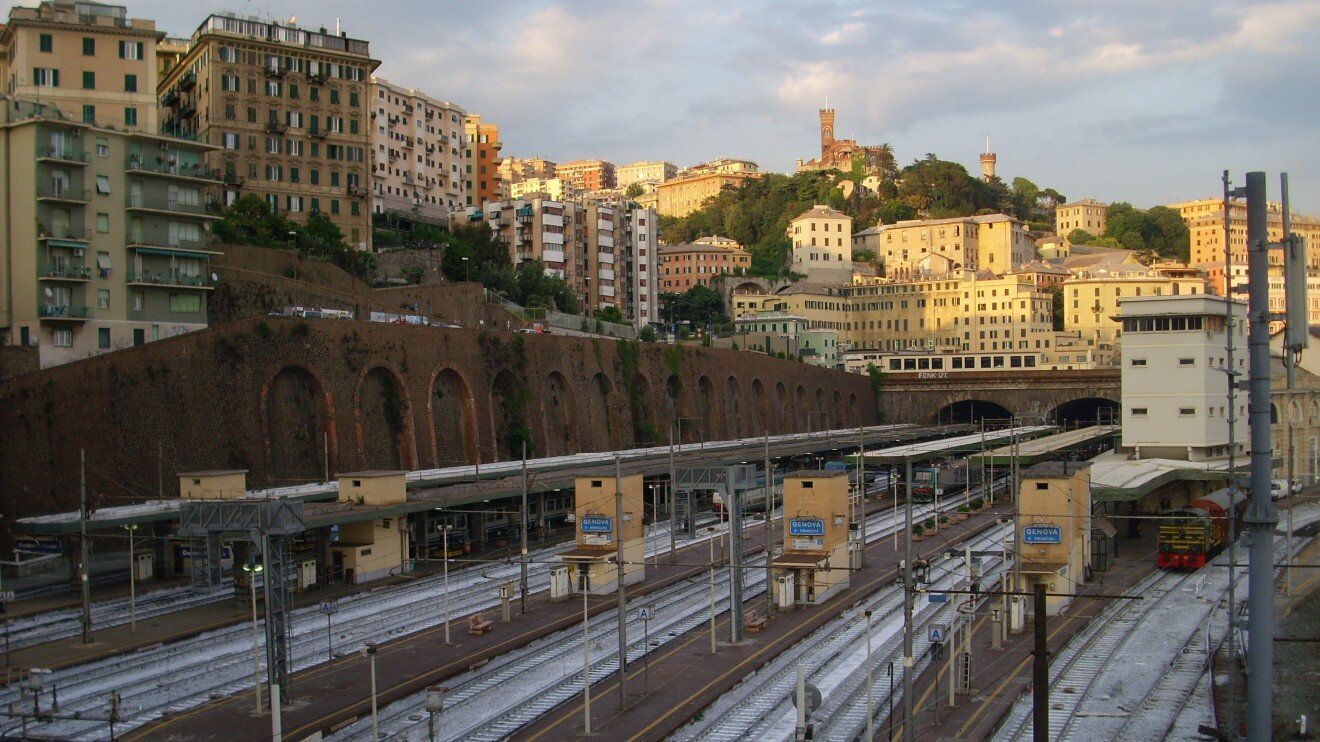
Genoa (Italian: Genova; Ligurian: Zêna) is the capital of the Italian region of Liguria, the sixth-largest city in Italy, and one of the most important ports on the Mediterranean. Situated on the Gulf of Genoa, the city was for centuries the center of a powerful maritime republic and remains a key European trading hub to this day.
Historical Significance
The Age of Maritime Power
Genoa was the capital of one of the most powerful maritime republics for more than seven centuries — from the 11th century until 1797. Especially from the 12th to the 15th centuries, the city played a leading role in the history of European trade, becoming one of the continent’s largest maritime powers and one of the wealthiest cities in the world.
The poet Francesco Petrarch nicknamed Genoa la Superba («the proud one») for its naval victories and impressive architectural monuments. The city controlled a significant share of trade with the Byzantine Empire, Tripoli, the Principality of Antioch, Cilician Armenia, and Egypt.
A Financial Center
In 1407, Genoa founded the Bank of St. George (Banco di San Giorgio) — the oldest known state deposit bank in the world, which played a crucial role in the city’s prosperity from the mid-15th century until its closure in 1805. In 1483, the second of the world’s oldest banks was founded — the Monte di Pietà of Genoa.
Christopher Columbus, born in Genoa around 1451, donated a tenth of his income from Spain’s discovery of America to the Bank of St. George, to ease the tax burden on foodstuffs.
The «Genoese Age»
Historian Fernand Braudel called the period from 1557 to 1627 the «age of the Genoese» — an era of rule so refined and subtle that historians long overlooked it. Genoese bankers supplied the sprawling Habsburg system with liquid credit and stable income, and in exchange, unreliable shipments of American silver were quickly transferred from Seville to Genoa to provide capital for new ventures.
Geography and Climate
The city of Genoa covers 243 square kilometers between the Ligurian Sea and the Apennine Mountains. It stretches along the coast for roughly 30 kilometers, from the Voltri district to Nervi, and 10 kilometers inland along the Polcevera and Bisagno valleys.
Genoa has a hot Mediterranean climate bordering on humid subtropical, with abundant rainfall due to its position along a common storm track. Because it sits between the sea and mountains rising above 1,000 meters, every district of Genoa has its own particular climate.
Main Landmarks
The Historic Center
Genoa’s historic center is one of the largest and most densely populated in Europe. In 2006, part of it was added to the UNESCO World Heritage List under the name «Genoa: Le Strade Nuove and the System of the Palazzi dei Rolli.» The historic center is also known for its narrow alleys and lanes, called «caruggi» by locals.
Palazzi dei Rolli
The world-famous Strade Nuove include Via Garibaldi (Strada Nuova), Via Cairoli (Strada Nuovissima), and Via Balbi (Strada Balbi). Among the most important palaces: Palazzo Rosso, Palazzo Bianco, Palazzo Podestà, Palazzo Reale, Palazzo Angelo Giovanni Spinola, and many others.
Of the 114 palaces built by the nobility in central Genoa and left substantially unaltered, 42 Palazzi dei Rolli are included in the World Heritage List. Palazzo Bianco, Palazzo Rosso, and Palazzo Doria Tursi are also known as the Musei di Strada Nuova, housing the famous art collection bequeathed to the city by Genoese philanthropist Maria Brignole Sale De Ferrari, Duchess of Galliera, as well as violins belonging to the Genoese violinist Niccolò Paganini.
Genoa Cathedral (San Lorenzo)
The Cathedral of San Lorenzo has a magnificent portal and a dome designed by Galeazzo Alessi. Inside is the cathedral treasury, which holds, among other items, what is considered to be the Holy Grail.
Symbols of the City
The Lanterna (lighthouse), 117 meters tall, is an ancient, still-operating lighthouse visible from the sea at a distance of more than 30 kilometers. A second symbol is the monumental fountain at Piazza De Ferrari, recently restored, the true heart of the city’s public life.
The Old Port (Porto Antico)
The ancient port area, called Porto Antico, was redeveloped for the celebration of the 500th anniversary of Christopher Columbus’s discovery of America in 1992. Here you’ll find the Genoa Aquarium — the largest in Italy and one of the largest in Europe — as well as a marina for pleasure craft.
Nearby is the Palazzo di San Giorgio. In the Middle Ages, this palace served as the headquarters of the Bank of St. George. In its prison cells, Marco Polo and Rustichello da Pisa wrote «The Travels of Marco Polo.»
Districts and Surroundings
Boccadasse — an ancient seaside district (the name means «donkey’s mouth») with colorful fishing boats, located at the end of Corso Italia, a promenade running along the Lido d’Albaro, known for its ice cream.
Nervi — the natural gateway to Liguria’s Eastern Riviera, offering a wealth of attractions: a seafront promenade called the Passeggiata Anita Garibaldi, parks with lush tropical vegetation, and numerous villas and palaces open to the public, now housing museums.
Pegli — the western gateway to the Western Riviera, home to the famous Villa Durazzo-Pallavicini.
Architectural Monuments
Renaissance and Baroque
The Genoese Renaissance began with the construction of the Villa del Principe, commissioned by Andrea Doria: the architects were Giovanni Angelo Montorsoli and Giovanni Ponzello, the interior was painted by Perino del Vaga, and the garden fountain was created by Taddeo Carlone.
In 1548, Galeazzo Alessi, with his design for the Villa Giustiniani-Cambiaso, created a new prototype for the Genoese palace, which went on to inspire other architects working in Genoa.
The 19th and 20th Centuries
Between 1935 and 1940, Genoa built the Torre Piacentini — one of the first skyscrapers built in Europe, and the tallest residential building in Italy until 1954.
Modern architecture is represented by the work of Renzo Piano, including the new design of the Old Port with the Aquarium, the Bigo, and the Biosphere, as well as the «Piano Bubble» — a large sphere of metal and glass set in the waters of the port.
Famous Natives
Genoa is the birthplace of many outstanding figures: Christopher Columbus, Andrea Doria, Niccolò Paganini, Giuseppe Mazzini, Renzo Piano, Grimaldo Canella (founder of the House of Grimaldi), and many others.
Genova Piazza Principe Railway Station
General Information
The Genova Piazza Principe railway station (often called simply Genova Principe, sometimes mistakenly Genova Porta Principe) is Genoa’s main railway station, located on Piazza Acquaverde, occupying the entire north side of Via Andrea Doria, where the station entrance is, in the city center near the Palazzo del Principe, from which it takes its name.
The station serves about 66,000 passengers a day and 24,000,000 a year, making it one of Italy’s most important transport hubs.
Construction History
The first temporary station opened in 1854, at the end of the line from Turin. Lines to Milan, Rome, and the French border at Ventimiglia opened later.
The name comes from the neighboring Piazza del Principe (literally «the Prince’s Square»), located next to the Palazzo del Principe on Via Andrea Doria, in the Fassolo district. A small freight yard, the original core of the first station, occupies the ground between Piazza del Principe, Via Andrea Doria, and Piazza Acquaverde, where the main entrance is located.
Architecture
The original station was designed by architect Alessandro Mazzucchetti; construction began in 1853 and was completed in 1860. The original building had a single-span steel-and-glass roof, covering ten platforms and buildings for arriving, departing, and transiting passengers.
In 1900, rising rail traffic led to an expansion of the station, designed by engineer Giacomo Radini Tedeschi.
Technical Evolution
On May 15, 1916, the station was electrified at 3,300 V three-phase AC at 15 Hz. It was later converted to the modern standard of 3,000 V DC, first on the Genoa–Rome line, then on the Genoa–Milan line. The last line to abandon the three-phase system was Genoa–Turin, between 1962 and 1964.
During World War II, as at other Italian railway stations, the roof covering the tracks was dismantled to salvage the metal.
Modern Structure
In 1993, to handle increased commuter traffic, an underground link opened between Genova Brignole and Genova Sampierdarena, including a new underground station beneath Genova Piazza Principe, with two platforms, called Genova Principe Sotterranea.
The station has a multi-level structure:
- The underground level contains service rooms and storage for FS (the Italian State Railways) and two commuter rail tracks of the underground station
- The platform level sits below the ground floor and is almost entirely occupied by FS offices, service rooms, storage, and commercial and public services
- The ground floor houses the main shops and passenger services
- The upper floors are entirely occupied by offices
Rail Services
The station is served by the following types of trains:
- Frecciabianca — high-speed service from Turin to Rome Termini via La Spezia, Pisa, and Livorno
- Intercity Ventimiglia–Rome
- Regional trains of Liguria (Treni Regionali Liguriani)
- EuroCity Marseille–Cannes–Nice–Monaco–Ventimiglia–Genoa–Milan
- EuroCity (SBB) Genoa–Milan–Monza–Lugano–Arth-Goldau–Zurich
Recommendations for Visitors
For a proper exploration of Genoa and its major sights, it’s recommended to spend at least three days in the city.
The first day is best spent in the historic center: a walk through the caruggi, a visit to the Cathedral of San Lorenzo, Piazza De Ferrari, and the Palazzi dei Rolli. The second day can be devoted to the Old Port, with its Aquarium and maritime museums, plus a climb up to the Lanterna. The third day allows for exploring the surroundings — Nervi with its parks and museums, or Pegli with the Villa Durazzo-Pallavicini, plus a boat trip to Portofino or the Cinque Terre.
Genoa is more than just a major transport hub — it’s a city with an immensely rich history, well worth careful exploration. Its role as the «capital of European merchants» is still felt today — in the architecture of its palaces, in the layout of its port, in the very spirit of a city that, for centuries, connected Europe to the rest of the world.