*The gigameter (Gm) is a unit of length in the International System of Units (SI), equal to 109 meters (1,000,000,000 m), or one billion meters. The prefix «giga-» comes from the Greek gígas, meaning «giant.»
For comparison:
- 1 gigameter = 1,000,000 kilometers
- 1 gigameter = 621,371,192 miles
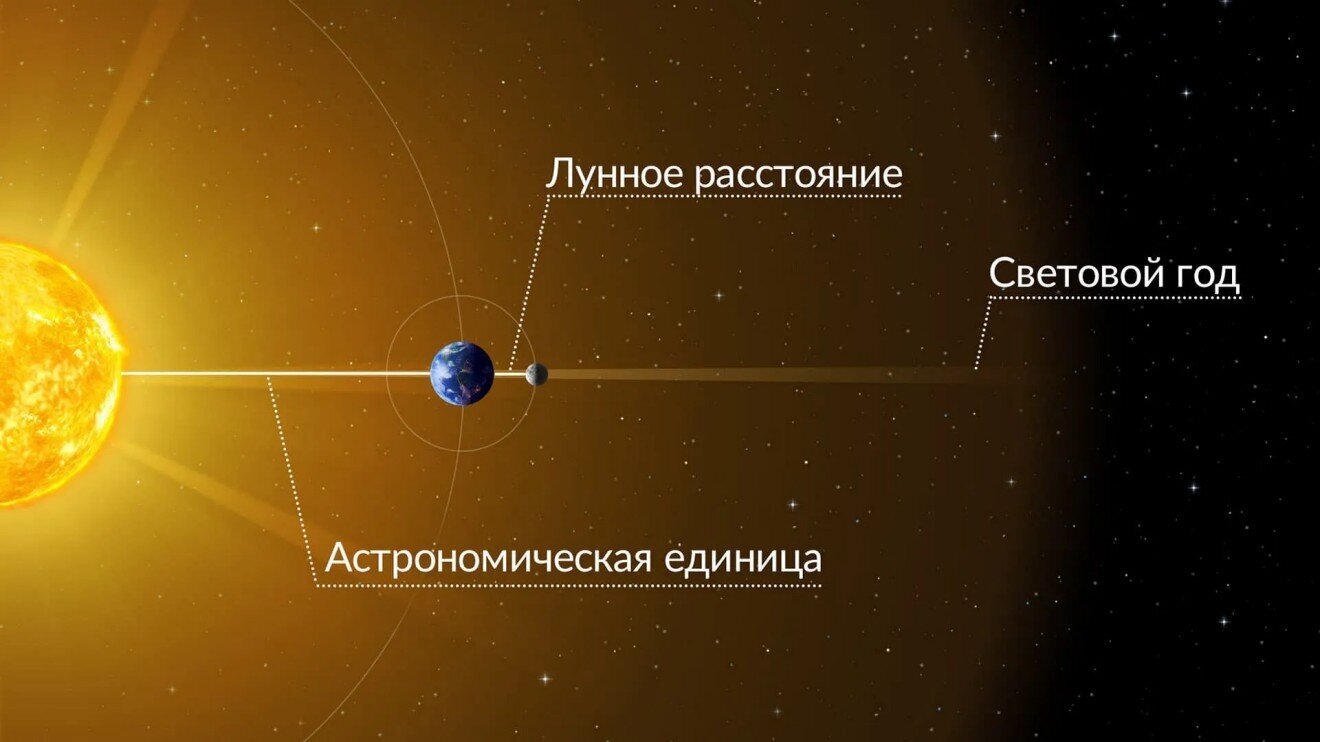
The average distance from Earth to the Sun is about 149.6 gigameters (149,600,000 km). This distance is also known as 1 astronomical unit (1 AU).
The «one hundred fifty gigameters» mentioned in the text corresponds almost exactly to the average Earth-Sun distance, suggesting that the passage refers to the Sun as the source of light coming through the curtains.
In astronomy and space science, gigameters are often used to describe distances within the Solar System:
- Distance from Earth to the Moon: about 0.384 Gm
- Distance from Earth to Mars (at closest approach): about 54.6 Gm
- Distance from Earth to Venus (at closest approach): about 38 Gm
- Diameter of the Sun: about 1.39 Gm
So the phrase «plasma at a distance of one hundred fifty gigameters» is a scientifically precise, poetic way of referring to the Sun.
The light-year is a unit of distance used in astronomy to describe interstellar and intergalactic distances. One light-year equals the distance light travels through a vacuum in one year, roughly 9.46 trillion kilometers (9.46 × 10¹² km), or about 9,460 gigameters.
For comparison:
- The Earth-Sun distance (1 AU, or 149.6 Gm) is about 0.000016 light-years
- The nearest star to the Sun, Proxima Centauri, lies about 4.24 light-years away
- The diameter of our Milky Way galaxy is about 100,000 light-years
- The distance to the nearest large galaxy, Andromeda, is about 2.5 million light-years
So while gigameters are convenient for measuring distances within the Solar System, astronomers prefer light-years for interstellar and intergalactic distances.