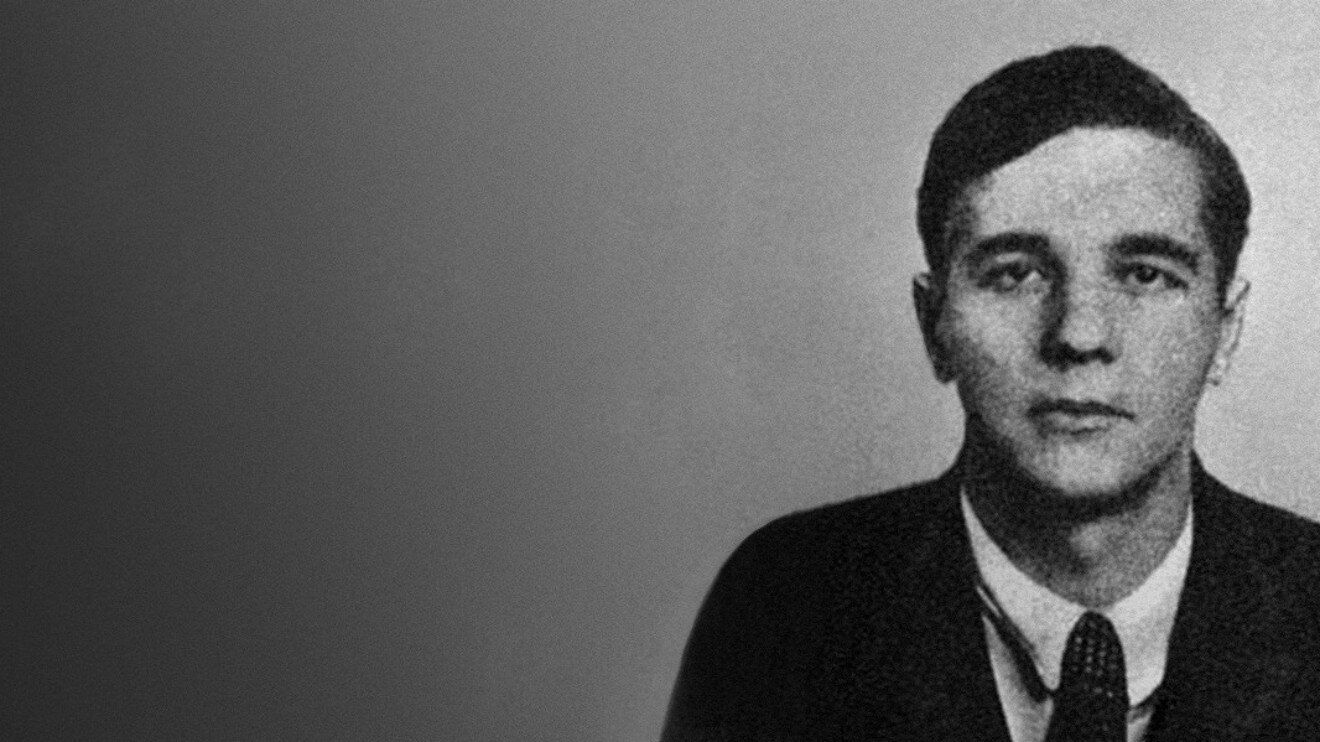
A quote from "Elegy" by Alexander Ivanovich Vvedensky (1904–1941), one of the vivid figures of the Russian avant-garde and a founder of the group OBERIU (the Association for Real Art). The lines "Toward death, toward death keep your bearing, O singer and poor horseman" are the closing lines of this work and represent the quintessence of the poet's worldview.
"Elegy" is one of Vvedensky's best-known works, one that traces rhythmic and thematic parallels with the poetry of Pushkin and Batyushkov. The poem transforms the classical elegy form, filling it with absurdist imagery and dismantling the usual connections of meaning.
The central theme of the work, as of Vvedensky's writing as a whole, is a meditation on time and death. Scholars believe the poet held that time only truly reveals itself at the moment of death. The closing lines of "Elegy" symbolize not only a personal awareness of the finiteness of existence, but a metaphysical collapse of cultural paradigms.
Alexander Vvedensky was born in 1904 in St. Petersburg, to a civil servant father and a mother who was a gynecologist. He was educated at the Nikolaevsky Cadet Corps, and later at a gymnasium. In 1921 he finished a labor school. In 1925, a fateful meeting with Daniil Kharms took place, and together they took part in founding OBERIU in 1927.
Vvedensky's philosophical lyric poetry is marked by radical semantic experiments, which scholars describe as "zaum" (transrational language), "absurdism," and "nonsense." Through the deliberate breakdown of logical connections, the poet cast doubt on the adequacy of reason, thought, and language as tools of understanding.
During his lifetime, Vvedensky published mainly as a children's writer, contributing to the magazines "Yozh" and "Chizh." His "adult" work became widely known only after his death.
In 1941, Vvedensky was arrested on charges of counter-revolutionary agitation. According to the most reliable account, during his evacuation from Kharkiv to Kazan he died on December 19, 1941, of exudative pleurisy. He was fully rehabilitated in 1964. A complete edition of his works was published in Russia only in 1993.
Elegy
Thus I composed this elegy
of how I rode upon a cart.Surveying the mountain peaks,
their endless measures,
jugs filled to the brim with wine,
the whole world, beautiful as snow,
I saw the mountain torrents,
I saw the storm's cruel gaze,
and the wind, peaceful and high,
and death's futile hour.Here a soldier, swimming like a whitefish,
filled with solemn courage,
against the sea's stirring waters
enters an unequal battle.
Here a horse, into mighty palms,
lays down the fire of a reckless chase,
and gloomy horses dance
in the hand of sovereign grass.Where the forest looks into the fields' expanse,
into the silent raiment of the nights,
while we look through a curtainless window
at the light of a soulless star,
we hide our heart in empty doubt,
and through the night, sleepless, languish weeping,
we mean almost nothing,
we wait for an obedient life.Rapture is unknown to us,
we are hard-pressed, gloomy, and cramped,
we betray a friend dishonorably
and God is no master to us.
We have grown the flower of misfortune,
we have forgiven ourselves unto ourselves,
to us, who have cooled like ash,
a carnation is dearer than an eagle.I look with envy on the beast,
trusting neither thoughts nor deeds,
a loss of minds has come to pass,
there is no cause left to struggle.
We shall take it all as a falling,
both day and shadow and dream,
and even the drone of music
shall not escape the abyss.In the sea's restless surf,
in the desert's loose, unruly sand,
and in the indecent female body
we found no solace.
We have forgotten carefree sobriety,
we have sung of death, we have sung of vileness,
we take remembrance for insolence,
and for that we are scorched.Divine birds are flying,
their braids streaming out behind them,
their robes gleam like spokes of a wheel,
in flight there is no mercy.
They count off the time,
they bear the burden,
let the empty stirrup jangle on —
there is no need to lose one's mind.Let the crystal stream go rushing on its way,
let the mirrored horse hasten at a trot,
breathing in the musical air —
you too breathe in decay.
O driver, frail and quarrelsome,
in the last hour of the drowsy dawn,
drive on, drive on the lazy cart —
fly on without delay.Swans do not beat their wings
above the feasting tables,
together with the bronze eagles
they do not sound the victory horn.
The vanished inspiration
now comes to us for but a moment,
toward death, toward death keep your bearing,
O singer and poor horseman.1940