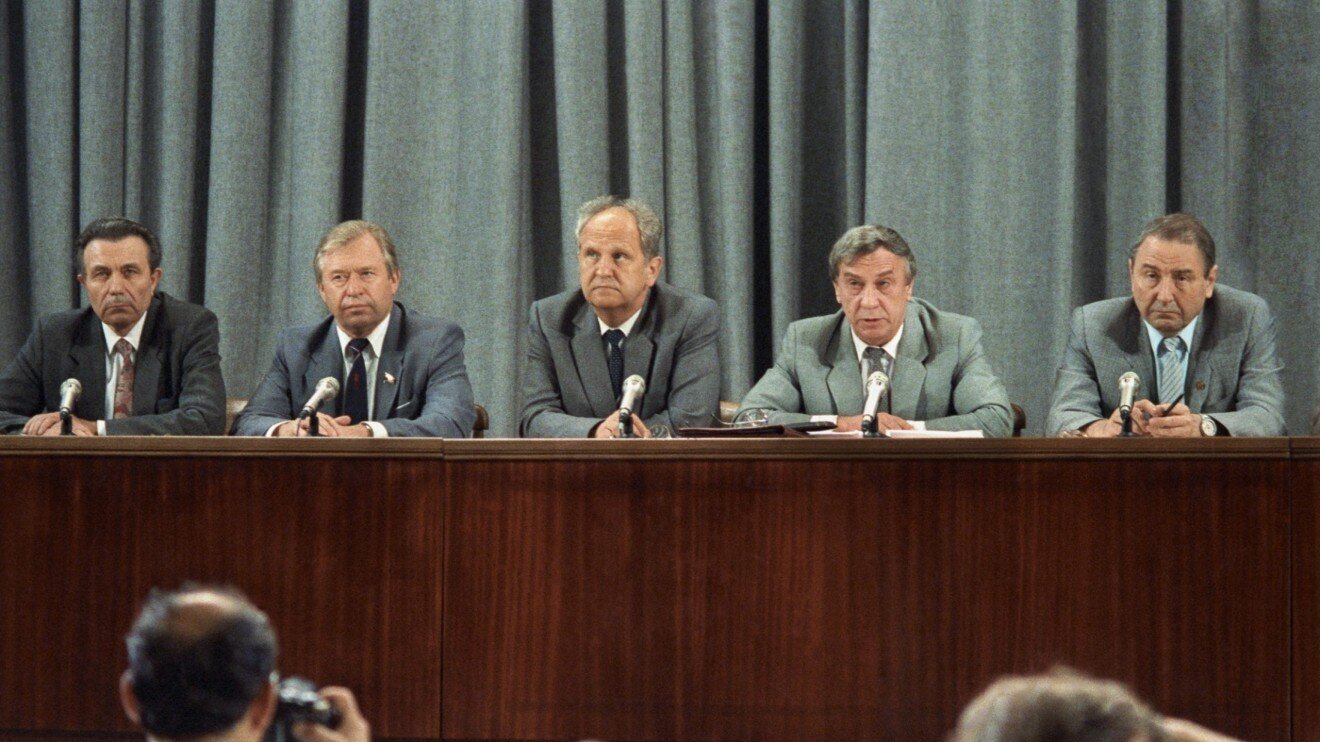
The State Committee on the State of Emergency (known by its Russian acronym, GKChP) was a self-proclaimed governing body in the USSR that existed from August 18 to August 21, 1991. This political crisis entered history as the «August Putsch» and became one of the key events that accelerated the collapse of the Soviet Union.
Background
By the summer of 1991, the economic and political situation in the USSR was deteriorating rapidly. The policies of perestroika and glasnost, launched by Mikhail Gorbachev, had fueled the growth of national movements in the republics and demands for greater independence from the center. On March 17, 1991, an all-union referendum was held in which a majority of citizens voted to preserve the USSR — but in a new form, as a renewed federation of equal, sovereign republics.
Preparation of a new Union Treaty (the so-called «Novo-Ogaryovo process») provoked strong resistance from conservative forces in the country's leadership, who feared losing power and seeing the unified state collapse. The treaty's signing was scheduled for August 20, 1991.
Members of the GKChP
The committee's membership included senior USSR officials:
- Gennady Yanayev — Vice President of the USSR, declared «acting president»
- Valentin Pavlov — Prime Minister of the USSR
- Vladimir Kryuchkov — Chairman of the KGB
- Dmitry Yazov — Minister of Defense
- Boris Pugo — Minister of Internal Affairs
- Oleg Baklanov — First Deputy Chairman of the USSR Defense Council
- Vasily Starodubtsev — Chairman of the USSR Peasants' Union
- Alexander Tizyakov — President of the Association of State Enterprises
Timeline of Events
August 18, 1991: Soviet President Mikhail Gorbachev was cut off from communication at his dacha in Foros, Crimea. A GKChP delegation arrived and demanded he either declare a state of emergency or hand power to Vice President Yanayev. Gorbachev refused.
August 19, 1991: Early in the morning, the GKChP announced a state of emergency in parts of the country. Central television broadcast a performance of «Swan Lake» on a loop. Tanks and armored vehicles rolled into Moscow. The GKChP issued a series of decrees effectively imposing censorship and restricting civil liberties.
That same day, RSFSR President Boris Yeltsin addressed the citizens of Russia, calling the GKChP's actions a coup d'état. He climbed onto a tank in front of the White House (the seat of the RSFSR Supreme Soviet) and read out his famous address, calling on citizens to resist the plotters.
August 19-21: Tens of thousands of defenders gathered around the White House, and barricades went up. On the night of August 21, an attempt was made to storm the White House, in which three people died: Dmitry Komar, Ilya Krichevsky, and Vladimir Usov, later honored as heroes and posthumously awarded the title Hero of the Soviet Union.
August 21: The putsch collapsed. GKChP members were arrested (Boris Pugo took his own life). Mikhail Gorbachev returned to Moscow.
Consequences of the GKChP
The putsch's failure had dramatic consequences for the fate of the Soviet Union:
- A sharp weakening of central authority and a strengthening of the republics' positions
- The suspension, and subsequent ban, of the Communist Party on RSFSR territory
- Recognition of the Baltic republics' independence
- An accelerated collapse of the USSR, culminating in the signing of the Belovezha Accords on December 8, 1991
- Gorbachev's loss of real power and Yeltsin's rise
Historical Significance
The events of August 1991 became a critical turning point in the recent history of Russia and the post-Soviet world. The GKChP's failure marked the definitive defeat of the conservative forces seeking to preserve the Soviet system in its old form. For many citizens, the three days of standoff at the White House became a symbol of democratic values and civil society triumphing over a totalitarian system.
Historians, however, still debate the GKChP's real goals and capabilities. Some researchers point to the plotters' poorly thought-out, indecisive actions, casting doubt on how serious their intentions really were. There are also theories suggesting the putsch was deliberately engineered to fail, in order to accelerate the USSR's collapse.
Whatever the truth, the GKChP marked a point of no return in the history of the Soviet Union, opening the door to the profound political and economic transformations across the post-Soviet space that shaped the character of modern Russia and the other states that emerged after the USSR's collapse.