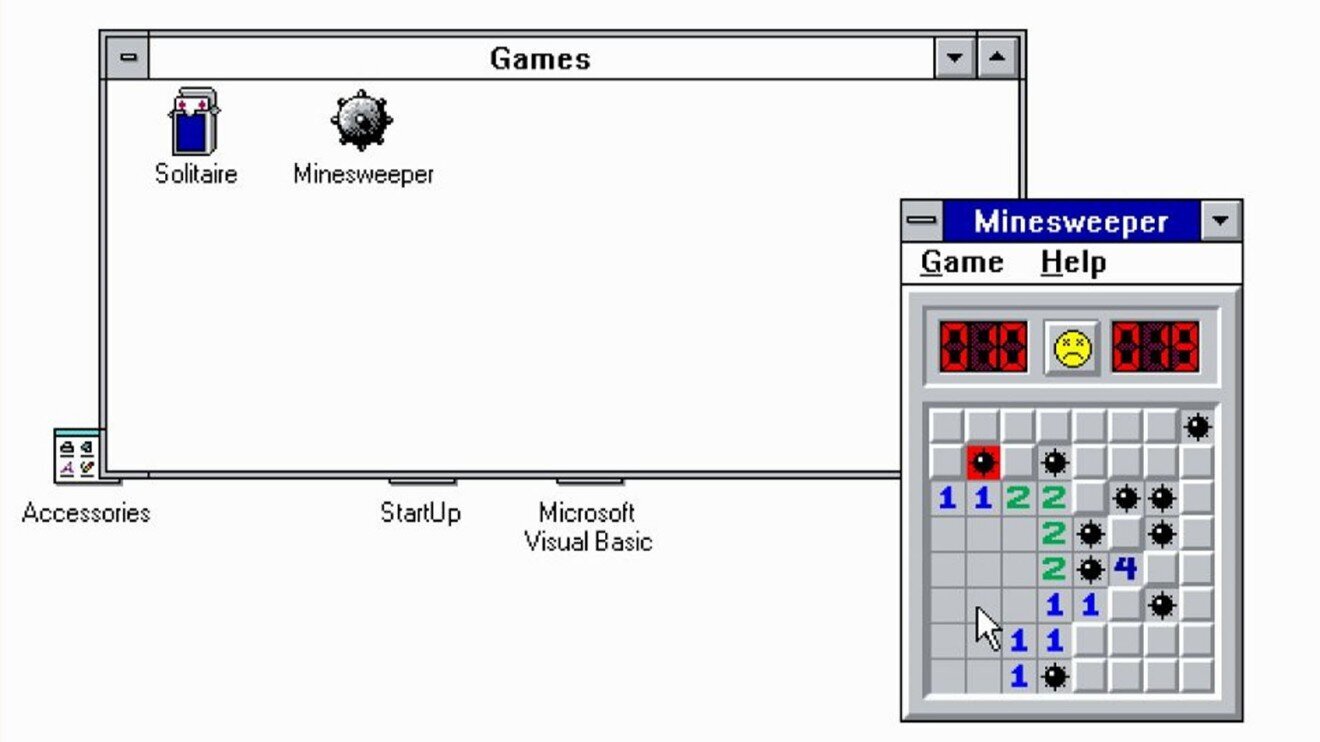
A cult computer puzzle game that became one of the symbols of the personal-computer era of the early 1990s.
Minesweeper is a logic game in which the player must clear a grid without setting off any of the mines hidden underneath it. Cells adjacent to a mine display the number of neighboring mines, which the player uses to gradually reveal safe cells and mark suspected mines with flags.
History
Early versions of games resembling Minesweeper date back to the 1970s. The modern version, though, was created by programmer Robert Donner in 1989 for the OS/2 operating system. In 1990, Curt Johnson adapted the game for Windows, naming it «Minesweeper.»
In 1992, Minesweeper was bundled into the standard set of Windows 3.1 games, putting it within reach of millions of users worldwide. By 1993, as Russia's own personal-computer boom got underway, Minesweeper was already popular among Windows users.
An Educational Purpose
Minesweeper, like the other standard Windows games (Klondike Solitaire, FreeCell), was bundled with the operating system for more than just entertainment. One of these games' important jobs was training users to work with the computer mouse.
In the early 1990s, many people were encountering a graphical interface and a mouse for the first time. These games offered an ideal environment for practicing the fundamental control skills:
- Single clicks (to reveal cells in Minesweeper)
- Double clicks (to quickly reveal several cells at once)
- Right-clicks (to place flags)
- Precise cursor positioning
So by playing Minesweeper, users unknowingly absorbed the Windows interface and learned to handle a mouse — a skill critical for working in a graphical shell.
Spread in Russia
In 1993 Russia, amid political and economic upheaval, personal computers were only just entering ordinary people's lives. Minesweeper was one of the first computer games new PC users encountered. Its simple rules and intuitive interface made it popular even among people far removed from technology.
Minesweeper became something of a cultural phenomenon, symbolizing Russia's entry into the computer age, and for many Russians it's still associated with their earliest experiences with a personal computer.
In modern versions of Windows, Minesweeper was dropped from the standard bundle, but remains available for download from the Microsoft Store, still popular in the twenty-first century.