The story of one of electronic music’s most iconic songs, and its reinterpretation by the British duo Pet Shop Boys
The song’s origins
The song «Go West» was written in 1979 by the American disco group Village People and became one of the most recognizable hits of the disco era. Its authors were Jacques Morali, Henri Belolo, and Victor Willis – the creative team behind the Village People phenomenon.
The song’s original call to «go west» carried a deep metaphorical charge. It pointed toward San Francisco – a city that in the late 1970s was seen as the «ideal» place of freedom for the gay community. The phrase «Go West, young man» has deep roots in nineteenth-century American history, when it became the rallying cry for the settlement of the American West.
Historical note: In the late 1970s the song was heard as a celebration of sexual freedom in San Francisco, in particular the acknowledgment of gay freedom, though the songwriters themselves denied that reading.
Pet Shop Boys: British pioneers of synth-pop
The duo comes together
Pet Shop Boys are a British synth-pop and house duo formed in 1981 in London, after a chance meeting between two young men in a music shop. Neil Tennant (born July 10, 1954) and Chris Lowe (born October 4, 1959) met on August 19, 1981, when Tennant was seeking help hooking a synthesizer up to his home stereo.
At the time they met, Lowe was working at an architecture firm, while Tennant was a music journalist who had already tried his hand at a string of professions over the previous decade. What brought them together was a shared love of dance music and similar creative ambitions.
Musical influences
From the start Pet Shop Boys settled on their direction – electronic music grounded in Italo disco and electro. The dramatic melodicism of their compositions drew on new-wave stylistics and traditional pop songwriting. Technologically, the musicians were especially influenced by:
- Giorgio Moroder – a pioneer of electronic dance music
- Kraftwerk – German innovators of electronic sound
- Bobby Orlando – an American disco producer
- New Order – British post-punk pioneers
- New York club music
The road to fame
The turning point came in 1983, when Tennant, then an editor at the music magazine «Smash Hits,» traveled to New York to cover a Police tour. He used the trip to meet with producer Bobby Orlando, who agreed to record the young group.
After the failure of their first singles in 1984–85, the musicians switched producers, working with Stephen Hague, and re-recorded «West End Girls,» which in November 1985 brought them international success, topping the charts in both Britain and the US.
Reinterpreting «Go West» in 1993
New meaning for a familiar melody
In 1993 Pet Shop Boys released their version of «Go West» on the album «Very,» a record that was the polar opposite of their previous, more intimate album «Behaviour.» Thanks to its bright dance melodies, many consider «Very» a masterpiece of the eurodance sound of its time.
In Neil Tennant’s own words, their version of the song took on an entirely different meaning: «‘Go West’ is about looking toward the future. About everything only getting better. And maybe it expresses a certain hope.»
Cultural context: The band gave the song a new coloring, slightly altering the original lyrics and adding a new verse, transforming «Go West,» in the words of Gay Times correspondent Richard Smith, «into a lament for a lost world» – meaning the «gay world» lost after the spread of AIDS.
Soviet motifs
Especially notable is that Pet Shop Boys arranged the song’s opening so that it echoed the Soviet national anthem. This was no accident – in the early 1990s the group took an active interest in Russia and Soviet themes.
Moscow filming and Russian connections
Red Square as a backdrop
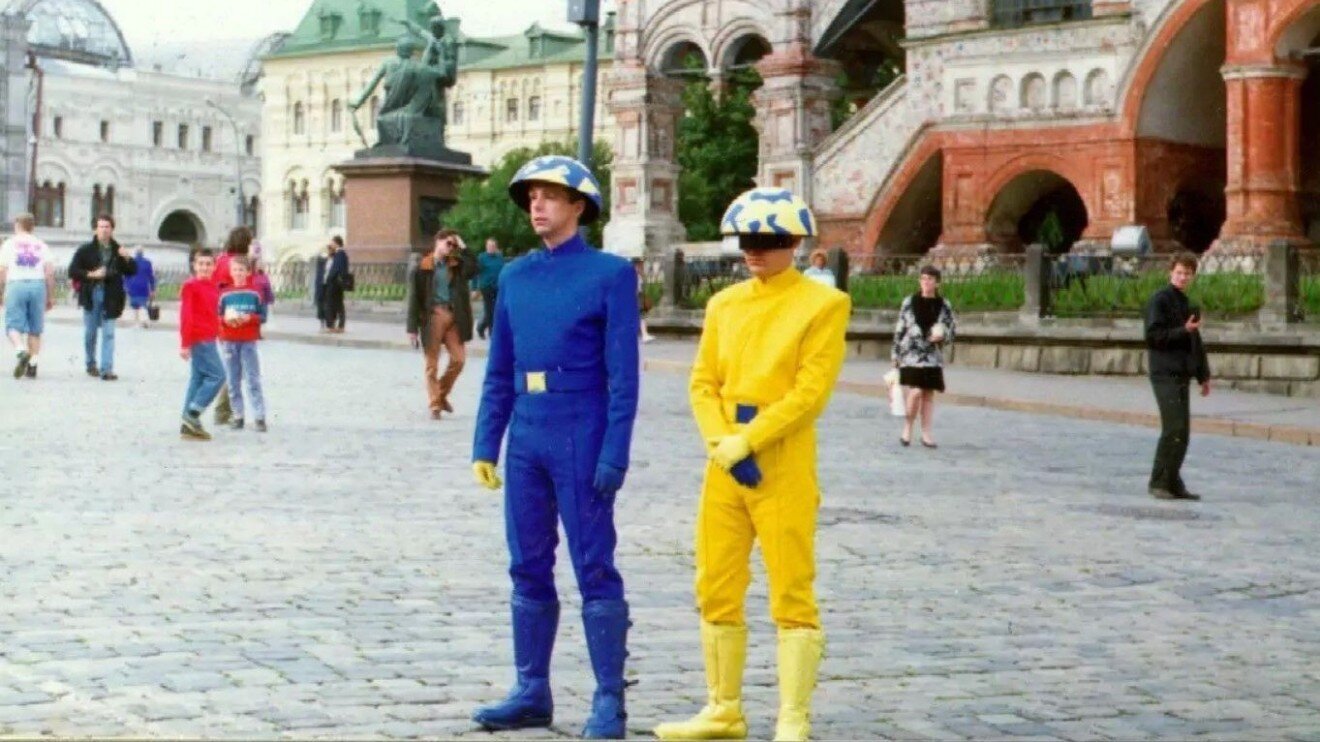
The music video for «Go West» was directed by Howard Greenhalgh in 1993 in Moscow – on Red Square, at Gagarin Square, and by the Cosmonautics Museum. Neil Tennant and Chris Lowe wore blue and yellow jumpsuits, respectively, topped with yellow-and-blue hard hats.
The video was clearly ironic about the USSR and communism, typical of the Western view of the post-Soviet space in the early 1990s. Pet Shop Boys had come to Moscow at the invitation to mark the launch of MTV broadcasting in Russia, and the group even rode around the city in Mikhail Gorbachev’s former limousine.
Russian tours
Pet Shop Boys visited Russia for concerts on several occasions. In February and March 1998 the group performed in Russia for the first time, giving one concert in Moscow and two in St. Petersburg, and also appearing on the show «Akuly Pera» («Sharks of the Pen»). Throughout the 1990s, Neil Tennant was a frequent guest at various events in Moscow and St. Petersburg.
Russian themes in Pet Shop Boys’ work
- «My October Symphony»
- «Go West»
- «London»
- «Numb»
- «Bolshy»
- «Battleship Potemkin»
In 1997, Pet Shop Boys recorded «A Red Letter Day» with a Moscow choir, further evidence of their serious interest in Russian culture.
Cultural significance and legacy
Critical acclaim
The Pet Shop Boys version of «Go West» earned high praise from critics. The British magazine New Musical Express included the track on its list of the «500 Greatest Songs of All Time,» ranking it at number 333.
Visual aesthetics
The groundbreaking videos from the «Very» album, including «Go West,» won awards. The clips used computer graphics that were cutting-edge for their time, and Tennant and Lowe wore unusual costumes – from the blue-and-yellow hard hats and greatcoats in the «Go West» video to meter-tall conical hats in other clips.
Geopolitical context
In the context of the 1990s, the «Go West» cover took on a particular resonance. It was a time of fundamental change in the world order: the collapse of the USSR, the end of the Cold War, the triumph of the Western development model. A song calling on people to «go west» symbolically captured the spirit of the age.
By 1997: Pet Shop Boys had established themselves as one of the most commercially successful British acts recording dance music. Over a decade and a half of their career they had released more than forty singles, twenty of which reached the British Top Ten.
Pet Shop Boys’ style and philosophy
«Intelligent dance music»
Pet Shop Boys’ work is often called «intelligent dance music» thanks to the paradoxical turns in their song narratives and unexpected borrowings from different areas of culture. As Neil Tennant explained:
«I’ve tried to bring into the lyrics things beyond the usual pop clichés. That’s where the Englishness comes in, because I try to use words or phrases that are almost too mundane to use. But I have a tendency to use English clichés as hooks, turning conversational phrases into hooks for dance records.»
Visual image
Pet Shop Boys developed a vivid, distinctive image that the band had already been cultivating for more than 30 years by 1997. Within the duo, Tennant played the dandy, while Lowe cultivated a semi-athletic look – baseball caps and sneakers – projecting a detached image sharpened by fashionable sunglasses.
A place in gay culture
Pet Shop Boys are regarded as important figures in gay culture, thanks to songs like «It’s a Sin» and the «Go West» cover. Neil Tennant came out in 1994, in an interview with the gay magazine Attitude, though many of the group’s lyrics are written from a deliberately ambiguous point of view, and a significant share of their fans are heterosexual.
Conclusion
By 1997 the Pet Shop Boys version of «Go West» had become a cult track, symbolizing not just the British duo’s musical achievements but the spirit of an age of change. The transformation of a 1970s disco anthem into a postmodern statement about the future reflected the complexity of the cultural processes of the 1990s.
The irony of the Moscow filming, the Soviet musical allusions, and the geopolitical subtext made this version of «Go West» more than just a successful cover – it became a work of art in its own right, one that continued to resonate in the cultural space of the mid-1990s.
Pet Shop Boys remained active participants in the music scene, regularly releasing albums and touring the world, including frequent visits to Russia.