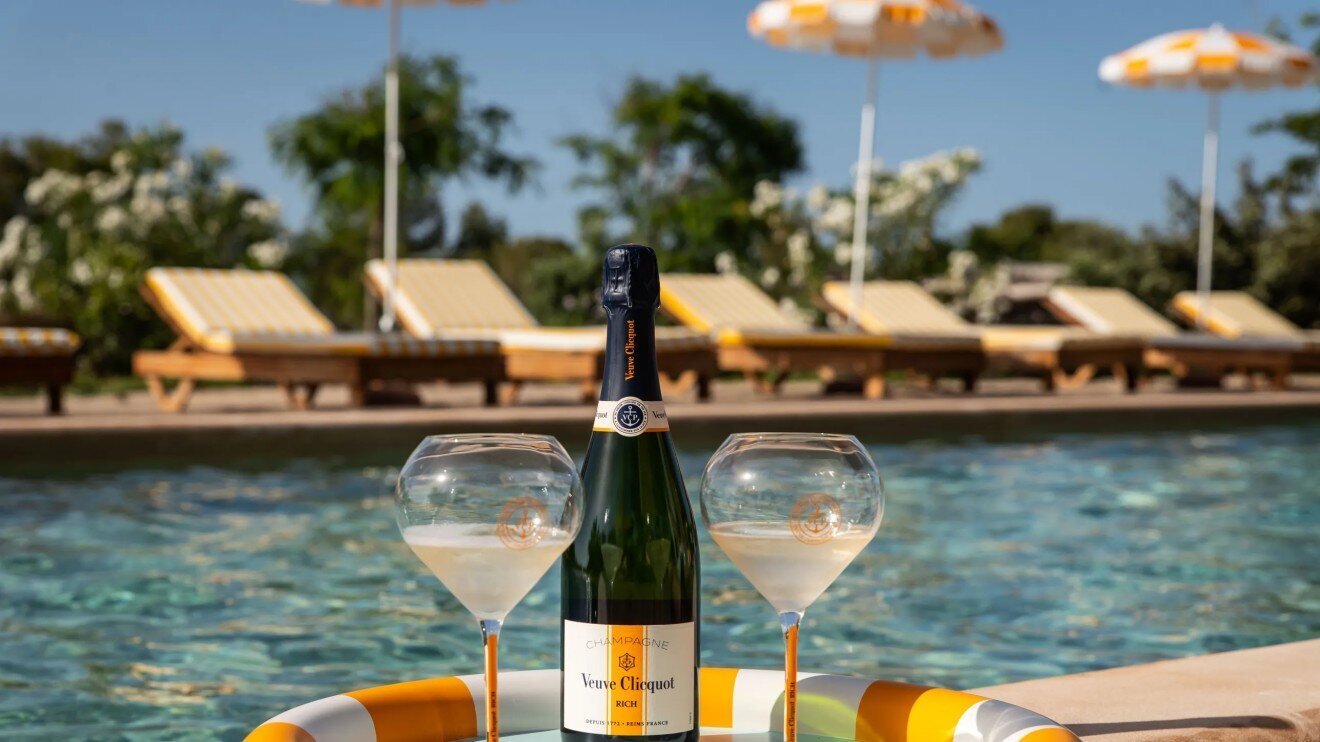
The champagne house Veuve Clicquot Ponsardin
Veuve Clicquot Ponsardin is one of the most prestigious champagne houses in the world, founded in 1772 in Reims, France. The name translates as «Widow Clicquot Ponsardin,» reflecting the dramatic history of the company and its legendary owner.
The legend of the «Grande Dame of Champagne»
The brand’s history is inseparable from the name of Barbe-Nicole Ponsardin, who went down in history as Madame Clicquot. This remarkable woman became a symbol of entrepreneurial spirit and innovation in the world of winemaking.
Biographical facts
- Born: 1777
- Married: 1798 (aged 21)
- Widowed: 1805 (aged 27)
- Died: July 29, 1866 (aged 89)
Achievements
- • The first woman to own a champagne house
- • Creator of the first vintage champagne (1810)
- • Inventor of the riddling technique (1816)
- • Creator of the first blended rosé champagne (1818)
After the death of her husband François Clicquot in 1805, the young widow made a decision that was revolutionary for its time – she took the reins of the wine business herself. Under the Napoleonic Code, women had no right to work or run a business without the consent of a husband or father. Only widows had the legal freedom to engage in entrepreneurship.
«We have only one quality – the finest»
Technological breakthroughs
Madame Clicquot made several breakthroughs that permanently changed the champagne industry:
Before Madame Clicquot invented the riddling process, champagne was cloudy because of dead-yeast sediment. The traditional way of clearing it was to pour the wine from bottle to bottle, which was labor-intensive and damaged the wine.
Together with her cellar master, Antoine de Müller, she created the pupitre – a wooden rack with holes that let bottles be turned upside down. Over six to eight weeks, the bottles were rotated a quarter-turn daily, shaking the sediment toward the neck. The neck was then frozen, the cork removed, and the sediment expelled by the pressure inside.
This technique is still used today and became the standard for champagne production worldwide.
Madame Clicquot was the first to produce champagne from grapes of a single harvest year, creating the concept of vintage champagne. This allowed the unique character of each year to shine through and significantly raised the product’s prestige.
The first blended rosé champagne was created by Madame Clicquot in 1818 by adding still red wine to sparkling white. Before that, the only house producing rosé champagne was Ruinart, and only by tinting it with elderberry juice.
Madame Clicquot’s method became the standard and is still used by most producers today.
The «Russian breakthrough» and world fame
A decisive moment in the house’s history came in 1814, with Madame Clicquot’s famous «Russian gambit.» During the Napoleonic Wars, the continental blockade had cut off trade routes, and Russian Emperor Alexander I had banned the import of French goods.
The 1814 strategic operation
Anticipating the end of the war, Madame Clicquot and her trusted agent Louis Bohne devised a daring plan. As soon as Napoleon was exiled to Elba, they secretly chartered a Dutch cargo ship, the «Zes Gebroeders,» and sent 10,550 bottles of champagne to Königsberg.
Result: The shipment sold out instantly. Grand Duke Mikhail Pavlovich, brother of Tsar Alexander I, declared that he would drink only Veuve Clicquot champagne. Word of this preference spread throughout the Russian court.
The Russian market became key to the Clicquot house. Sales grew from 43,000 bottles in 1816 to 280,000 in 1821. It was in Russia that Clicquot champagne achieved the status of a drink for high society and the aristocracy.
The famous yellow label
The recognizable yellow label first appeared on Veuve Clicquot bottles in 1876. It was originally used to distinguish dry champagne from sweet on the British market. In 1877 the color was officially registered as a trademark.
A symbol of luxury and prestige
By the end of the nineteenth century, Veuve Clicquot had firmly established itself as a symbol of luxury and high status. The house received royal warrants, including one from Queen Elizabeth II of the United Kingdom.
Cultural influence
Clicquot champagne became an inseparable part of high-society culture:
- In literature: In nineteenth-century Russian novels, the term «Clicquot» became a byword for top-shelf champagne
- On stage: In the 1830s and 1840s the brand was frequently referenced in operettas, vaudevilles, and revues
- On screen: In «Casablanca» (1942), Captain Renault recommends Veuve Clicquot to Major Strasser
- In contemporary culture: Referenced in the works of Ian Fleming and in modern music
Veuve Clicquot in 1990s Russia
In the period depicted in the novel (1997), Veuve Clicquot champagne occupied a special place in the culture of Russia’s emerging elite. After decades of Soviet shortages and isolation, access to prestigious Western brands became an important marker of social status.
The 1990s sociocultural context
In 1990s Russia, «Clicquot» became one of the chief symbols of the «New Russians» – people who had grown rich quickly during the era of economic reform. Drinking expensive French champagne demonstrated:
- Financial means (a bottle cost serious money)
- European ambitions and a break from the Soviet past
- Membership in the elite of the «new era»
- Familiarity with Western brands and their hierarchy
The modern LVMH empire
In 1987 the house of Veuve Clicquot was acquired by the Louis Vuitton Moët Hennessy (LVMH) conglomerate, becoming part of the world’s largest luxury-goods empire. This acquisition only strengthened the brand’s status as a symbol of prestige and exclusivity.
Production today
- 971 acres of vineyards
- 55% Grand Cru-classified vineyards
- 40% Premier Cru-classified vineyards
- Average aging – at least 30 months
- Vintage cuvées aged 5 to 10 years
Grape composition
- 50% Chardonnay
- 45% Pinot Noir
- 5% Meunier
Yellow Label – the flagship product – is a blend of 50 to 60 different crus
Archaeological finds
The brand’s prestige is confirmed by some remarkable archaeological discoveries:
A philosophy of quality
Madame Clicquot’s principle – «We have only one quality, the finest» – remains the house’s motto to this day. It shows up in every aspect of production:
Grapes
Only hand-picked, from the best plots in Champagne
Aging
A minimum of 30 months; up to 10 years for vintage cuvées
Tradition
Preserving historic production methods
The legacy of the «Grande Dame»
The story of Veuve Clicquot is more than the story of a liquor brand. It’s a saga of female entrepreneurship, innovation, and the pursuit of excellence. Madame Clicquot, nicknamed by her contemporaries «la grande dame de la Champagne,» became a symbol of how determination and vision can overcome social barriers and create something lasting.
«Only one quality – the finest»
In the context of the novel
The mention of «Clicquot» champagne in the text of the novel is no accident – it’s a precise historical and sociocultural detail, characterizing the character Zhorik as a representative of the new Russian elite of the 1990s, for whom consuming prestigious Western brands had become a way of displaying status and breaking with the Soviet past.