
A tapestry is a form of decorative art: a hand-woven wall hanging with a pictorial or ornamental design, made on a special loom. The name comes from the Gobelin family of dyers, who founded a workshop in Paris in the 15th century that later became a royal manufactory.
The technique behind tapestry-weaving is a special kind of weaving in which the weft threads don’t run the full width of the fabric, but only through sections of a given color, building up the image piece by piece. The weaver works not from the front but from the back, which makes the process especially demanding.
The History of Tapestry Art
Tapestry art has ancient roots. Woven images made with a technique similar to tapestry-weaving already existed in ancient Egypt and Babylon. The art reached a particular peak in medieval Europe, where tapestries (called «wall hangings» before the 17th century) not only decorated the cold stone walls of castles but served as a kind of heat and sound insulation too.
The golden age of tapestry fell in the 14th-16th centuries, when Flemish weavers perfected the technique. The cities of Arras, Brussels, and Tournai became centers of top-quality tapestry production. It was during this period that the famous tapestry series were created that today stand as priceless works of art.
In the 17th century, the center of tapestry art shifted to France, where in 1662 Louis XIV’s minister Jean-Baptiste Colbert founded the famous Royal Gobelins Manufactory. That manufactory still exists today and is considered a benchmark in the world of textile art.
Interesting Fact
Making a single large tapestry could take weavers several years. The most complex works were done collectively, with each weaver specializing in certain elements: one on faces, another on landscapes, a third on ornamental patterns.
Golden Ages of Tapestry Art
Tapestry’s popularity shifted over time, but a few periods of particular flourishing stand out:
- 14th-15th centuries — the golden age of Flemish tapestries, an era of magnificent series on religious and allegorical themes
- 17th-18th centuries — the Baroque and Rococo tapestries of France, and the creation of famous cycles based on designs by Rubens, Le Brun, and other prominent artists
- Late 19th to early 20th century — a revival of interest in hand-weaving during the Art Nouveau era, driven by the work of William Morris and the Arts and Crafts movement
- The 1960s-70s — a new flourishing of tapestry as a form of contemporary art, with experimental textile compositions
Tapestry in the USSR: From Decorative Art to a Symbol of Petty-Bourgeois Taste
In the Soviet Union, tapestry took an unusual turn. In the 1920s-30s, tapestry was treated as an important part of decorative and applied art, and large-scale works with Soviet symbolism were made to decorate public buildings. Alongside this professional art, though, factory-woven rugs with printed designs, imitating tapestries, began entering the daily life of Soviet citizens.
By the 1960s-70s, these mass-produced factory items — rug panels showing deer, swans, hunting scenes, or copies of famous paintings — became enormously popular among the public. People hung them on apartment walls as a sign of prosperity and «cultured» living.
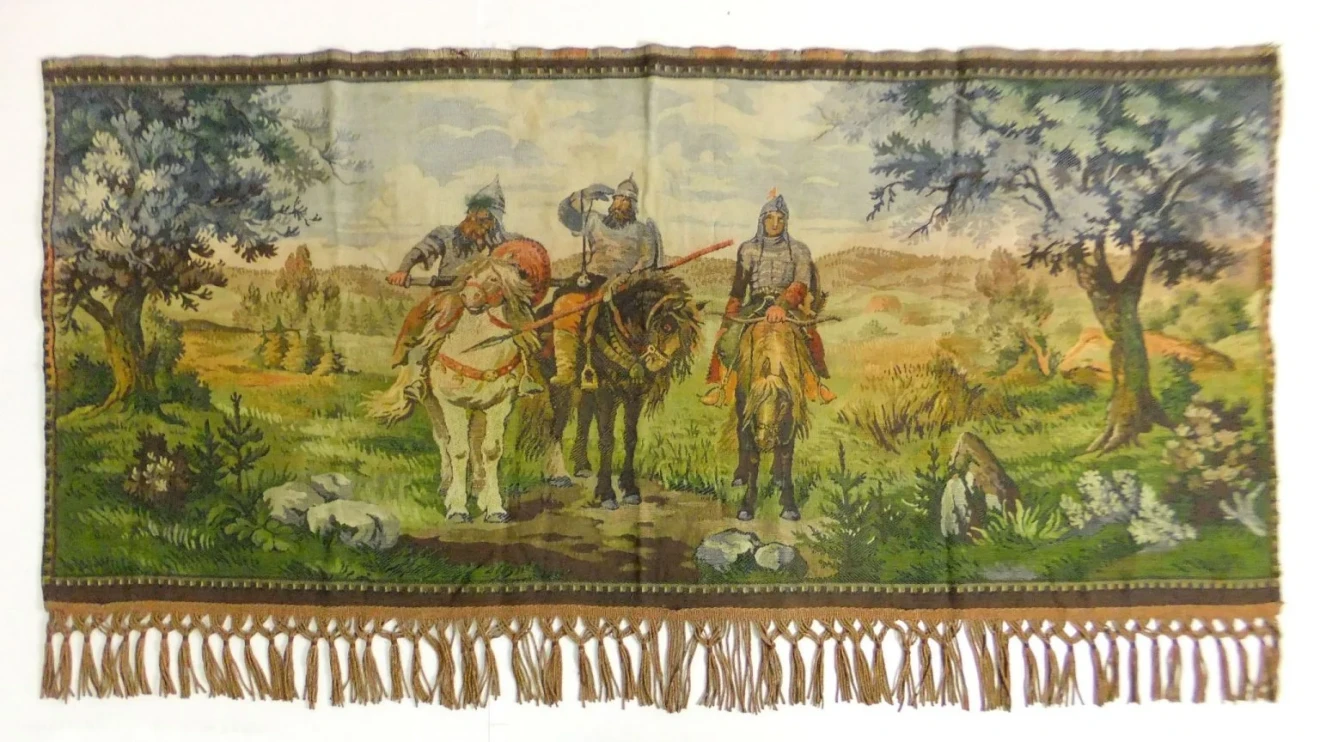
It was exactly this mass popularity, and the low artistic quality of most such items, that led the Soviet intelligentsia to start seeing tapestries as a symbol of petty-bourgeois taste and bad style. In the literature and cinema of the 1970s-80s, a rug with deer on the wall became a fixed image marking a narrow, philistine mindset and a crude sense of beauty.
The situation was compounded by the fact that people started calling any woven rug image a «tapestry,» regardless of the technique used to make it. Most of these «tapestries» were mass-produced on Jacquard-type looms and had nothing in common with genuine tapestry art.
Reasons for the Negative View of Tapestries in the USSR
- The mass availability of low-quality factory-made items
- The endless repetition of a narrow set of clichéd subjects
- Its association with a petty-bourgeois craving for surface «prettiness» in the home
- The cultural gap between professional tapestry art and mass-produced imitations
- Criticism in literature and art as a symbol of a consumerist attitude toward culture
Even so, it’s worth noting that alongside the mass craze for factory rugs, professional tapestry art kept developing in the USSR. In the Baltic republics, Armenia, Georgia, and Russia, talented textile artists were producing original tapestries of genuine artistic merit.
Today, attitudes toward tapestry are gradually shifting. Contemporary designers and artists are reviving interest in this form of textile art, creating original works that fit harmoniously into 21st-century interiors. Antique tapestries are once again valued as high art, and hand-weaving is experiencing a rebirth.
Even so, the cultural memory of «tapestries with deer» as a symbol of petty-bourgeois taste is still alive across the post-Soviet world, making this piece of home decor an interesting cultural phenomenon, one reflecting shifts in a society’s aesthetic norms and values.