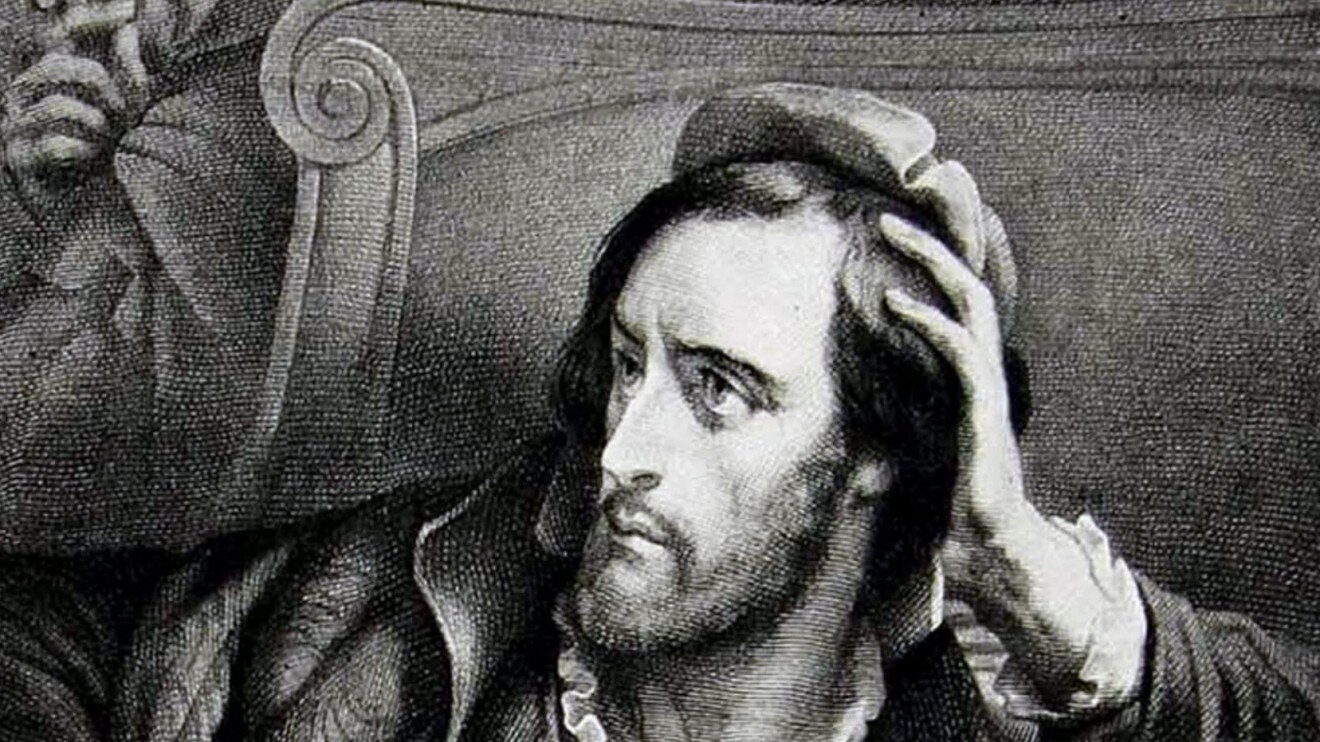
The full quote from Goethe’s Faust reads:
I’ve won no honor, gathered no estate,
Nor tasted yet what makes life sharp and great.
A dog would howl at such a fate!
And so to magic I have turned,
That some spirit’s voice, once summoned,
Might show me being’s deepest truth.
That I, no fool, need never more
Play the wise man I am not,
But grasp, in solitude, at last,
The inner bond that holds the universe fast,
Behold all things at their very source,
And deal no longer in empty words.
Johann Wolfgang von Goethe and the Poem "Faust"
“Faust” is a philosophical drama considered the crowning achievement of the great German poet Johann Wolfgang von Goethe (1749-1832), and one of the greatest works of world literature.
The Author and His Era
Johann Wolfgang von Goethe was born August 28, 1749, in Frankfurt am Main, to a lawyer and imperial councilor. Given a brilliant home education, Goethe studied law at the Universities of Leipzig and then Strasbourg. But his true calling turned out to be literature.
Goethe lived a long life (he died March 22, 1832), spanning several historical periods: the Seven Years’ War, the French Revolution, the Napoleonic era, and the events that followed. He spent most of his life in Weimar, where he held high government posts at the court of Duke Karl August and ran the palace theater.
Besides his literary work, Goethe took the natural sciences seriously: botany, anatomy, optics, mineralogy, geology. He introduced the term “morphology” into science and made several important scientific discoveries.
The History of "Faust"’s Creation
Work on “Faust” occupied Goethe for about 60 years of his life. The first drafts appeared in 1772-1775 (the so-called “Urfaust”). The first part of the tragedy was written in the 1790s, completed in 1806, and published in 1808. Goethe worked on the second part in the last years of his life, and it was published posthumously in 1832.
Such a long period of work meant the poem reflects different stages of the writer’s creative evolution: from the fiery romanticism of youth (the “Sturm und Drang” movement) to the seasoned classicism of his later years.
The Poem’s Plot
The first part opens with a prologue, in which Mephistopheles makes a wager with God for Faust’s soul. The action begins with the scholar Faust, disillusioned with science and life, on the verge of suicide. Mephistopheles offers him a deal: he will serve Faust on earth, and Faust will then serve him in hell. The condition for Faust’s soul passing to Mephistopheles will be the moment Faust says to an instant, “Stay, thou art so fair!”
Under Mephistopheles’ influence, Faust falls in love with the young Margarete (Gretchen). Their love leads to tragedy: Margarete’s mother dies from a sleeping draught, her brother Valentin dies in a duel with Faust, and Margarete herself, having borne and drowned a child, awaits execution. Though Faust tries to save his beloved, she refuses to flee with the help of dark powers.
The second part is a more complex, philosophical work, dense with symbolism and mythological allusion. The action moves to the ancient world, where Faust meets Helen of Troy. He then occupies himself with affairs of state at the emperor’s court. In the finale, the now-blind Faust oversees the construction of a dam to protect people from the sea, dreaming of building an ideal society. Dying, he speaks the key words: “Stay, thou art so fair!” — not because he has achieved personal happiness, but because he sees meaning in work for humanity’s benefit.
Under the terms of the contract, Faust’s soul should pass to Mephistopheles, but angels save it, carrying it off to heaven. The final lines declare: “The Eternal Feminine draws us upward.”
Differences from Traditional Faust Legends
The story of Doctor Faustus was popular in European culture long before Goethe. The best known are the 16th-century “Faustbuch” and Christopher Marlowe’s “The Tragical History of Doctor Faustus.” But Goethe substantially reworked the traditional story:
In earlier versions, Faust makes a deal with the devil out of a thirst for knowledge, power, or pleasure. In Goethe’s version, Faust’s motivation is more complex — disillusionment with knowledge and a search for the true meaning of life.
The love story between Faust and Margarete is entirely Goethe’s invention and absent from the traditional legends.
The main difference is the ending: in the classic versions, Faust goes to hell; in Goethe’s, his soul is saved thanks to his tireless striving toward a higher ideal.
The Philosophical Depth of the Poem
“Faust” is a multilayered work, touching on the fundamental questions of human existence: the meaning of life, the nature of good and evil, the limits of knowledge, personal freedom and responsibility.
Mephistopheles himself in the poem is not simply the embodiment of evil, but a dialectical force, part of the world order. His famous words — “I am part of that power which eternally wills evil and eternally works good” — reflect Goethe’s understanding of the contradictory nature of development.
Goethe’s Faust is a symbol of eternal human striving, the search for truth and meaning, found not in contemplation but in action. Faust’s ultimate salvation reflects the author’s optimistic view of human nature.
Its Significance in World Culture
Goethe’s “Faust” has had an enormous influence on world culture. The work has been translated into many languages and has inspired countless theatrical productions, operas, ballets, and films.
Among the well-known musical works based on “Faust”: Charles Gounod’s opera, Franz Liszt’s “A Faust Symphony,” Hector Berlioz’s “The Damnation of Faust,” and Arrigo Boito’s “Mefistofele.”
“Faust” also left a deep mark on Russian culture. Outstanding translations were made by V.A. Zhukovsky, E.I. Guber, A.A. Fet, N.A. Kholodkovsky, and B.L. Pasternak. Many Russian writers turned to the image of Faust and Faustian themes in their own work.
In the Russia of 1993, as the country lived through profound social and political change, turning to Goethe’s “Faust” could be read as an attempt to make sense of society’s rapid transformation through the lens of the eternal problems of human existence and the search for harmony amid chaotic change.