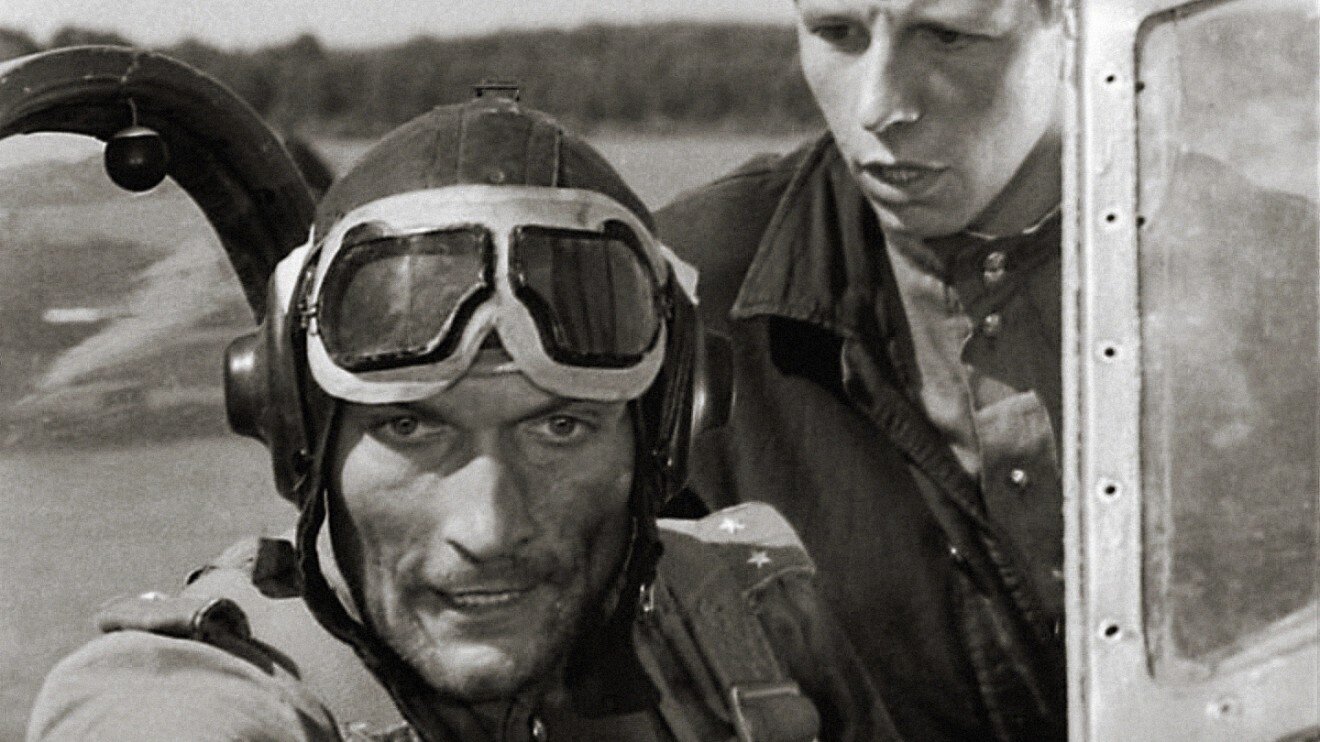
In the text of the novel, the hero recalls an episode from a Soviet war film, where a character rams an enemy plane and shouts about the “curly green maple.” This scene refers to the cult film “Only Old Men Go to Battle” by director Leonid Bykov, released in 1974 and one of the most beloved Soviet films about the Great Patriotic War.
The Film
Leonid Bykov’s black-and-white film depicts the daily life of fighter pilots during the Great Patriotic War. The action unfolds in late summer 1943, during the Battle of the Dnieper, and follows the second squadron of a Guards fighter regiment commanded by Captain Titarenko, nicknamed “Maestro.”
The film drew 44.3 million viewers and placed fourth at the 1974 box office, the only WWII-themed film in that year’s top ten highest-grossing pictures — an unexpected success, since war films rarely drew such numbers by then.
Plot and Characters
At the story’s center is the second squadron, known as “the Singing Squadron.” After combat missions, the pilots turn into an amateur orchestra, with Captain Titarenko conducting. The squadron’s motto: “Wars pass, music is eternal!”
New recruits arrive at the regiment — young pilots including Lieutenant Alexandrov (nicknamed “Grasshopper”), junior lieutenants Shchedronov (“Smuglyanka”) and Sagdullaev (“Romeo”). Titarenko asks each of them about their musical talents — the condition for joining the famous squadron.
The Tragic Episode with Skvortsov
A special place in the film belongs to the fate of Senior Lieutenant Sergei Skvortsov, Maestro’s wingman. After a head-on collision with a German fighter over Ponyri during the Battle of Kursk, Skvortsov unconsciously grew afraid of combat and pulled out of battle several times without orders. Titarenko gives his friend a chance to redeem himself, burning his report recommending his discharge from the air force.
In one episode, Maestro deliberately tells Skvortsov that his weapon had jammed in a fight against German aces. Coming to his friend’s rescue, Skvortsov overcomes his fear for the first time in a long while, and even shoots down an enemy plane.
The Iconic Sacrifice Scene
The squadron gives a concert, inviting female pilots from a neighboring regiment. Sergei Skvortsov performs the Ukrainian song “Nich Yaka Misyachna.” On one of the following combat sorties, Skvortsov dies performing a “fire ram” — directing his burning plane into an enemy rail convoy.
It is at that exact moment, diving at the fascist column, that he shouts the legendary line: “Boys! We’ll live!” This is one of the most iconic and piercing scenes in Soviet war cinema.
Right after this, the film plays “Smuglyanka” — the song that became the picture’s musical symbol, forever tied in viewers’ minds to the images of the fallen pilots.
The words about the “curly green maple,” which the novel’s hero recalls, are taken from the lyrics of “Smuglyanka,” not from Skvortsov’s line. The novel’s author deliberately merged two elements — the heroic death with the cry “We’ll live!” and the lyrics of the song that plays after that scene — into a single image in the character’s memory. This shows how the film and its soundtrack fused into an inseparable whole in the popular imagination.
The Song "Smuglyanka"
The film’s “calling card” was the song “Smuglyanka,” written by poet Yakov Zakharovich Shvedov and composer Anatoly Grigoryevich Novikov in 1940, commissioned by the Political Directorate of the Kyiv Special Military District for its song-and-dance ensemble.
Leonid Bykov said he had wanted to include this song in a film since childhood. As a teenager, he used to ride on the footboards of freight cars, and in one of them saw a pilot, an infantryman, and an artillery gunner traveling from the front through the Donbas, singing “Smuglyanka.” “And at that moment I decided that if I ever made a film about pilots, it would be in there for sure,” Bykov said.
The Song’s Lyrics and Their Connection to the Plot
The song contains the lines:
- “Curly green maple, carved leaf”
- “Under that maple, that green one, curly just like you”
It is precisely these words about the “curly green maple” that likely surface in the novel hero’s memory when he imagines Valerka’s death. In the film, “Smuglyanka” is a symbol of life, love, and hope, which the pilots carry with them into deadly combat.
In the film’s plot, one of the newcomers, junior lieutenant Shchedronov, hums “Smuglyanka” when meeting Titarenko and earns his corresponding nickname. Later, Smuglyanka is killed — shot down by German “diamond” fighters (a squadron of “free hunter” aces whose planes bore a distinctive diamond-suit marking).
The Film’s Finale
The film has a tragic ending. Time passes, Soviet territory is nearly liberated. Among the “old men” now are Romeo (a senior lieutenant and Maestro’s wingman) and Grasshopper (a senior lieutenant and commander of the second squadron), while Titarenko himself, now a major, commands the regiment.
Fifteen minutes before a combat sortie, Romeo asks his commander for permission to marry the pilot Masha, since either of them could be shot down at any moment. Titarenko gives his permission. Romeo returns from his next mission gravely wounded and dies after landing the plane.
When Maestro, Makarych, and Grasshopper go to the women’s regiment’s airfield to tell Masha the news, they learn the regiment has flown off, and that Masha, along with her wingmate Zoya, have also died. Makarych and Titarenko sit by the girls’ grave and promise to come back once the war is over, to sing “Smuglyanka” together from start to finish.
The film closes with the credits “Dedicated to those who did not return from combat missions” and the song “Za Togo Parnya,” performed by Lev Leshchenko.
Real Prototypes
The film is based on real events of the Great Patriotic War. Bykov consulted extensively with veterans, and many characters had real-life prototypes:
- Captain Titarenko (“Maestro”) — a composite image based on Hero of the Soviet Union Major Vasily Merkushev, commander of the 270th Fighter Aviation Regiment; twice Hero of the Soviet Union Vitaly Popkov; and Hero of the Soviet Union Ivan Laveykin. The surname and callsign were taken from Dmitry Titorenko, wingman of three-time Hero of the Soviet Union Ivan Kozhedub.
- “Smuglyanka” — believed to be based on Viktor Shchedranov, a childhood friend of Leonid Bykov who died on April 17, 1945, as a cavalryman during the liberation of Czechoslovakia.
- Zoya — based on Hero of the Soviet Union Nadezhda Popova, deputy squadron commander of the 46th Guards Women’s Night Bomber Regiment. Unlike her character, Nadezhda Popova survived the entire war and later married Hero of the Soviet Union Semyon Kharlamov, who served as the film’s chief consultant.
- “Grasshopper” — based on Guards Lieutenant Boris Kiselev, who flew a Yak-1.
The “Singing” squadron really did exist, in the 5th Guards Fighter Aviation Regiment, which flew La-5s under the command of Vitaly Popkov. The squadron had its own choir, and two planes had been donated to the front by Leonid Utyosov’s orchestra. In 1944 the choir gave a concert in Kramatorsk that a teenage Leonid Bykov happened to attend.
Making the Film
The Road to the Screen
As a young man, Leonid Bykov dreamed of becoming a pilot, but wasn’t accepted into the Krivoy Rog flight school due to his falsified age and short stature (163 cm). After moving from Leningrad to Kyiv in the early 1970s, he decided his first film in his new home would be about war pilots.
The finished script was rejected by Goskino officials as “unheroic.” Bykov then began reading pieces of the script aloud during tours of different Soviet cities. This invariably delighted audiences. Gradually, Great Patriotic War veterans began advocating for the script.
Filming
Filming began on May 22, 1973. A major problem was the complete absence of WWII-era aircraft in the USSR — not a single La-5FN fighter had survived. Air Marshal, three-time Hero of the Soviet Union Alexander Pokryshkin ordered five planes allocated to the film crew: four Yak-18Ps and a Czechoslovak Zlin Z-326, repainted and dressed up to look like fighters.
Bykov disliked being doubled and tried to do all the stunts himself. During filming he became fairly skilled at flying: he started the engine and taxied on the airfield by himself.
The Cast
Bykov had a hard time getting Alexei Smirnov approved for the role of mechanic Makarych — the Leningrad actor was known exclusively for comedic roles. Bykov told the studio about Smirnov’s combat record, a decorated Great Patriotic War veteran with three orders.
A month before filming began, the studio had already cast someone else as Smuglyanka in another film. Leonid Bykov, in a hurry, picked Sergei Podgorny from a group of first-year students at the Kyiv Theater Institute. The portrayal turned out so accurate that after the film’s release, the mother of the real Viktor Shchevronok found Podgorny and thanked him, saying, “Thank you, Vitya.”
The role of Skvortsov was played by Vladimir Talashko, who later called it the most significant of his life. The film marked the screen debut of Yevgenia Simonova (Masha), then an 18-year-old second-year student at the Shchukin Theatre Institute.
Release and Recognition
After the premiere at Goskino, representatives of Ukraine’s Ministry of Culture disliked the film and it was shelved. Viewers and veterans advocated for it, including Central Committee member and Chief Marshal of Aviation, Hero of the Soviet Union Pavel Kutakhov.
The final decision to release the film widely came after its success at the 7th All-Union Film Festival in Baku, where it won two first prizes — best film and best male performance — and a special prize from the USSR Ministry of Defense.
The film went into wide release on August 12, 1974. By year’s end it had drawn 44.3 million viewers.
Cultural Influence
Many of the characters’ lines became catchphrases, entering Soviet and post-Soviet folklore:
- “We’ll live!”
- “Only old men go to battle”
- “Wars pass, music is eternal”
- “Appoint him officer on permanent airfield duty!”
Monuments to the film’s characters were erected: to Captain Titarenko in Kyiv (Leonid Bykov depicted as Maestro, seated on his plane’s wing), to mechanic Makarych in Kharkiv (2011), and at the Levtsovo airfield in Yaroslavl Oblast (2018).
In 2020, Lenfilm studio installed a memorial plaque depicting Alexei Smirnov as Makarych with the line “We’ll live.”
Why the Novel’s Hero Recalls This Film
For Soviet and post-Soviet audiences, “Only Old Men Go to Battle” became the gold standard for depicting war — not as a parade, but as something human, where pilots not only fight heroically but sing, fall in love, joke, and live full lives in the face of death.
The scene of Skvortsov’s death, sending his burning plane at the enemy while crying “We’ll live!”, is one of the most piercing episodes in Soviet cinema. It’s not just a heroic death, but an affirmation of life in the face of death, faith in the future the pilots were fighting for.
When the novel’s hero imagines Valerka’s death as a shot from a war film, he’s reaching for an image deeply rooted in cultural memory. In 1993, when the novel is set, Bykov’s film was well known to every generation — regularly shown on television for Victory Day and other memorial dates.
The blending in the hero’s memory of the song lyrics (“curly green maple”) and Skvortsov’s line (“We’ll live!”) shows how film quotes and songs fused into a single whole in the popular consciousness, becoming part of the collective memory of the war.
Awards
- Alexander Dovzhenko Silver Medal “For Works on Heroic-Patriotic Themes” (1974)
- First prize for feature films at the 7th All-Union Film Festival in Baku (1974)
- First prize for best male performance for Leonid Bykov at the 7th All-Union Film Festival in Baku (1974)
- Special Jury Prize and the Prize of the Central Committee of the Czechoslovak-Soviet Friendship Union at the 19th Karlovy Vary IFF (Czechoslovakia, 1974)
- Grand Prize of the “Films for Freedom” IFF in Sopot (Yugoslavia, 1974)
- Taras Shevchenko State Prize of the Ukrainian SSR (1977, awarded to Leonid Bykov for the films “Only Old Men Go to Battle” and “In Bursts and Rushes, the Soldiers Marched…”)
Conclusion
“Only Old Men Go to Battle” is more than a war drama — it’s a philosophical meditation on war, life, and death, on the importance of holding onto one’s humanity under inhuman conditions. The “Singing Squadron”’s motto — “Wars pass, music is eternal” — became a symbol of the idea that even in the most terrible times, people must not stop being people.
For the novel’s hero, living through tragedy in 1993, turning to this film’s images is a way of making sense of loss through the lens of heroism and self-sacrifice, finding meaning in a senseless death, affirming life in the face of death — just as Skvortsov did, sending his burning fighter at the enemy.