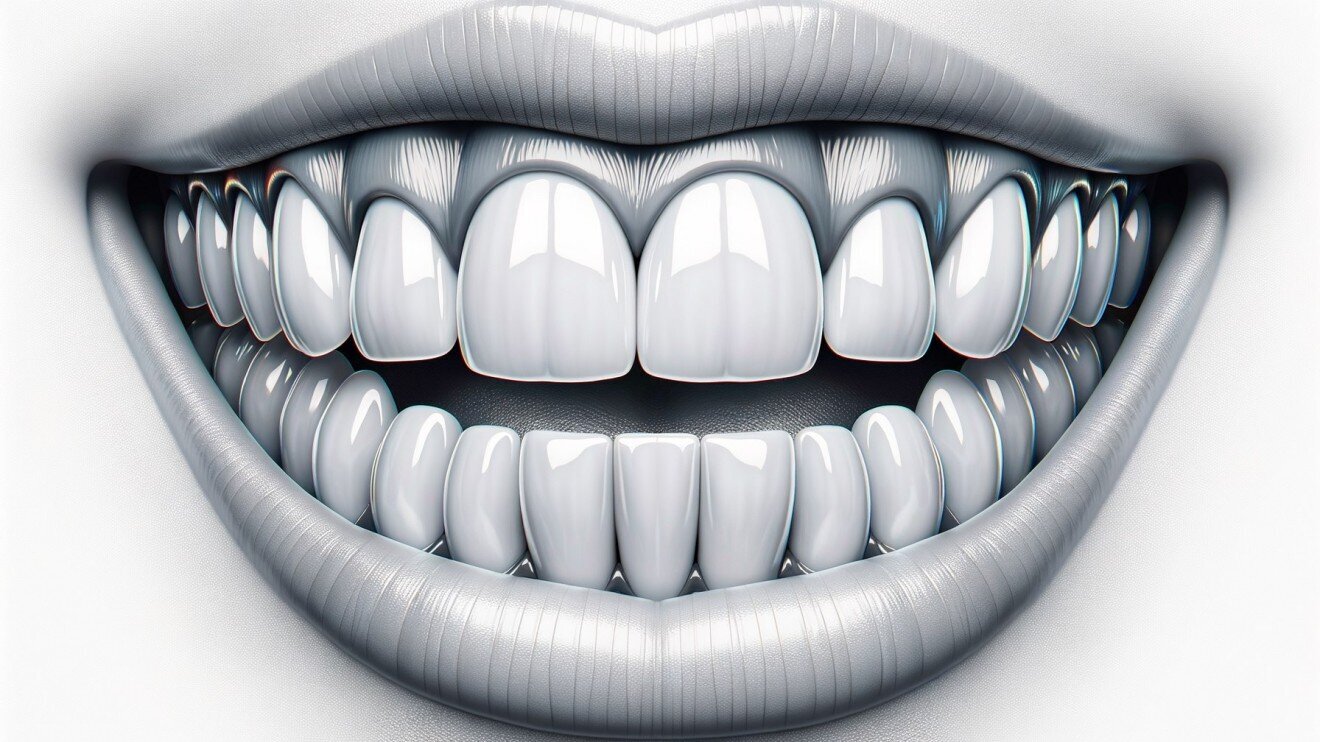
The English word "grin" denotes a wide smile, often showing the teeth, which can express genuine joy as well as slyness, self-satisfaction, or even malicious glee. Unlike an ordinary smile, a grin is more expressive and often carries an undertone.
Etymology and origin
The word "grin" has an ancient origin, tracing back deep into the Germanic languages. It comes from the Old English "grennian," meaning "to bare the teeth," "to grimace." This word, in turn, traces to the Proto-Germanic root *grinjanan.
Interestingly, the word originally carried more negative connotations than it does today. In Old English, "grennian" was often used to describe an animal baring its teeth, especially in a moment of aggression or pain. Only over time did its meaning soften, taking on a more neutral, or even positive, shade.
Related words exist in other Germanic languages: German "grinsen" (to smirk), Dutch "grijnzen" (to grimace), pointing to a shared descent from a single Proto-Germanic root.
How its meaning evolved
In medieval literature, "grin" was often associated with demonic creatures, skulls, and symbols of death. The famous phrase "grin like a death's head" reflects this grim tradition of using the word.
Gradually, however, the word's meaning broadened. By the 16th and 17th centuries, "grin" came to describe not just sinister expressions, but simple, wide, open smiles. Expressions like "grin from ear to ear" appeared, no longer carrying a negative undertone.
An important shift came in the 18th century, when "grin" began to be associated with simplicity and naivety. The expression "grin and bear it" reflects the idea of a forced but resilient smile in the face of hardship.
Literary examples and cultural references
One of the most famous literary images associated with "grin" is the Cheshire Cat from Lewis Carroll's "Alice's Adventures in Wonderland" (1865). His mysterious grin, which remains even after the rest of the cat has vanished, became a symbol of mystery and irony. Carroll used precisely the word "grin" to describe this famous smile.
In 19th-century American literature, "grin" was often used to characterize simple but good-natured characters. Mark Twain repeatedly used the word to describe his characters' smiles, especially in "The Adventures of Huckleberry Finn" and "The Adventures of Tom Sawyer."
Shakespeare used the word "grin" in several of his plays, often in the context of death or danger. In "Hamlet," the image of a grinning skull appears; in "Macbeth," the witches "grin" menacingly.
Psychological and social aspects
From a psychological standpoint, a "grin" is a distinct type of facial expression, set apart from an ordinary smile by several key characteristics. First, a grin is usually wider, showing more teeth. Second, it is often not accompanied by the characteristic "crow's feet" around the eyes, which can signal insincerity or a hidden subtext.
Research in social psychology shows that people intuitively distinguish sincere smiles from insincere ones. A "grin" is often perceived as less sincere than an ordinary smile, which may explain its historical associations with slyness and cunning.
Attitudes toward wide smiles vary across cultures. In American culture, a "big grin" is often received positively, associated with openness and friendliness. In some Asian cultures, by contrast, too wide a smile can be read as a sign of insincerity, or even aggression.
Modern usage
In modern English, "grin" has a fairly broad range of meanings and uses. As a noun, it can denote:
- A wide smile: "She gave him a big grin"
- A self-satisfied smirk: "He had a smug grin on his face"
- A forced smile: "She managed a weak grin despite the pain"
As a verb, "to grin" means to smile in precisely this way. Many idiomatic expressions use this word:
- "Grin and bear it" — to endure without showing it
- "Grin from ear to ear" — to smile broadly
- "Wipe that grin off your face" — stop smirking
- "Shit-eating grin" (vulgar) — a self-satisfied smirk
In film and popular culture
20th-century Hollywood did much to shape the modern understanding of the "Hollywood smile," or "Hollywood grin." Silent-film stars like Mary Pickford and Charlie Chaplin used exaggerated facial expressions, including broad grins, to convey emotion without words.
In the era of sound film, actors like Cary Grant, Clark Gable, and later Tom Cruise, became famous for their dazzling smiles. The term "million-dollar smile," or "megawatt smile," is often used in the context of exactly this kind of "Hollywood grin."
Interestingly, in 1950s–60s American culture, a wide grin became a symbol of success and the American dream. Advertising campaigns of the era often used images of broadly grinning people to promote goods and services.
Regional variation and dialects
In different varieties of English, "grin" can carry somewhat different connotations. In British English, it more often keeps a shade of slyness or self-satisfaction. American English tends toward a more neutral or positive reading of the word.
In Australian slang, there is the expression "grin like a shot fox," describing an inappropriately wide smile in an unsuitable situation. Irish English uses "grin like a Cheshire cat," in the same sense as the British expression.
Interesting regional variants exist in American dialects too. In the American South, "grin" is often paired with "possum," creating the expression "grin like a possum eating persimmons."
Scientific research on smiling
Modern emotion science distinguishes several types of smiles. Paul Ekman, the well-known psychologist, identified the genuine smile (the "Duchenne smile") and various types of insincere smiles. A "grin" often falls into the category of insincere or social smiles.
Neurobiological research shows that a "grin" activates somewhat different regions of the brain than a genuine smile. This may explain why people intuitively sense the difference between these types of emotional expression.
Research in evolutionary psychology suggests that baring the teeth (characteristic of a "grin") may have served various functions over the course of human evolution — from threat display to appeasement.
Translation challenges
Translating the word "grin" into other languages presents certain difficulties, since not every language has a precise equivalent of this concept. In Russian, the closest translations are "ukhmylka" (a smirk), "ukhmylyat'sya" (to smirk), and "skalit'sya" (to bare one's teeth), though each of these carries its own particular shade of meaning.
"Ukhmylka" often carries a more negative undertone than the English "grin." "Skalit'sya" can sound too aggressive. Translators, as a result, often resort to descriptive phrases: "to smile broadly," "to grin ear to ear," "to beam with a smile."
In French, the closest equivalent is "ricaner" or "sourire largement." In German, "grinsen," which is etymologically related to the English word. In Spanish, "sonreír ampliamente," or "mostrar una gran sonrisa," is used.
The context of 1990s Russia
In the context of early-1990s Russia, when the novel is set, the use of the borrowed English word "grin" (transliterated into Russian) is especially interesting. This was a period of intense penetration by Western, and above all American, culture into Russian society. Hollywood films, American music, and the American lifestyle became objects of imitation for many Russians.
The "Hollywood grin," on the lips of the character Zhora, reflects an attempt to imitate a Western, American manner of behavior. This was characteristic of the era, when many people tried to copy the outward trappings of Western culture, often without understanding their deeper meaning or context.
Using the English loanword "grin" instead of a Russian equivalent may also reflect the character's drive toward modernization, toward keeping pace with the new era. At the same time, the deliberateness of this gesture (especially combined with a mangled pronunciation) creates a comic effect, exposing how unnatural such behavior really was.
Conclusion
The word "grin" is a fascinating example of how a single lexical item can evolve over centuries while preserving its core semantic structure. From the Old English "baring of teeth" to today's multifaceted concept, spanning the whole range from genuine joy to sly smirk, this word reflects the complexity of human emotion and its expression.
In the novel's literary context, "grin" becomes a powerful tool for characterization and atmosphere. Its use in a novel about 1990s Russia adds further layers of meaning, tied to the cultural transformations of the era.
Understanding every nuance of this word helps the reader see more deeply into the characters' psychology, and better grasp the work's cultural context. Zhora's "Hollywood grin" is not merely a smile — it is an entire cultural gesture, reflecting the spirit of an age of change.
A note for readers
In the novel's text, the transliterated form "grin" is used as a borrowing from English, conveying a particular type of wide, showy smile characteristic of Hollywood actors. It underscores the character's attempt to imitate a Western manner in early-1990s Russia.