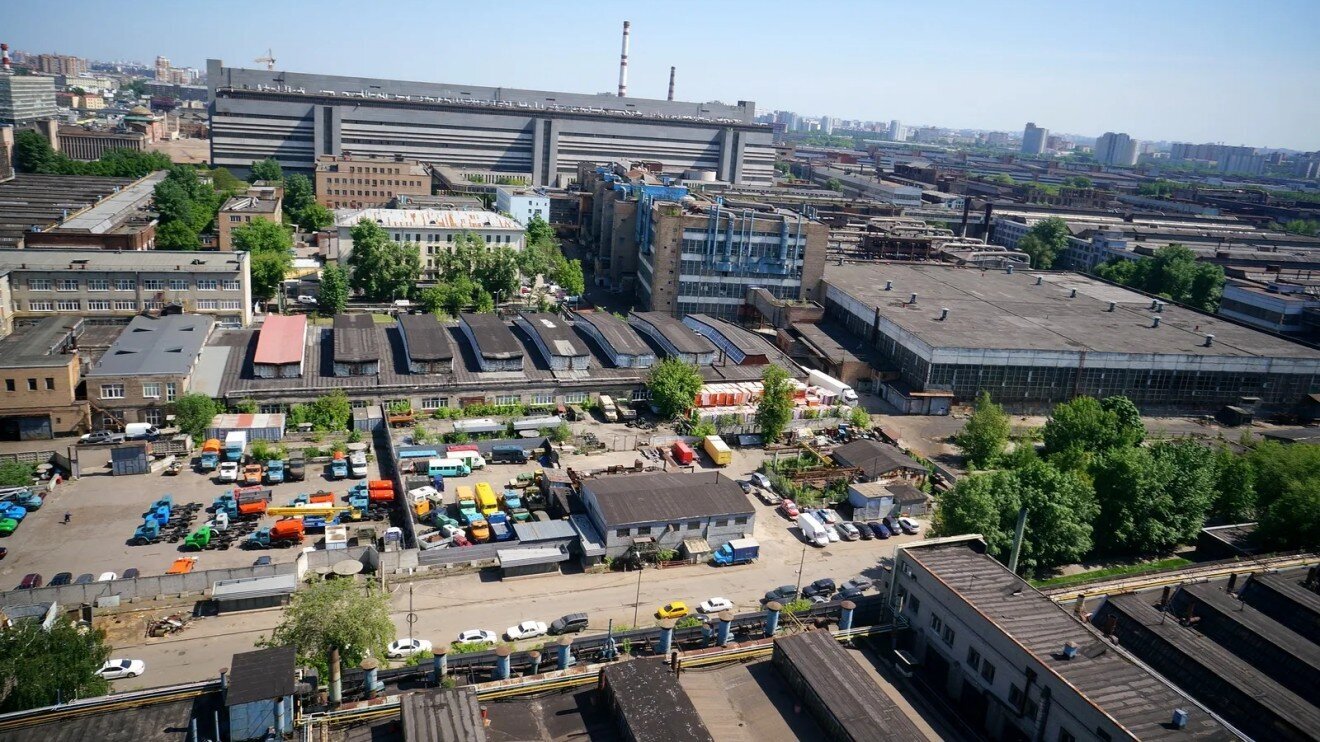
The history of the Likhachev Automobile Plant (ZiL) is the story of a remote Moscow outskirt turning into the center of the capital, of an industrial zone becoming a city district, and of a factory settlement becoming a modern neighborhood.
Founded on a Remote Outskirt
In 1916, when the Ryabushinsky brothers chose a site for the first Russian automobile plant, the Tyufeleva Roshcha area in southern Moscow really was a remote outskirt — empty land beyond the city limits, where a major industrial operation could be built without worrying about residential development or urban infrastructure.
The construction contract was signed February 27, 1916, between the Main Military-Technical Directorate and the «Kuznetsov, Ryabushinsky and Co. Trading House.» The plan called for licensed production of the 1.5-ton FIAT 15 Ter truck, with the plant required to reach at least 10 percent readiness against a total order of 1,500 vehicles by the deadline.
Construction was overseen by the accomplished specialists A.V. Kuznetsov and A.F. Loleit, with facades for some buildings designed by the architect K.S. Melnikov. Even then, the foundations were being laid for the industrial landscape that would define this part of Moscow for decades to come.
Industrial Development, «However the Shop Foreman Ordered It»
Because the plant was built on empty land, far from the existing fabric of the city, no one gave any thought to how the territory might one day fit into the urban environment. Industrial buildings, administrative offices, and auxiliary structures were all built purely to serve production needs and manufacturing processes.
In the Soviet period, this tendency only intensified. The plant expanded and was rebuilt in line with production plans, with no regard for urban-planning principles. Over the years, the site included:
- An auto-assembly building
- A press-and-welding shop
- A paint shop
- A cold sheet-metal stamping shop
- A home-refrigerator factory
- Its own power station
- Numerous auxiliary facilities
By the late 1980s, ZiL was producing 195,000-210,000 trucks a year, requiring enormous production space. The plant's total territory covered about 300 hectares.
Factory Infrastructure and Daily Life
As a city-forming enterprise, the plant developed the corresponding infrastructure around it. For workers, the following were built:
- Company housing on Bakinskaya Street
- A factory hospital (today City Clinical Hospital No. 12)
- Cultural and sports facilities
- Kindergartens and schools
This infrastructure, too, was built by the principle of «whatever the plant needed,» with no regard for citywide planning. The result was a kind of «city within a city» — a self-contained factory world with its own logic of spatial organization.
From Outskirt to City Center
Over the course of the twentieth century, Moscow grew rapidly, and territory that had been a remote outskirt in 1916 found itself in the middle of the city. By the 1990s, the ZiL plant sat in a relatively central part of the capital, surrounded by residential districts and urban infrastructure.
Even so, the industrial zone kept its separateness. Factory buildings, built at different times to different designs, formed a strange mosaic of industrial architecture. Narrow lanes between shops, technological walkways, temporary structures — all of it formed a maze legible only to those who worked there.
By the early 1990s, the contrast between the ZiL industrial zone and the surrounding city had become especially stark. As Moscow modernized, the factory grounds remained an island of Soviet industrial aesthetics, with its utilitarian approach to organizing space.
Crisis and the Decline of Production
The 1990s marked a turning point for the plant. Where ZiL had once been the flagship of Soviet truck manufacturing, under the new economic conditions the enterprise faced serious difficulties. Output collapsed catastrophically, falling from 195,000-210,000 trucks a year in the 1980s to just 7,200 in 1996.
The vast factory grounds gradually began to empty out. Many buildings stood idle, equipment grew obsolete, and infrastructure deteriorated. An industrial zone that had once epitomized Soviet manufacturing might turned into «industrial ruins» in the heart of Moscow.
Architectural Legacy
Despite its utilitarian approach to planning, the ZiL territory retained several architectural landmarks. The factory administration building, constructed 1916-1920 to a design by Konstantin Melnikov, became a recognized architectural monument of the early twentieth century. The facades of some 1920s-30s buildings were designed by the workshop of the Vesnin brothers.
These buildings represented examples of the industrial architecture of their time — functional, spare, yet possessing a certain aesthetic value.
Final Closure
In 2013, production at the plant was finally halted. The last ZiL-brand trucks (six units) were produced in 2016 — the 100th anniversary of the founding of the AMO enterprise.
In 2020, ZiL as an automobile manufacturer was fully liquidated, and the territory handed over for development. The company was re-registered with a new primary business activity: «real estate management.»
Modern Redevelopment of the Site
Since the early 2010s, a wholesale reorganization of the former ZiL grounds has been underway. In place of an industrial zone laid out «however the shop foreman ordered it,» a modern city district with carefully planned infrastructure is being built.
The new project calls for:
- Residential blocks for 30,000 people
- A pedestrian boulevard over 1.2 km long
- A 14.5-hectare park
- A Moscow branch of the Hermitage Museum
- 4 metro stations with two major transit hubs
- A developed transport network
- A landscaped Moskva River embankment
Under a design by the architectural firm Meganom, which brought in leading Russian and international architects, the site is being transformed into a modern, upscale «art» district combining housing, cultural venues, and public spaces.
14 New Streets
Fittingly, 14 new streets on the former ZiL grounds have been named after Russian avant-garde artists and constructivist architects — a tribute to the era when the industrial enterprise that defined this part of Moscow for a century was itself being built.
From Industrial Zone to the «Zilart» District
Most of the production buildings were demolished in 2015. In 2022, ZiL's last remaining shop — the press-and-welding building — was torn down. In the fall of 2024, demolition began on the ZiL power plant.
On the site of what was once a mighty industrial enterprise, the «Zilart» district is taking shape — a modern urban neighborhood with developed infrastructure, green spaces, and cultural facilities. It marks a fundamental shift in the character of the territory, from a utilitarian industrial zone to a comfortable urban environment.
Historical Memory
To preserve the memory of the plant, several museum spaces have been created:
- A hockey museum in the former factory administration building (opened 2016)
- The exhibition «ZiL Plant: 100 Years of a Legend» on Sokolnichesky Val (2016-2024)
- Plans for a permanent exhibition dedicated to the plant's history
The famous «ZIL» stele has also been preserved, standing as a symbol of continuity between the territory's industrial past and its new identity.
Conclusion
The history of the ZiL territory is the story of a remote Moscow outskirt becoming the city's center, and then a modern urban district. The path from industrial development laid out «however the shop foreman ordered it» to a thoughtfully planned urban project reflects the evolution of approaches to organizing city space.
What was once built purely to serve production needs, with no regard for its urban context, is today becoming a model example of modern city planning. A territory that for a century was «industrial wilderness» is becoming one of Moscow's most attractive districts.
This transformation is emblematic of Moscow as a whole today — a city actively reimagining its industrial heritage, turning former factory grounds into comfortable urban spaces.