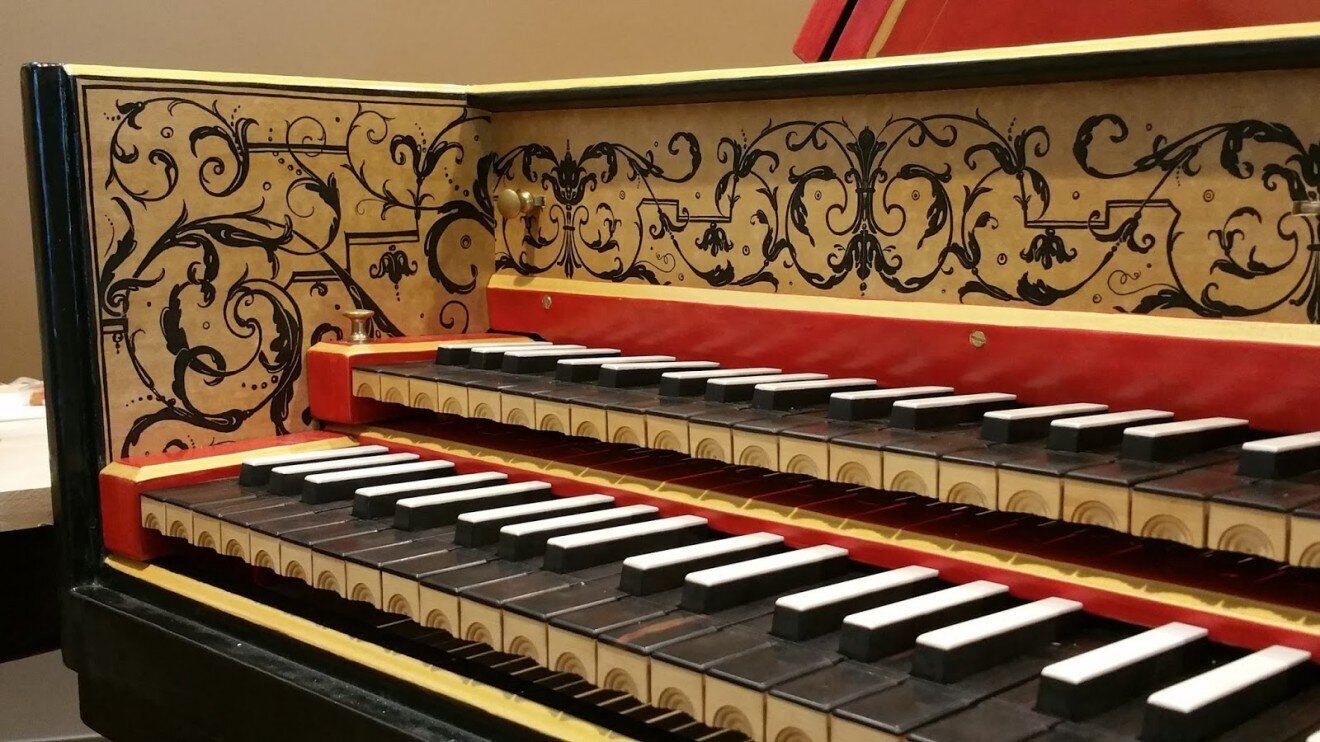
General Information
The harpsichord (French clavecin, Italian clavicembalo, German Cembalo) is a stringed keyboard instrument, one of the forerunners of the modern piano. Unlike the piano, where hammers strike the strings, the harpsichord’s strings are plucked by small plectra, or «quills.»
History
The harpsichord appeared in Western Europe in the late 15th or early 16th century, as a development of earlier stringed keyboard instruments. The earliest known mention dates to 1397 (in a letter from a notary in Padua), and the earliest surviving depiction to 1425 (on a German altarpiece).
The first known harpsichord makers were Italian; in the 16th century, the Ruckers family of Antwerp in particular founded an entire school of instrument-making. Later, production centers arose in France, England, and the German states.
Interesting Fact
Harpsichords were often richly decorated with painting, inlay, carving, and gilding, becoming not just musical instruments but genuine works of art.
The Golden Age
The harpsichord’s golden age fell within the Baroque period (1600-1750). During this time, it was the most important instrument in European musical life, serving both as a solo and an accompanying instrument.
Distinguished composers who wrote for harpsichord include:
- Johann Sebastian Bach
- George Frideric Handel
- Domenico Scarlatti
- François Couperin
- Jean-Philippe Rameau
The harpsichord was an integral part of the orchestra in operas, oratorios, and church music, where it played the basso continuo part. In aristocratic salons, the harpsichord was considered a prestigious instrument, and knowing how to play it was a mark of good breeding.
Decline
By the late 18th century, the harpsichord began giving way to a new instrument, the piano, which let a musician vary the volume of a note. By the early 19th century, the harpsichord had all but vanished from concert practice.
Revival
Interest in the harpsichord revived in the early 20th century, thanks to the historically informed performance movement. Wanda Landowska became the first well-known harpsichordist of the modern era to popularize the instrument.
The Character of Its Sound
Why Does a Harpsichord Sound Different From a Grand Piano?
| Feature | Harpsichord | Piano (Grand) |
|---|---|---|
| Sound production | Strings plucked by quills | Hammers striking the strings |
| Dynamics | Barely changes with key-press force | Directly depends on key-press force |
| Character of sound | Bright, crisp, metallic | Soft, singing, smoothly fading |
| Sustain | Short, fades quickly | Long, can be sustained with the pedal |
The main difference between a harpsichord and a piano lies in how the sound is produced. In a harpsichord, pressing a key plucks a string with a small quill, giving a distinctive metallic, ringing timbre. Since the plucking force doesn’t change with how hard the key is struck, a harpsichordist can’t play softer or louder simply by varying finger pressure.
To broaden their expressive range, harpsichords were often built with several registers (sets of strings of different thickness and length) and several manuals (keyboards), letting players vary the instrument’s timbre and volume.
«The harpsichord sings quite differently from the piano. It’s not worse, and not better — it’s a different instrument with its own voice and character, requiring its own understanding and its own technique.»
The Harpsichord Today
Today the harpsichord is widely used in early-music ensembles and Baroque repertoire. Modern makers build both historical replicas of period instruments and new models with improved characteristics.
Beyond performing early music, some contemporary composers write pieces specifically for harpsichord, putting its unique timbre to use in new musical contexts.