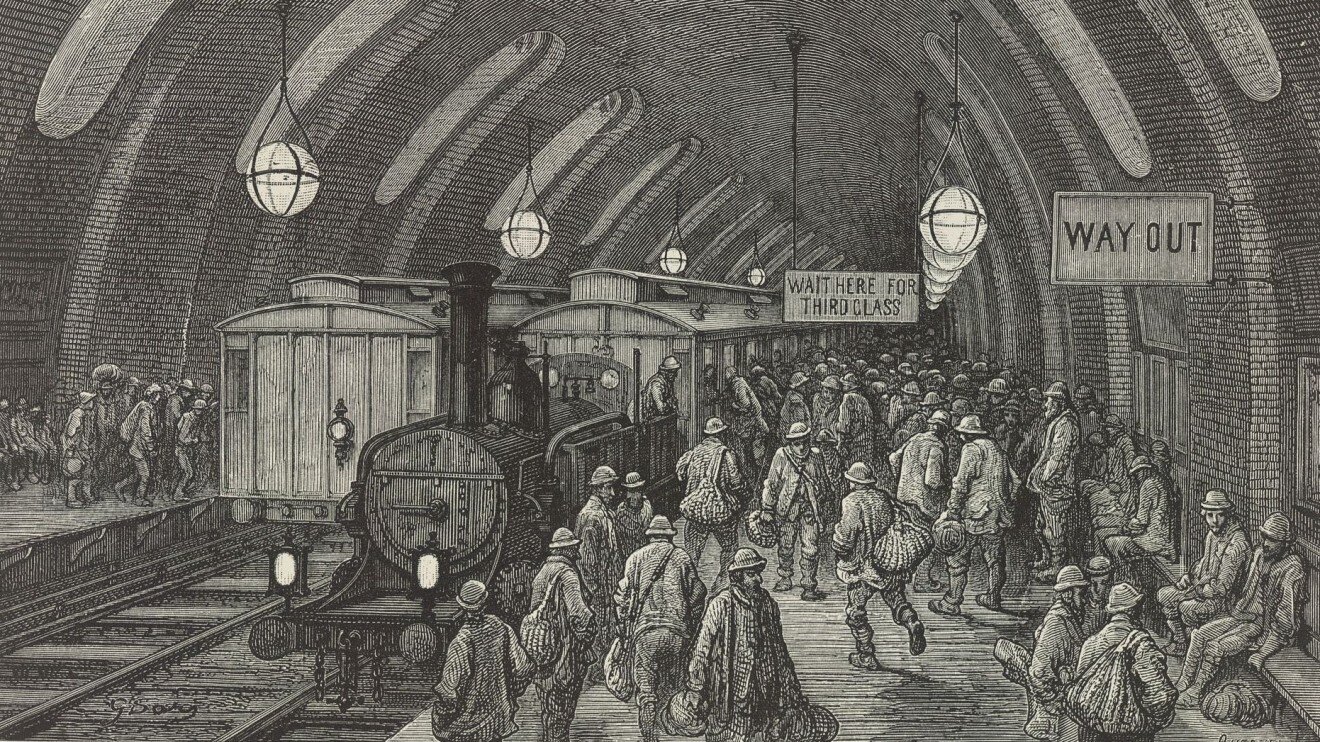
The birth of the underground railway
The history of the metro began long before the first trains entered underground tunnels. In 1813, the English engineer of French origin Marc Brunel invented the tunneling shield — a device that changed what was thought possible to build underground. Using this invention, the world's first tunnel under a body of water through soft ground was built between 1825 and 1843: the Thames Tunnel.
Curiously, Brunel's project was originally intended not for London at all, but for St. Petersburg. A tunnel under the Bolshaya Neva was planned, but the death of Emperor Alexander I in 1825 put an end to those plans. So Russia missed its chance to be a pioneer of underground construction.
The Thames Tunnel was an imposing structure — 11 meters wide and 6 meters high. At first it served as a pedestrian crossing, but in 1865 it was acquired by a railway association, and freight and passenger trains began running through it. From 1948 to 2007, this historic tunnel was part of the Underground; today, London Overground trains run through it.
London: the metro born out of transport chaos
A city choking on traffic
By the mid-19th century, London faced a problem that would look familiar to any resident of a modern megacity — transport collapse. The British capital's population had reached two million. The Industrial Revolution had given rise to a new phenomenon — commuting: residents of the suburbs traveled into the city center for work every day.
England's railway network developed rapidly, with trunk lines converging on London like spokes of a wheel. By 1854, six terminus stations had been built on the edge of the city center: London Bridge, Euston, Paddington, King's Cross, Bishopsgate, and Waterloo. But the authorities forbade extending the tracks closer to the center, fearing vibrations would damage historic buildings.
The result was predictable: monstrous congestion built up on the central streets. The only form of public transport was the omnibus, connecting Paddington to the City, but the bulk of transport was carried out by private cabmen. The streets were jammed with carriages, and traffic ground to a halt.
A solution underground
The first proposals for an underground railway appeared as early as the 1830s, but weren't seriously discussed until the first half of the 1850s. In 1855, an Act of Parliament approved the construction of an underground railway with a telling name — the "Metropolitan Railway."
The project nearly died from lack of funding. It was saved by Charles Pearson, solicitor to the City of London Corporation — one of the true founding fathers of the Underground, although he never formally sat on the construction leadership. Pearson saw the metro not just as a solution to a transport problem, but as a social project: he advocated demolishing insanitary slums and building new housing for residents of the outskirts, with fast transport to jobs in the center. In a tragic irony of fate, Pearson died in 1862, a year before the metro opened, never seeing his dream realized.
Work began in February 1860, under chief engineer John Fowler. Construction used the cut-and-cover method: a trench up to 10 meters deep was dug, rails laid on the bottom, brick arched vaults built over them, and the whole thing backfilled. The method was disruptive: street traffic stopped entirely during construction, and buildings and infrastructure were demolished.
January 10, 1863: the metro's birthday
The first line of the London Underground opened on January 10, 1863, becoming the world's first metro system. The first stretch had seven stations: Bishop's Road (now Paddington), Edgware Road, Baker Street, Portland Road (now Great Portland Street), Gower Street (now Euston Square), King's Cross, and Farringdon Street. The line's total length was just 6 kilometers.
Trains ran on steam power. Picture it: a steam locomotive in an underground tunnel! To keep the steam from accumulating, it was condensed and vented at the surface. In upscale neighborhoods, these ventilation outlets were disguised as fake houses, so as not to spoil the look of respectable streets. But ventilation was still insufficient, and the Underground would fill with smoke so badly that at times it became hard to breathe on the platforms.
Despite the discomfort, the Underground became enormously popular — it was the fastest form of transport in the city. On opening day, ridership reached 26,000 people. In its first year of operation, the metro carried 9.5 million passengers; in its second, already 12 million.
The network's rapid growth
The London Underground began growing immediately after opening. On June 30, 1864, the Hammersmith & City line opened, connecting Paddington to the western district of Hammersmith. The number of stations reached 13. In December 1865, the Metropolitan line was extended east to Moorgate. In the late 1860s, lines opened to Swiss Cottage, South Kensington, and Addison Road.
An interesting technical detail: until 1869, the London Underground had mixed dual-gauge track. This was because broad-gauge trains of the Great Western Railway company and the more common standard-gauge trains ran simultaneously. By March 1869, the broad-gauge trains had been withdrawn from service.
On December 24, 1868, the District line began operating, built by the Metropolitan District Railway company. It connected South Kensington and Westminster. In 1884, this branch was extended to Tower Hill and Whitechapel. This way, the Metropolitan and District lines together formed a loop.
By the late 1880s, the London Underground network was already fairly well developed. By the end of the 19th century, the Metropolitan line even extended beyond London — to Aylesbury, and stations at Brill and Verney Junction. This gave rise to new settlements around the stations, changing the very structure of settlement patterns.
Moscow: from dream to "underground palaces"
The long road to the first station
The first proposal to build a metro in Moscow appeared in 1875 — more than a decade after the London Underground opened. Engineer Vasily Titov proposed an underground railway line from Kursky Station through Lubyanka and Trubnaya squares to Maryina Roshcha. But the idea went no further.
Serious plans emerged in 1897, when, following Berlin's example, the board of the Ryazan-Ural Railway Society presented a project for a triple-track diametral line to carry passengers between the terminus stations. The line was to run through a tunnel across the city center.
In 1901, engineer A.I. Antonovich presented the first fully worked-out project for a Moscow metro. It called for a surface ring line within the city boundary, an underground diametral line from Trubnaya Square to Ilyinka, and five radial lines. Based on this project, the Moscow Circle Railway was built, but without the radial lines.
The Balinsky-Knorre project: the metro that never was
The best-known project was one from 1902, developed by engineers P.I. Balinsky and E.K. Knorre. They proposed building an "off-street railway" connecting Zamoskvorechye with Tverskaya Zastava. On August 7, 1902, the project was presented to the City Duma.
Heated discussions followed. Duma members doubted the project was well thought out. The tram lobby played a role too — the tram brought substantial profit to the city treasury. Some representatives of the church also opposed it. In the end, the Duma issued a harsh resolution: "To refuse Messrs. Knorre and Balinsky in their solicitations." The official reason given was economic impracticality.
Other projects were proposed before the First World War, but all remained on paper. During the Civil War, city transport fell into decline; in 1920, tram service effectively stopped. But by 1922, a new recovery had begun, and the question of a metro returned.
Negotiations with the Germans and Soviet planners
In August 1923, the presidium of the Moscow City Council decided to resume negotiations with foreign firms. In April 1924, talks began with the German firm Siemens Bauunion GmbH. A project was prepared — calling for 80.3 kilometers of track and 86 stations, including 17 interchange stations. But no investors could be found, and the project remained on paper.
In parallel, a metro-design subdepartment was created within the Tram Administration in September 1923. Initially it was one man — engineer K.S. Myshenkov. By October 1928, the subdepartment had grown to 27 staff members. By July 1930, the design work was complete — calling for four diametral lines and a circle line, totaling about 50 kilometers.
But then disaster struck. Starting in March 1930, a purge unfolded. The planners were accused of squandering public funds, deliberately slow work, and sabotage. A significant number were arrested. The subdepartment was shut down on January 1, 1931.
Transport catastrophe and the decision to build
On January 6, 1931, Moscow came to a complete transport standstill. The gridlock that day is considered the most catastrophic in the capital's history: neither trams, buses, cabs, nor taxis were running. The tram system couldn't handle the transport needs of a population that had grown to 4 million. The expression "tram boor" (kham tramvainy) dates from this period.
On February 9, 1931, at a meeting on tram-service problems, an unflattering picture emerged: the tracks and rolling stock were outdated, and a quarter of the tramcars had been taken out of service. Moscow's party leadership, headed by L.M. Kaganovich and Moscow City Council chairman N.A. Bulganin, concluded that reorganizing the tram system alone would not be enough to fix the situation.
On May 14, 1931, a Politburo commission, on Stalin's initiative, resolved to develop a metro project. At the June plenum of the Central Committee, Kaganovich gave a three-hour speech, speaking now as a convinced supporter of building a Moscow metro. The plenum resolved to "proceed without delay with preparatory work for constructing a metro in Moscow."
The start of construction and technical disputes
On August 5, 1931, P.P. Rotert, who had overseen construction of the Dnieper Hydroelectric Station, was appointed head of construction. The organization "Metrostroy" was created under the Moscow City Council. That fall, after the leadership intervened, the arrested planners K.S. Myshenkov and S.N. Rozanov were released.
On December 10, 1931, in the courtyard of building No. 13a on Rusakovskaya Street, near Sokolniki, the spades of seven workers first bit into the ground. This was the first Metrostroy shaft — the beginning of construction of the Moscow metro.
In January 1932, work began at every site. It was assumed the metro would be mostly above ground, running underground only in the center, at shallow depth. Work went slowly due to a shortage of specialists. Of all the engineers, only S.N. Rozanov had experience building the Paris metro.
In February 1932, 27-year-old engineer V.L. Makovsky concluded that shallow open-cut tunneling was not feasible. Having studied material on the London and New York metros, he chose deep-level tunnels — 20 to 35 meters down. Every engineer opposed this, but the party leadership liked the idea.
On May 23, 1932, Stalin spoke out in favor of the deep-tunneling project. This effectively halted construction for 9-10 months. By the start of 1933, only 0.6% of the first line's total length had been dug. Foreign specialists had to be brought in, and engineers sent abroad for training.
For deep tunneling, E.T. Abakumov and a team of experienced mining engineers were dispatched from the Donbass. Tunneling shields with pressurized caissons began to be used. By the summer of 1933, the required depth had been reached, and tunnel construction began.
Mass mobilization and the opening
Labor productivity was low, and deadlines slipped. Kaganovich practically lived at the construction site day and night — workers privately called him "the first foreman." On December 29, 1933, a plenum of the Moscow City Council decided: every Moscow enterprise was assigned its own section of the line. Workers from factories and plants were sent to obligatory "subbotnik" work sessions.
Different construction methods were used for different sections. From Sokolniki to Komsomolskaya, and from the Lenin Library to Park Kultury, cut-and-cover construction was used. On the deep section, from Okhotny Ryad to Dzerzhinsky Square, tunneling shields were used. Where quicksand was encountered, caisson methods, ground freezing, and chemical silicatization were applied.
The first-stage stations used 21,000 square meters of marble, mined in quarries in Crimea, the Caucasus, Karelia, and the Urals. The Moscow Metro was conceived not merely as transport, but as "underground palaces" for the working people.
The opening was planned for November 7, 1934, but was delayed because of the escalators. This device had first appeared in the London Underground only in 1911, and only two firms in the world made them. Mosmetrostroy bought one escalator for 200,000 gold rubles, in order to take it apart and copy it. Soviet-made escalators appeared in January 1935.
The Moscow Metro opened on May 15, 1935 — 72 years after the London Underground. The opening stretch included 11.6 kilometers of track and 13 stations. The first section ran from Sokolniki to Park Kultury, with a branch to Smolenskaya.
Building the first stage was an achievement of Soviet industry as a whole. Orders were fulfilled by 540 factories across the Union. It took 88,000 tons of metal, about 600,000 cubic meters of timber, and 330,000 tons of cement.
Two philosophies: private competition versus state monopoly
The London model: a station on every corner
The London Underground was built amid capitalist competition. Different companies — the Metropolitan Railway, the Metropolitan District Railway, the Great Western Railway — built and operated their own lines. Each sought to capture the maximum passenger flow.
This gave rise to the concept of closely spaced stations. In London, stations were built roughly every 500 meters. The logic was simple: a passenger should be able to walk from the station to home in five minutes, without turning to competitors — the tram, bus, and omnibus companies, which independently split up the transport market.
Closely spaced stations offered advantages:
- Convenience for passengers — minimal walking time
- Coverage of maximum territory
- A competitive edge over surface transport
- Tying passengers to a specific metro line
But there were downsides too: higher construction costs, lower average travel speed due to frequent stops, and greater complexity in organizing service.
The Moscow model: transport hubs and surface routes
The Soviet state built its metro under completely different conditions. There was no competition between operators — the entire transport system was unified. There was no market battle for passengers. But there were strict budget constraints.
The young Soviet state simply couldn't afford to build stations every 500 meters, as in London. Money was tight. But Moscow, unlike London, had a developed tram network. In the 1930s, the tram remained the primary form of public transport — accounting for 70% of all trips.
This gave rise to the Soviet concept: place metro stations at intersections of tram routes, at transport hubs. A metro station became an interchange hub, from which a tram, trolleybus, or bus would carry citizens the rest of the way home. The metro was responsible for trunk transport across the whole city; surface transport handled "door to door" delivery.
This concept had its own logic:
- Significant savings on construction costs
- Higher average travel speed thanks to long stretches between stations
- Integration with surface transport
- Creating a transport system where different modes complemented rather than competed with each other
There was one drawback, but a serious one: passengers had to make transfers. From home to the metro station by tram, then the metro, then surface transport again. This increased total travel time.
The long stretches of the Moscow Metro
The result of the Soviet concept was the long stretches between stations characteristic of the Moscow Metro. In the 1930s, sections were built with the following distances:
- Paveletskaya – Avtozavodskaya: 2,919 meters (an absolute record from 1943 to 1966)
- Avtozavodskaya – Kolomenskaya: 3,354 meters (a record from 1969 to 2015, later split in two by an intermediate station)
- Kolomenskaya – Kashirskaya: 2,817 meters
For comparison: in London, the average stretch was about 500-700 meters. In Moscow, three long stretches ran consecutively: Paveletskaya – Avtozavodskaya – Kolomenskaya – Kashirskaya. A trip along this section took considerable time, but in exchange, the metro carried passengers over great distances faster than any surface transport could.
Even longer stretches appeared in Moscow later:
- Volgogradsky Prospekt – Tekstilshchiki: 3,413 meters (an absolute record from 1966 to 1986)
- Tushinskaya – Shchukinskaya: 3,349 meters (1975-2014)
- Sportivnaya – Universitet, via the temporarily closed, damaged Leninskiye Gory station: 4,478 meters (a temporary record from 1986 to 2002)
Architecture: function versus ideology
London: simplicity and practicality
The first stations of the London Underground were functional structures with no architectural flourishes. Brick arched vaults, minimal decoration, an emphasis on practicality. This was transport built by private companies for profit, not for propaganda.
Steam power created serious ventilation problems. The Underground would fill with smoke, and breathing became difficult on the platforms. But Londoners put up with it for the sake of faster travel. Only much later did the Underground begin to be electrified.
Moscow: "underground palaces" for the people
The Moscow Metro was conceived quite differently. It was an ideological project, meant to showcase the greatness of the Soviet system. The stations were to become "underground palaces" for millions of working people, instilling confidence in a "bright future."
The first-stage stations used 21,000 square meters of marble and granite, mined in quarries in Crimea, the Caucasus, Karelia, and the Urals. This was luxury in a country where many still lived in barracks and communal apartments. But that was precisely the point: the palace belonged to the people, and every Soviet citizen could enter it with a ticket costing a few kopecks.
The station "Mayakovskaya," opened in 1938 (architect A.N. Dushkin, artist A.A. Deineka), became the pinnacle of this concept. Oval niches with light fixtures, and mosaic panels on the theme "A Day in the Land of the Soviets," created the feel of a grand hall. In 1939, the design won the Grand Prix at the New York World's Fair. Foreign visitors called the Moscow Metro "the most beautiful and comfortable in the world."
Other prewar stations — "Ploshchad Revolyutsii," with its bronze sculptures, "Kropotkinskaya," with its marble columns — continued this line. The architectural design was among the most brilliant and modern of its time.
The systems' development in the prewar years
London by the end of the 19th century
By the late 1880s, the London Underground network was already extensive. The Metropolitan line reached Chesham; the District line reached Hounslow, Wimbledon, and Whitechapel. The eastern line reached New Cross.
By the end of the 19th century, the Underground had extended beyond London itself. Lines reached Aylesbury, and stations at Brill and Verney Junction. This changed settlement patterns — new towns arose around the stations. The Underground became not just transport, but a factor in urbanization.
Moscow before the war
Construction of the Moscow Metro continued after the first stage opened. Between 1935 and 1938, work proceeded on the sections of the second stage. On March 20, 1937, the "Smolenskaya" – "Kievskaya" section opened. Metro trains crossed the Moskva River via the Smolensky metro bridge — the first metro bridge in the USSR.
On March 13, 1938, the section from "Ulitsa Kominterna" to "Kurskaya" opened. Combining it with the previously built section created the new Arbatsko-Pokrovskaya line. The section "Sokolniki" – "Park Kultury" formed the Kirovsko-Frunzenskaya line. Trains on the two lines began running separately.
On September 11, 1938, a third line opened — the Gorkovsko-Zamoskvoretskaya, from "Sokol" to "Ploshchad Sverdlova" (now "Teatralnaya").
By the start of the war, the Moscow Metro had three lines. This didn't bring about a fundamental improvement in the transport situation. In 1940, the metro carried only 14% of passengers; buses and trolleybuses, 8% each. The tram remained the leading mode of transport — 70% of all trips.
The results: two models, two fates
The London and Moscow metro systems were born in different worlds, and embodied different philosophies.
The London Underground was built by private companies under competition. It was functional, practical, profit-oriented. Closely spaced stations gave passengers convenience and gave operators a competitive edge. Its architecture was modest — this was transport, not a monument.
The Moscow Metro was built by the state as an ideological and social project. It was monumental, luxurious, meant to showcase the greatness of the Soviet system. Sparsely placed stations were dictated by budget constraints and the concept of integration with surface transport. Long stretches between stations became a defining feature of the Moscow underground.
Both models had their advantages and drawbacks. The London model was more convenient for passengers — a short walk from home to the station. The Moscow model was more economical, and offered higher speeds on trunk routes.
But the main difference wasn't in the technical parameters — it was in their very essence. The London Underground was a business. The Moscow Metro was an idea.
The legacy: how this shapes the present
The concepts laid down when the first lines were built shaped the development of both systems for decades to come.
In London, a dense network of stations became the standard. Every expansion of the Underground followed the same logic: stations close together, maximum territorial coverage, convenient walking distance. This made the London Underground one of the most convenient systems in the world — and also one of the most expensive to build and operate.
In Moscow, the concept of long stretches and transport hubs persisted for a long time. Even in the postwar decades, new lines were built with an eye to integration with surface transport. Stretches remained long — 2-3 kilometers between stations was the norm, not the exception.
The Moscow Metro's stretch-length records were constantly being broken:
- From 1943 to 1966, the absolute record was 2,919 meters, between Paveletskaya and Avtozavodskaya
- From 1966 to 1986, the record was 3,413 meters, between Volgogradsky Prospekt and Tekstilshchiki
- From 1986 to 2002, a temporary record of 4,478 meters held on the Sportivnaya – Universitet section (running around the closed, damaged Leninskiye Gory station)
These long stretches created a distinctive feel to riding the Moscow Metro. The train runs a long time through the dark tunnel, and passengers have time to think, read, sink into their own thoughts. Three or four minutes between stations is a very different experience from one minute on the London Underground.
Trams, which had formed the basis of the Moscow Metro concept in the 1930s, gradually lost their significance. They were displaced by buses and trolleybuses, and later by marshrutka minibuses. But the metro's structure remained the same — stations at major transport hubs, long stretches between them.
Only at the end of the 20th century did Moscow begin building stations closer together. But by then, the concept of long stretches had already become part of the Moscow Metro's identity, its distinguishing feature, setting it apart from the metro systems of Western capitals.
Conclusion
The history of the London and Moscow metro systems is not simply a history of transport. It is a history of two different approaches to organizing urban space, two economic systems, two civilizational models.
The London Underground was born from the free market and competition. It was the result of entrepreneurial initiative, technical daring, and a desire to solve a specific problem — transport collapse in a growing city. Closely spaced stations, practical architecture, gradual network growth — all of this reflected the logic of a capitalist city.
The Moscow Metro was born from state will and ideological necessity. It was the result of centralized planning, mass mobilization of resources, and a drive to create a symbol of the new society. Long stretches, luxurious stations, integration with a unified transport system — all of this reflected the logic of socialist construction.
Nearly a century and a half has passed since the first line opened in London, and nearly a century since the first line opened in Moscow. Both systems have grown, modernized, changed. But at the core of each still lie the principles laid down when the first stations were built.
And when a passenger rides a long stretch of the Moscow Metro — from Paveletskaya to Avtozavodskaya, from Avtozavodskaya to Kolomenskaya, from Kolomenskaya to Kashirskaya — they are moving not simply through underground space. They are moving through history, through a concept, through an idea, embodied in stone and metal, of what a city should be and how people should live in it.