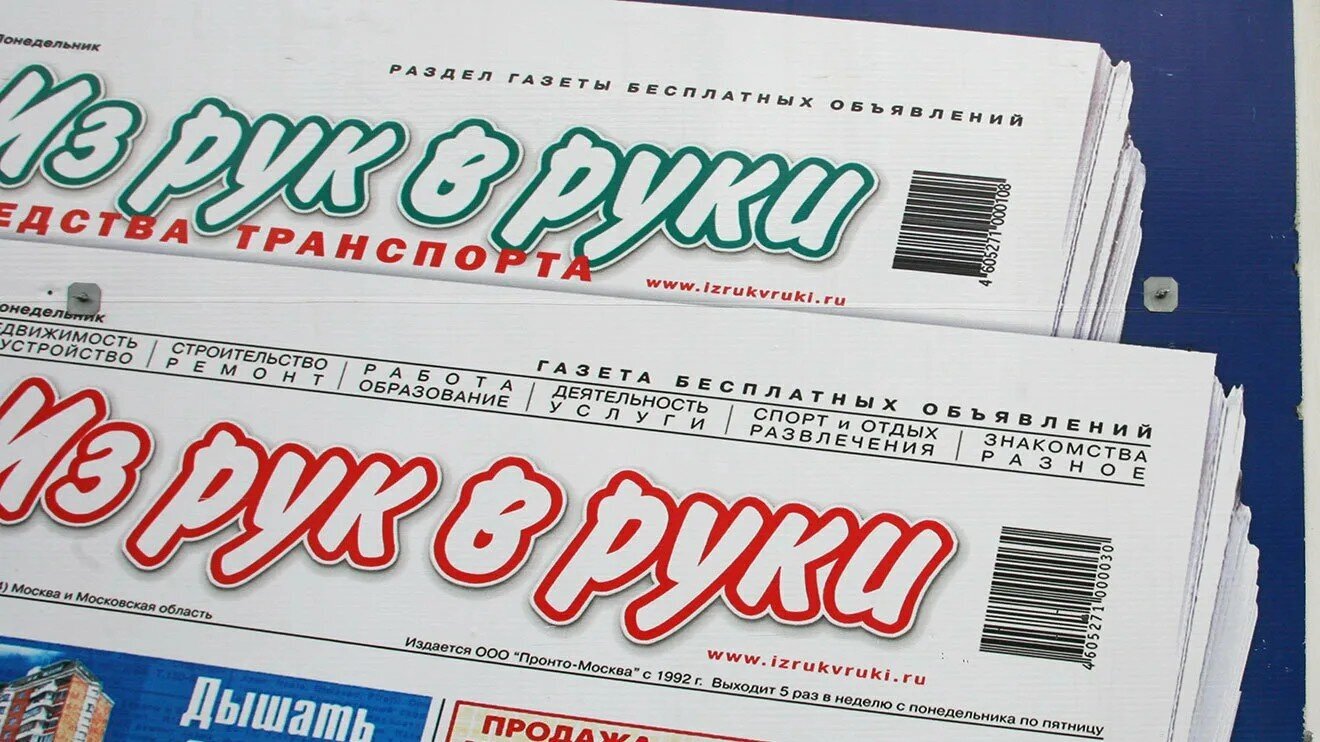
In the early 1990s, Russia saw the rapid growth of a market for printed classified-ad publications, which became an important part of the emerging market economy.
"Iz Ruk v Ruki" ("Hand to Hand")
The newspaper "Iz Ruk v Ruki" was founded in January 1992. Its first official issue came out on January 28, 1992, though a pilot "zero" issue had appeared two weeks earlier, on January 14. An interesting fact: the ads for the first issue were literally gathered by editorial staff off of posts, fences, and garages around town.
As early as summer 1992, the paper's first regional branch opened in St. Petersburg, marking the start of its aggressive regional expansion. By 1993, "Iz Ruk v Ruki" had become one of the primary resources for buying and selling any kind of goods or services.
The paper quickly gained popularity for its convenient categorization of ads and broad reach. It became an indispensable tool for individuals and entrepreneurs looking to buy or sell anything — from cars and real estate to appliances and even pets.
"Vsyo dlya Vas" ("Everything for You")
The publishing house "Vsyo dlya Vas" began operating in 1991, slightly earlier than "Iz Ruk v Ruki." The paper quickly carved out a significant niche in the classified-ad market, especially in Moscow and the surrounding region.
In 1993, "Vsyo dlya Vas" circulated mainly in Moscow and Moscow Oblast. Its main distribution method was free delivery to mailboxes and placement on branded stands in shopping centers. It was also sold at Soyuzpechat kiosks and post offices.
The publication was split into several regional editions: "Southeast," "Northeast," "Western Moscow Oblast," and "North," letting advertisers target their audience more precisely.
The role of classified-ad papers in the 1990s business world
In 1993, when the novel is set, both papers were essential tools for growing a business. In the absence of the internet and modern means of communication, these print publications became the primary platform for:
- Finding and listing property for rent (both residential and commercial)
- Posting job openings and looking for work
- Selling cars and other equipment
- Advertising construction and repair services
- Buy-and-sell listings for any kind of goods
"Iz Ruk v Ruki" and "Vsyo dlya Vas" were, in a sense, the "analog marketplaces" of their time. Placing an ad in them was a relatively cheap and effective way to find clients or partners.
For entrepreneurs like the novel's Zhora, these papers were the ideal tool for quickly finding tenants for a space. Both papers had dedicated real-estate sections, carrying both private listings and offers from agencies.
The ad for a "gorgeous office with Euro-standard renovation, class B-minus, on Prospekt Mira, dirt cheap" was a typical marketing tactic of the era, meant to catch the eye of potential tenants amid Moscow's nascent business boom.