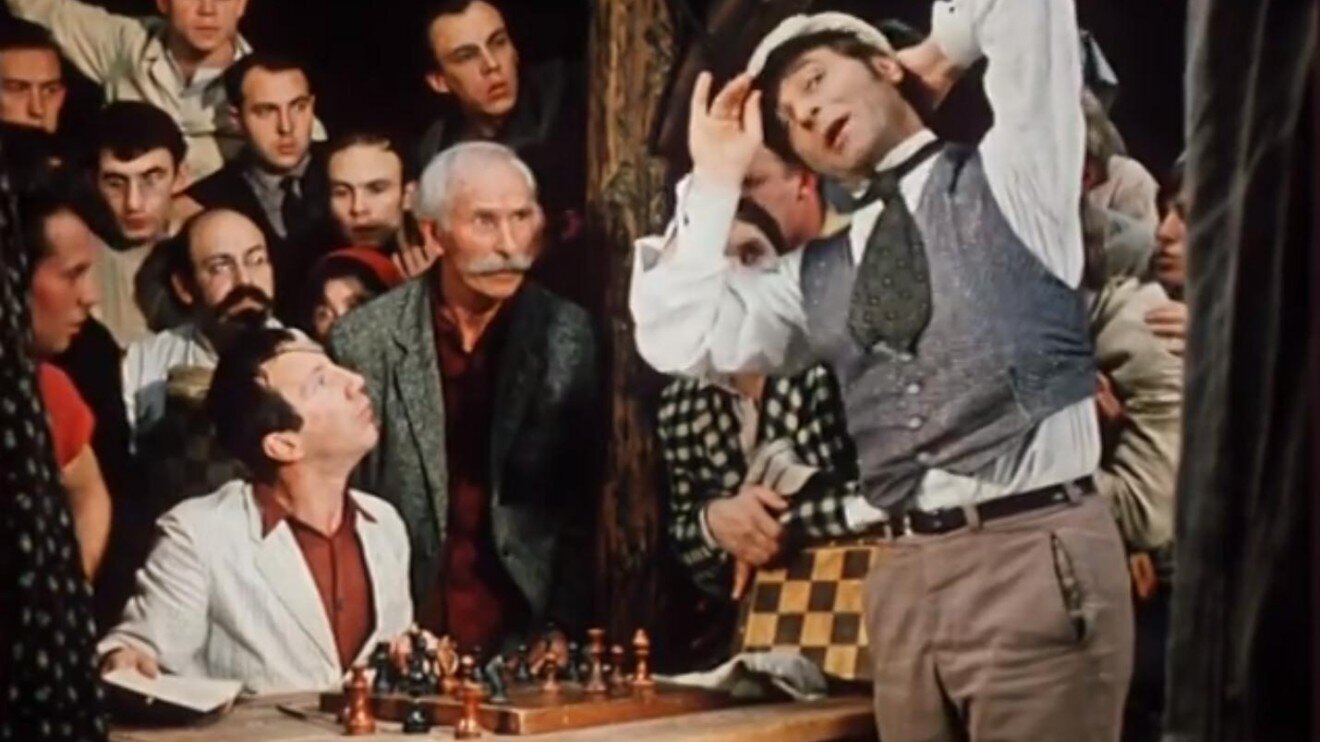
The phrase about the «first interplanetary mathematics symposium in the history of creation» is a direct allusion to a famous episode from Ilya Ilf and Yevgeny Petrov's novel «The Twelve Chairs» (1927), where the protagonist Ostap Bender gives a chess lecture in the provincial town of Vasyuki.
In chapter 35 of the novel, titled «The Interplanetary Chess Congress,» Ostap Bender, finding himself broke in Vasyuki, organizes a simultaneous chess exhibition, promising the local chess enthusiasts grandiose prospects. He convinces the townspeople that after hosting an international chess tournament, their town will become the world's new capital, renamed New Moscow, and eventually the center of interplanetary communication: «And who knows, maybe in eight years' time Vasyuki will host the first interplanetary chess congress in the history of creation!»
This scene is considered one of the most vivid in Soviet literature and became a cultural phenomenon, giving rise to the expression «the Vasyuki project» as a metaphor for grandiose but unrealistic plans. In the context of 1993 Russia, when the country was going through a period of economic reform and the birth of a market economy, such references to «Vasyuki projects» carried special irony — many business plans and government programs of the time were marked by excessive optimism and detachment from reality.
The chess tournament episode reflected the atmosphere of the chess boom that began in the USSR in the 1920s. Shortly before the book's release, the country had held an All-Union Chess Congress, and chess clubs and circles were springing up everywhere. The very idea of an interplanetary chess congress parodied the era's popular futurological fantasies about space travel and contact with other planets.
Cultural scholars note that the scene involving posting flyers and organizing the exhibition at the "Cardboard Worker" club has parallels with an episode in Mark Twain's "The Adventures of Huckleberry Finn," where the con-artist characters put up theater posters promising the public an "astonishing spectacle."
In "The Twelve Chairs," the chess exhibition ends in a scandal — Bender loses every game, and the enraged townspeople try to lynch the con man. The episode became a symbol of utopian projects collapsing on contact with reality — a lesson that remained just as relevant for 1990s Russia.
Using this literary allusion in a novel about 1993 Russia creates a layered irony, tying the characters' grandiose plans to the tradition of Ostap Bender's con schemes and underscoring the cyclical repetition of certain social phenomena throughout Russian history.