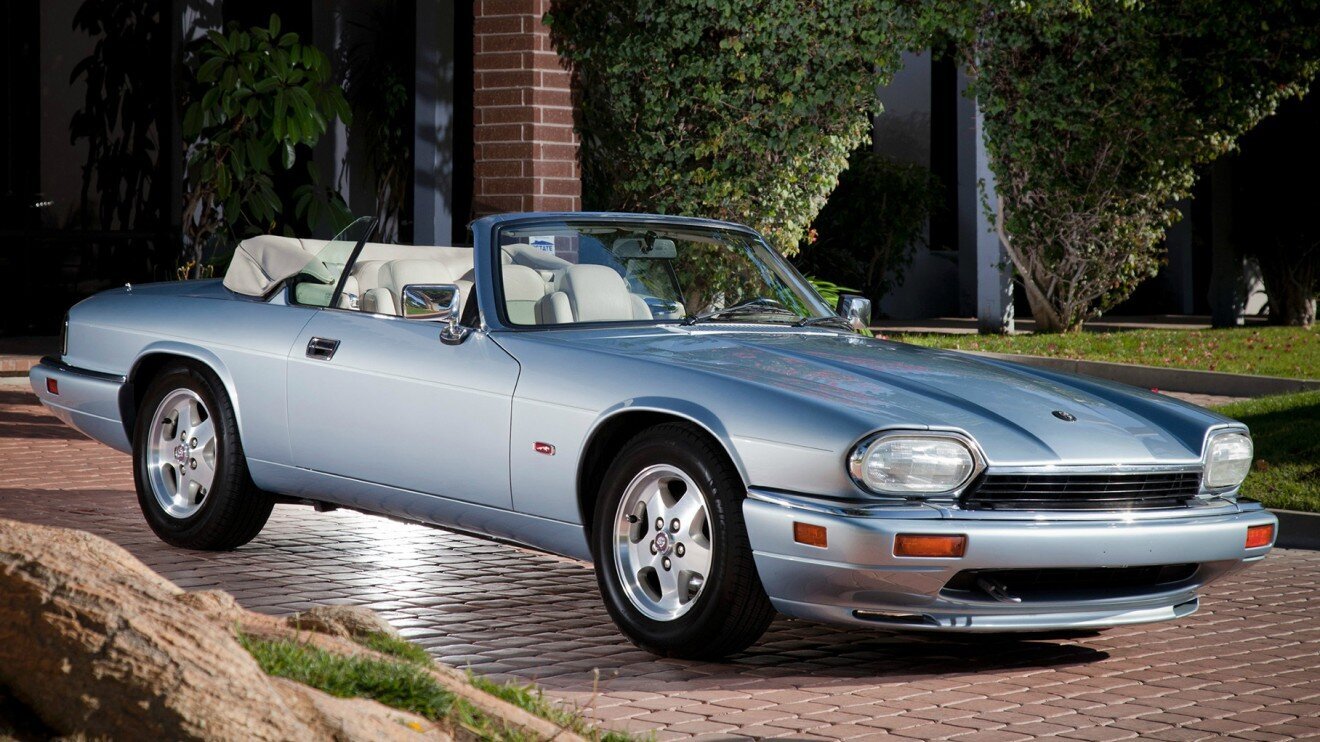
The Jaguar XJS was a luxury grand tourer from the British automaker Jaguar Cars, produced from 1975 to 1996. The car marked a radical departure from its predecessor, the sporty Jaguar E-Type, shifting from a sports car to an elegant touring vehicle built for long-distance travel.
Origins and Design
Development of the XJS began in the late 1960s under the project codename XJ27. Its initial styling came from legendary designer Malcolm Sayer, one of the first designers to apply aerodynamic principles to automotive design. After Sayer’s death in 1970, Jaguar’s in-house design team, led by Doug Thorpe, finished the work.
The car’s signature feature was its distinctive «flying buttresses» — the substantial pillars sweeping smoothly from the roof down to the rear of the body. Contrary to popular belief, these were never intended to accommodate a mid-engine layout — they were conceived purely as a styling element that also improved aerodynamics.
The XJS Convertible
The history of the XJS’s open-top versions was fairly convoluted. The first attempt was the XJ-SC (1983–1988) — not a true convertible but more of a targa, with a fixed center roll bar and removable roof panels over the passenger seats. The rear section of the roof was fabric and could be folded down.
Starting in 1986, the American company Hess & Eisenhardt of Ohio offered a conversion of the XJS coupe into a full convertible. This version featured a deeper-folding soft top, which required two separate fuel tanks and significant reinforcement of the body structure.
Finally, in 1988, Jaguar introduced its own factory-built full convertible XJS. This version had a heavier, softly lined top that didn’t fold as compactly as the Hess & Eisenhardt version, but preserved nearly all of the coupe’s original components.
Technical Specifications
At the heart of the XJS was the famous 5.3-liter V12 — a rarity among production cars of the time. Only Italian supercar makers Ferrari and Lamborghini were using engines like it. After a 1981 update, the engine was branded «HE» (High Efficiency) and produced 295 horsepower (220 kW) in European trim.
A 3.6-liter inline-six AJ6 engine was also offered, introduced in 1983. Between 1991 and 1996, the engine lineup expanded further, adding a 4.0-liter AJ6 variant and a powerful 6.0-liter V12 producing 304 horsepower.
Its Place in the Automotive Hierarchy
The XJS was positioned as a luxury grand tourer — a car for comfortable, high-speed, long-distance travel. Unlike purely sporting cars, it offered a high level of comfort, luxurious leather-and-wood interior trim, and relative practicality with 2+2 seating.
The XJS convertible became a symbol of success and prestige. It cost significantly more than most of its contemporaries and was accessible only to well-off buyers. In the mid-1990s, a new XJS convertible cost around $70,000–$80,000.
Production and Legacy
Over 21 years of production, 115,413 examples of the XJS were built across all variants. The model was discontinued in 1996 and replaced by the more modern XK8, which nonetheless used a modified version of the XJS platform through 2005.
The XJS was the last representative of classic British car-making — an elegant, powerful, unhurried grand tourer, built before the era of mass computerization and strict emissions standards.