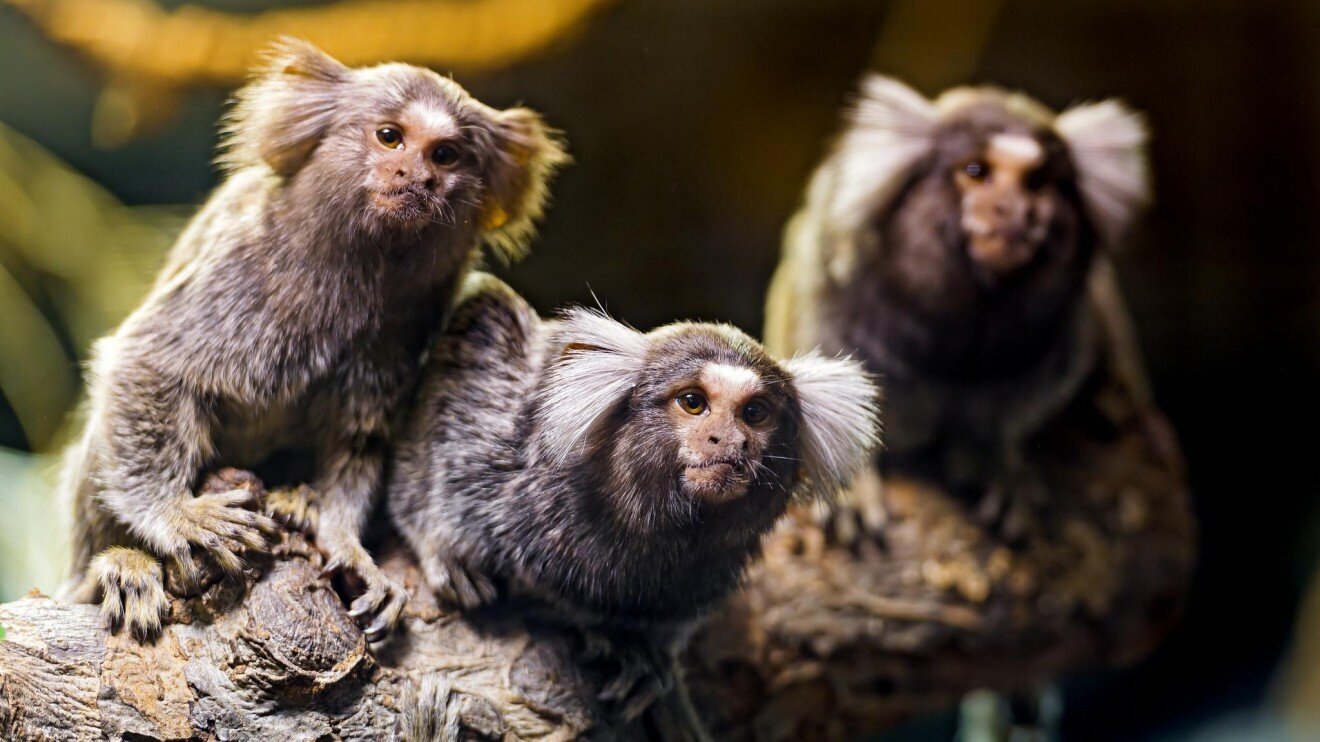
Marmosets (common marmosets, Latin Callithrix) are a genus of small primates of the family Callitrichidae, native to South America.
These tiny monkeys inhabit mainly the coastal forests of Brazil along the Atlantic Ocean, where they've adapted beautifully to life in the trees. Their body length is only 18-30 cm, and they weigh 300-450 grams. Their tail length can exceed their body length.
Distinctive traits of marmosets:
- Fluffy fur with characteristic ear tufts
- A long, non-prehensile tail (used for balance, not gripping)
- Specialized claws instead of nails on all digits except the big toes
- Specially adapted teeth for gnawing into tree bark
Marmosets feed mainly on tree sap and gum, which they extract by gouging the bark with their specialized teeth. This unique adaptation lets them survive even during periods when other food becomes scarce. Their diet is supplemented by fruit, insects, spiders, small vertebrates, and bird eggs.
An interesting feature is their social structure — marmosets live in groups of 2-15 individuals with a dominant female who suppresses reproduction in the other females. Unlike most primates, marmosets frequently give birth to twins or even triplets, and all members of the group, including the males, take part in raising the young.
Despite their small size, marmosets have well-developed intelligence and a complex communication system. They use a variety of high-frequency vocal signals, including trills, whistles, and chirps, along with expressive facial gestures and body movements to communicate within the group.
In recent decades, some marmoset species have become popular as pets, though keeping wild primates as pets raises serious ethical questions and is prohibited by law in many countries. In scientific circles, marmosets are widely used in medical research due to their compact size and certain physiological similarities to humans.
Unfortunately, many marmoset species are endangered due to the destruction of their natural habitat — the Atlantic Forest of Brazil, of which less than 10% of its original area remains today.