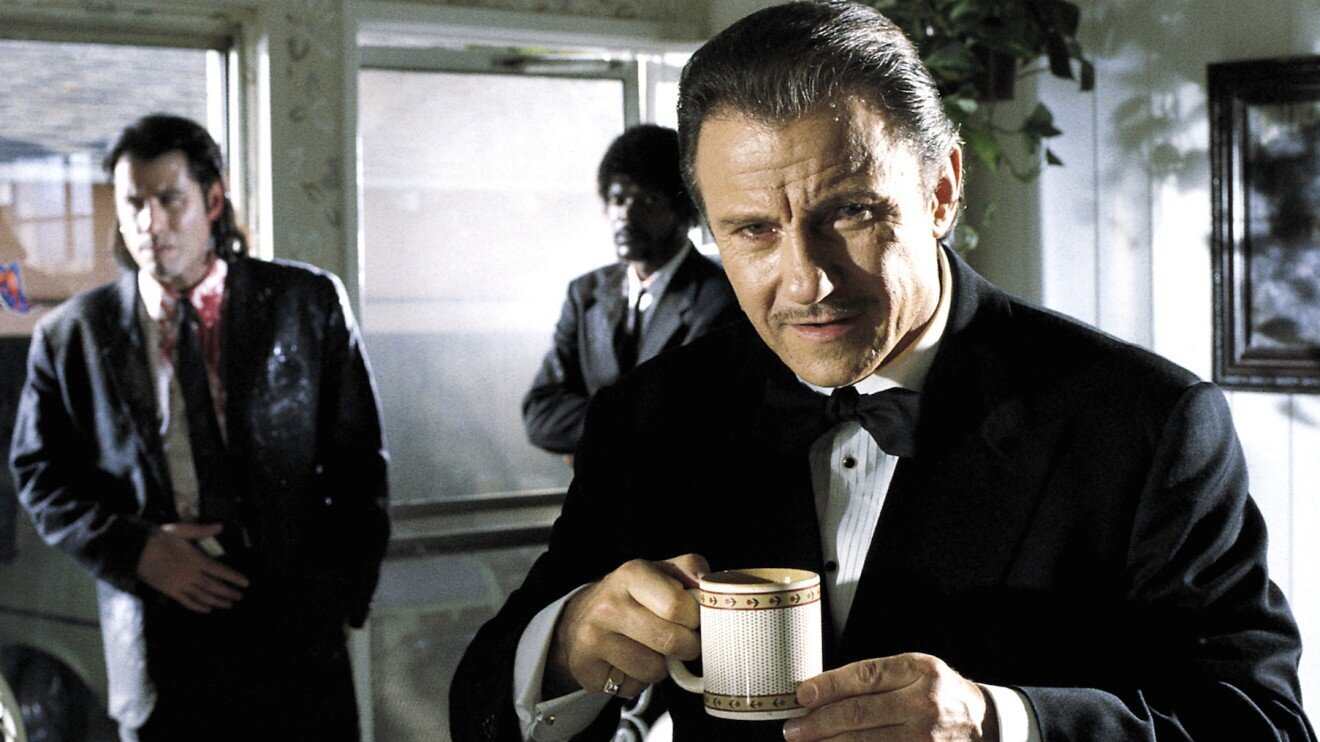
The character Kazbek Volkov in the novel is a complex literary allusion to the cult character from Quentin Tarantino’s «Pulp Fiction» (1994) — Winston Wolfe, known simply as «The Wolf.»
The Origin of the Name
The choice of the name «Kazbek Volkov» is deliberate, carrying several layers of reference to the original character:
Kazbek — a nod to Kazbek cigarettes, which, in the context of the novel, echo «Winston» cigarettes, the brand whose name resembles Winston Wolfe’s own. This play on tobacco brands builds a cultural bridge between American and Russian reality.
Volkov — a direct adaptation of the surname «Wolfe,» preserving both the sound and the meaning of the original. The wolf, as the archetypal image of the predator and the decisive man of action, fits the character perfectly.
Winston Wolfe in «Pulp Fiction»
Winston Wolfe, played by Harvey Keitel, appears in the film’s «The Bonnie Situation» segment as a professional «problem solver» — a cleaner in the criminal world. His role, though brief, is critical to understanding the structure of the criminal world Tarantino builds.
Wolfe’s character embodies the ideal of professionalism in the criminal milieu. He appears after Vincent Vega accidentally kills Marvin in the car, threatening to turn into a catastrophe for Jules Winnfield and Vincent. Marcellus Wallace calls in Wolfe as the last resort to resolve the crisis.
Defining Traits of «The Wolf»
Wolfe displays several key qualities that make him a unique figure in Tarantino’s gallery of characters:
Professional competence: He knows exactly what to do in any situation. His instructions are precise, concrete, and effective. When he explains to Jules and Vincent how to clean the blood out of the car, every word carries the weight of experience.
Time discipline: Wolfe works under intense time pressure. He arrives nine minutes after being called and constantly reminds the others to move fast, since Jimmie’s wife could come home at any moment.
Authority without aggression: Unlike many of the film’s characters, Wolfe never resorts to violence or threats. His authority rests on professional reputation and problem-solving ability. When Vincent bristles at his commanding tone, Wolfe calmly explains the logic of the situation.
Business ethics: He compensates Jimmie for the inconvenience by promising Marcellus will make it right — showing an understanding of the importance of maintaining relationships within the criminal ecosystem.
His Function in the Narrative
Within the structure of «Pulp Fiction,» Wolfe functions as a deus ex machina — appearing at a critical moment to resolve a situation that seemed hopeless. But Tarantino avoids an easy solution, giving the character depth and believability.
Wolfe embodies the ideal professional of the criminal underworld — a man who commits no crimes himself, but ensures others get away with theirs. He functions as a connective link between different levels of the criminal hierarchy, with access both to bosses like Marcellus Wallace and to rank-and-file operatives.
Cultural Influence
Winston Wolfe became a cult figure, symbolizing a professional approach to problem-solving. His line, «I solve problems,» became a catchphrase used well beyond the film’s own context.
The character has significantly influenced popular culture, inspiring countless imitations and references across other works. The «problem solver» archetype became a fixture of contemporary culture, symbolizing efficiency and professionalism under extreme conditions.
Adapting the Character to a Russian Context
Transplanting the character into Russian reality requires a cultural adaptation that preserves the essence of the original while fitting it to local realities. Kazbek Volkov, in the novel, performs the same function as his American prototype, but within the Russian criminal world.
The choice of the name «Kazbek» not only references the cigarette brand but carries Caucasian connotations as well, which, in a Russian context, may point to particular cultural and professional traits. In Russian public consciousness, the Caucasus region is often associated with notions of honor, professionalism in certain fields, and the ability to settle difficult matters.
Symbolic Meaning
The wolf, as a symbol across cultures, represents the archetype of the predator, the strategist, the pack leader. In the context of a criminal narrative, this image takes on additional connotations:
Predatory efficiency: Like a wolf in nature, the character acts fast, precisely, without wasted motion. Every action aims at a specific goal.
Pack thinking: Wolfe understands the importance of group dynamics and hierarchy. He knows how to motivate people and coordinate their actions toward a shared goal.
Territorial instinct: The character shows deep understanding of «territory,» both physical and social. He knows where he can operate openly and where caution is required.
Literary and Cinematic Predecessors
The image of the professional «problem solver» has deep roots in literature and film. Several parallels can be drawn:
The detective tradition: Classic literary private eyes, like Sam Spade or Philip Marlowe, also specialized in solving problems, though from a different moral standpoint.
Crime fiction: Intermediary characters in crime fiction often serve as connective links between different criminal factions.
Film noir: The tradition of depicting professional criminals and their fixers created a rich gallery of characters that anticipated Wolfe’s arrival.
A Psychological Portrait
Winston Wolfe represents an interesting psychological type: a man who found his calling in solving other people’s problems. His motivation isn’t reducible to simple financial gain — he takes genuine pleasure in the process of solving difficult problems.
The character shows emotional stability under stress, a professional necessity. He doesn’t panic, doesn’t lose his composure, and keeps a clear head under time pressure.
Interestingly, the film doesn’t demonize Wolfe. Tarantino presents him as a man who does his job honestly, even if that job is in the criminal sphere — creating a moral ambivalence characteristic of many of the director’s characters.
Dialogue and Speech Patterns
Wolfe’s dialogue in the film is marked by extreme functionality. He never wastes a word — every line aims at a specific goal. His famous line, «Pretty please, with sugar on top: clean the ******* car,» combines politeness and firmness, characteristic of the character.
Wolfe uses professional jargon and shows deep knowledge of the specifics of his work. He discusses the details of cleaning the car with the same thoroughness a surgeon might use to describe an operation.
Visual Characterization
Wolfe’s appearance in the film underscores his professional status. His black tuxedo signals he was called away from some society event, but he came without hesitation to solve the problem — demonstrating his commitment to the job and his sense of priorities.
Harvey Keitel plays the character with his characteristic intensity, but without excessive drama. His performance underscores how routine this all is for Wolfe — it’s just another job, one he carries out with professional dignity.
His Place in Tarantino’s Body of Work
Winston Wolfe occupies a special place in Tarantino’s gallery of characters. Unlike many of the director’s other heroes, he’s not given to philosophizing or long monologues. His character reveals itself through action, not words.
The character exemplifies Tarantino’s skill at creating memorable supporting characters. Despite relatively little screen time, Wolfe leaves a vivid impression and becomes one of the film’s most quoted figures.
Influence on the Genre
Winston Wolfe significantly influenced the development of the crime-drama genre. The «fixer» character became a popular archetype in contemporary film and literature.
Many subsequent works have featured similar characters — professional intermediaries specializing in solving the criminal underworld’s problems. This archetype has become an inseparable part of contemporary crime fiction.
Conclusion
Kazbek Volkov in the novel is a successful adaptation of Quentin Tarantino’s cult character for a Russian context. While preserving the original’s core traits — professionalism, efficiency, authority without aggression — the character takes on new cultural connotations suited to Russian reality.
The reference to Winston Wolfe isn’t simple borrowing, but a creative reimagining of the «problem solver» archetype within the Russian criminal world, letting the author use a recognizable cultural code to build a layered character who functions both at the level of plot and of cultural allusion.
The choice of the name «Kazbek Volkov» demonstrates the author’s literary inventiveness, forging an organic link between American pop culture and Russian reality without breaking the narrative’s internal logic.