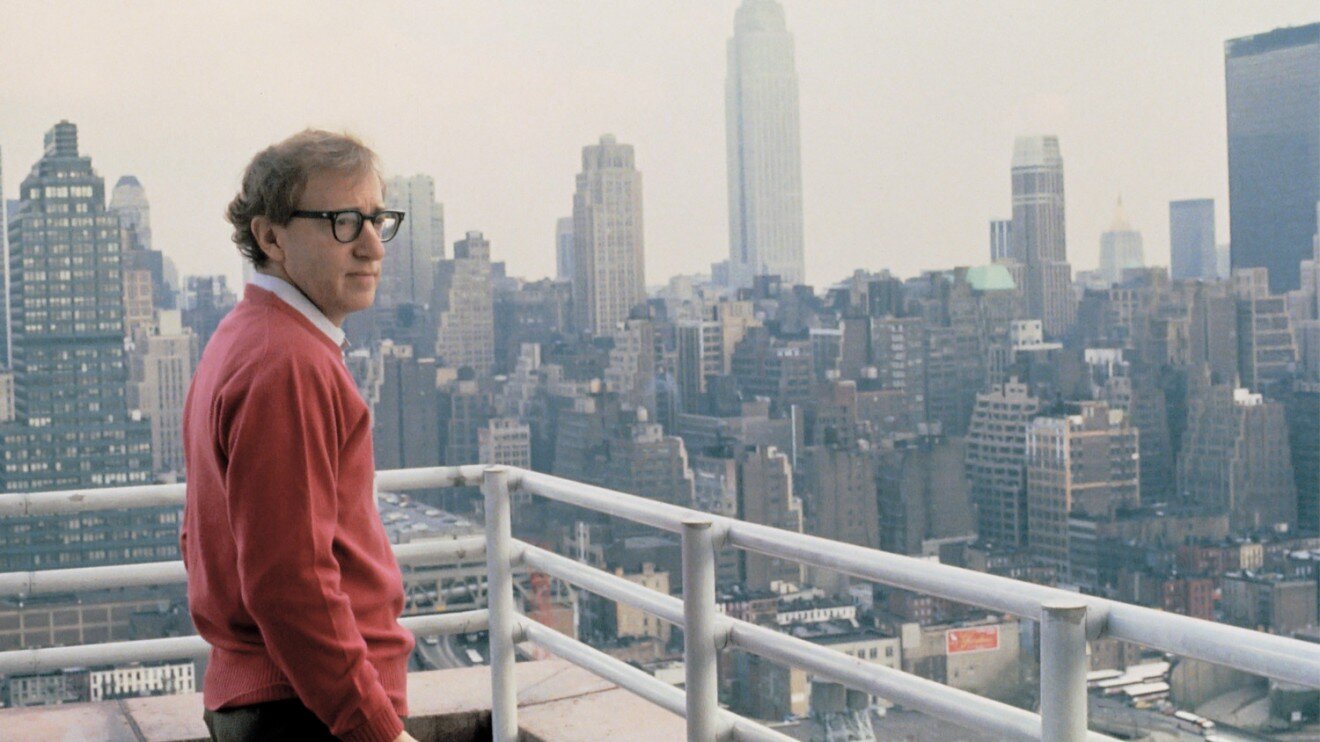
Heywood «Woody» Allen (born Allan Stewart Konigsberg) is an American film director, comic actor, screenwriter, and writer whose work has had an enormous influence on world cinema. Born November 30, 1935, in the Bronx, Allen became one of the most recognizable and influential directors of his time, creating a singular style that critics dubbed «intellectual comedy.»
Early Years and Formation
Allen grew up in a Jewish family in the Midwood section of Brooklyn. His grandparents were immigrants from Lithuania and Austria whose native language was Yiddish. His mother, Nettie, worked as a bookkeeper at the family candy store, and his father, Martin Konigsberg, was a waiter and jewelry engraver. This upbringing — typical of a Jewish immigrant family in mid-20th-century New York — shaped much of the director’s later work.
After finishing school, Allen enrolled at New York University, studying communications and filmmaking. Academic study didn’t engage him, though — he failed cinematography and was expelled from the university. He later briefly attended City College of New York, but didn’t stick around there either. This experience of failing at formal education paradoxically freed him to find his own path in art.
A Literary Career and Stand-Up Comedy
Allen’s creative path began with screenwriting. In 1954, he went to work for the comedian Herb Shriner, writing material for $75 a week. He soon began writing for popular television programs: «The Ed Sullivan Show,» «The Tonight Show,» «Caesar’s Hour,» and many others. His earnings quickly rose to $1,500 a week — a solid sum for a young writer.
During this period, Allen worked closely with the seasoned writer Danny Simon, brother of the famed playwright Neil Simon. It was Danny Simon who helped Allen form his own literary voice, something the director later expressed deep gratitude for.
In 1961, Allen debuted as a stand-up comic at the Duplex club in Greenwich Village. He deliberately turned his personal insecurities into winning material, developing the persona of a neurotic intellectual — smart but self-conscious, witty but insecure — that would become the foundation for many of his future film characters.
Alongside his performances, Allen wrote short stories for various publications, especially the prestigious magazine The New Yorker. His parodic sketches formed the basis of his first collection, «Getting Even,» published in 1971.
Theatrical Success
In 1966, Allen achieved considerable success on Broadway with the play «Don’t Drink the Water,» which ran for 598 performances. That success cemented his reputation as a talented playwright and opened the door to film.
A Musical Passion
Allen chose the stage name «Woody» in honor of jazz clarinetist and saxophonist Woody Herman. Music always played an important role in his life — from a young age he played clarinet and performed regularly at various clubs. His group, the New Orleans Jazz Band, played every week at the Carlyle Hotel in New York, performing old-fashioned jazz. This musical pursuit was documented in the film «Wild Man Blues» (1997), directed by Barbara Kopple.
The Path Into Film
Allen’s film debut came in 1965 with «What’s New Pussycat?» Producer Charles Feldman brought him in to rework the script and craft a role for Warren Beatty. In the process, though, Allen substantially built up his own role at the expense of Beatty’s, leading to a conflict. The studio backed Allen, deeming his version of the script the stronger one. Beatty left the project, and Peter O’Toole was brought in to replace him.
His next experiment was «What’s Up, Tiger Lily?» (1966), where Allen redubbed a Japanese spy thriller for comic effect, exploiting the mismatch between image and sound. Though the technique wasn’t original, it gave Allen his first directing experience.
Dissatisfaction with the results of these early works led Allen to an important decision: going forward, he would fully control the making of his films, minimizing producer interference.
Finding His Voice (1969–1970s)
Starting in 1969, Allen’s films were produced by Jack Rollins & Charles H. Joffe Productions. His first fully realized auteur film was «Take the Money and Run» (1969), followed by «Bananas,» «Everything You Always Wanted to Know About Sex (But Were Afraid to Ask),» «Sleeper,» and «Love and Death.»
These early works were comedies built on broad farce, inventive gags, and a relentless stream of one-liners. He drew on the influence of Bob Hope, the Marx Brothers, and Humphrey Bogart. Allen made films in the tradition of absurdist comedy, but even then a distinct intellectual depth was already showing through.
A Turning Point: «Annie Hall» (1977)
A genuine breakthrough in Allen’s work came with «Annie Hall» (1977). The film marked a turn toward more sophisticated humor and deeper drama. It won four Academy Awards, including Best Picture and Best Actress (Diane Keaton) — extraordinary for a comedy.
«Annie Hall» set a new standard for the modern romantic comedy. It was originally titled «Anhedonia» (a term meaning the inability to feel pleasure) and was built around a mysterious murder. But during filming, Allen radically reworked the material, focusing instead on the romantic relationship between the two leads. The film took its final title from Diane Keaton’s grandmother, and anhedonia became the picture’s central theme.
The film ranks 35th on the American Film Institute’s list of the «100 Greatest Films» and fourth in its «100 Greatest Comedies» category.
New York as the Leading Character
The black-and-white film «Manhattan» (1979) became a genuine love letter to New York. In it, the city is as much a lead character as any of the people in it. Allen captured New York with such affection and poetry that the film stands as one of cinema’s finest portraits of a city.
A special place in Allen’s work belongs to the so-called «New York Trilogy» — «Annie Hall,» «Interiors,» and «Manhattan.» These films celebrate the city where the director spent his whole life, showing it from many angles: romantic, melancholic, energetic.
The Influence of Bergman and European Film
In the late 1970s, Allen’s work took another important turn. As critic M. Brashinsky put it, «Bergman took possession of Allen.» «Interiors» (1978) became a bleak psychological drama in the vein of Ingmar Bergman’s late films — one of the American director’s great idols.
This period is marked by a clear influence of European cinema — not only Bergman but also Strindberg, Fellini, and Russian classical literature, especially Chekhov. His films from this era take on a particular poetic mood, a philosophical depth.
Creating the Genre of Intellectual Comedy
Allen is considered the creator of a distinct genre — «intellectual comedy» — in which the seriousness of the themes he and his characters explore coexists with a mocking, ironic form. His films are always full of cultural references — to classic and contemporary literature, to the films of great directors, to current events in society.
Allen’s typical characters are middle-class figures, academics, writers, intellectuals. Their pretentious intellectualism can seem amusing at times, but the stories are full of deep meaning and hazy implication. His favorite themes are psychoanalysis, sex, death, religion, and his own Jewish roots.
Filmmaking: Principles and Methods
Allen’s work is a model of «auteur cinema.» As a rule, he writes the screenplay, directs, and stars in most of his own films. This triple role lets him fully control the creative process and realize his own vision.
Allen is known for his high output and enormous work rate. He shoots practically a film a year, which commands the respect of his peers and the surprise of critics. And yet the quality of his work remains consistently high.
Personal Life and Creative Partnerships
Allen’s personal life was closely intertwined with his work. His relationship with actress Diane Keaton, which began in 1970, had an enormous influence on his films. Keaton appeared in pictures like «Sleeper» (1973), «Love and Death» (1975), «Annie Hall» (1977), «Interiors» (1978), and others.
Later, actress Mia Farrow played an important role in the director’s life and work; they lived together as a de facto couple from 1980 to 1992. Farrow appeared in 13 of his films, including «Zelig» (1983), «The Purple Rose of Cairo» (1985), and «Hannah and Her Sisters» (1986).
Literary Work
Alongside filmmaking, Allen was actively engaged in literature. In 1978, he won the prestigious O. Henry Award for his short story «The Kugelmass Episode,» published in The New Yorker. His stories share the same wit and intellectual depth as his films.
International Recognition
By the mid-1990s, Allen was recognized as one of the greatest and most influential directors of his time. His films won numerous awards at international film festivals, and he himself became a four-time Academy Award winner.
By the late 1960s, Allen was already recognized as a leading American comedy filmmaker, popular enough for his photo to grace the cover of the influential magazine Life (1969).
Philosophical Outlook
Allen is a committed atheist, as attested by numerous interviews and his participation in the documentary «The Unbelievers» (2013). His films often address questions of religion, death, and the meaning of life, but always from the standpoint of a skeptic and an intellectual.
As the writer Ray Bradbury put it: «If a man thought about death day and night, he’d become Woody Allen.» That line captures one of the central themes of the director’s work — reflection on the transience of human existence.
Influence on World Cinema
Allen’s influence on world cinema is hard to overstate. He created a new type of comedy, fusing intellect with entertainment, serious philosophical themes with light irony. His style influenced an entire generation of directors worldwide.
Allen’s films have become classics of world cinema. Pictures like «Annie Hall,» «Manhattan,» and «Hannah and Her Sisters» regularly appear on lists of the greatest films of all time compiled by critics and film scholars.
New York in Allen’s Work
A special place in Allen’s legacy belongs to his love of New York. He didn’t just film in the city — he made it one of the central characters of his movies. Allen portrayed New York as a city of intellectuals, neurotics, and creative people. His camera lingered lovingly on the city’s famous views, its cozy cafes and restaurants, its bustling streets.
Thanks to Allen’s films, New York took on a special romantic aura in world cinema. Many directors after him tried to recapture that poetic vision of the city, but few managed to achieve the same organic, sincere quality.
Conclusion
By 1997, Woody Allen had already secured a firm place in the pantheon of great 20th-century directors. His body of work, which began with simple comedies, evolved into a complex system of artistic imagery, philosophical reflection, and cultural allusion. He created a unique cinematic language, recognizable throughout the world.
Allen remains one of the most prolific and consistent auteurs in the history of film. His influence on 20th-century culture reaches far beyond cinema — he shaped how people perceive urban intellectual life, how they understand humor, and how they relate to psychoanalysis and many other facets of modern culture.
For understanding the cultural context of the 1990s, the figure of Woody Allen is essential. He was a director who not only reflected the spirit of his time but, in many ways, helped shape it, setting new standards for intellectual cinema and urban culture.