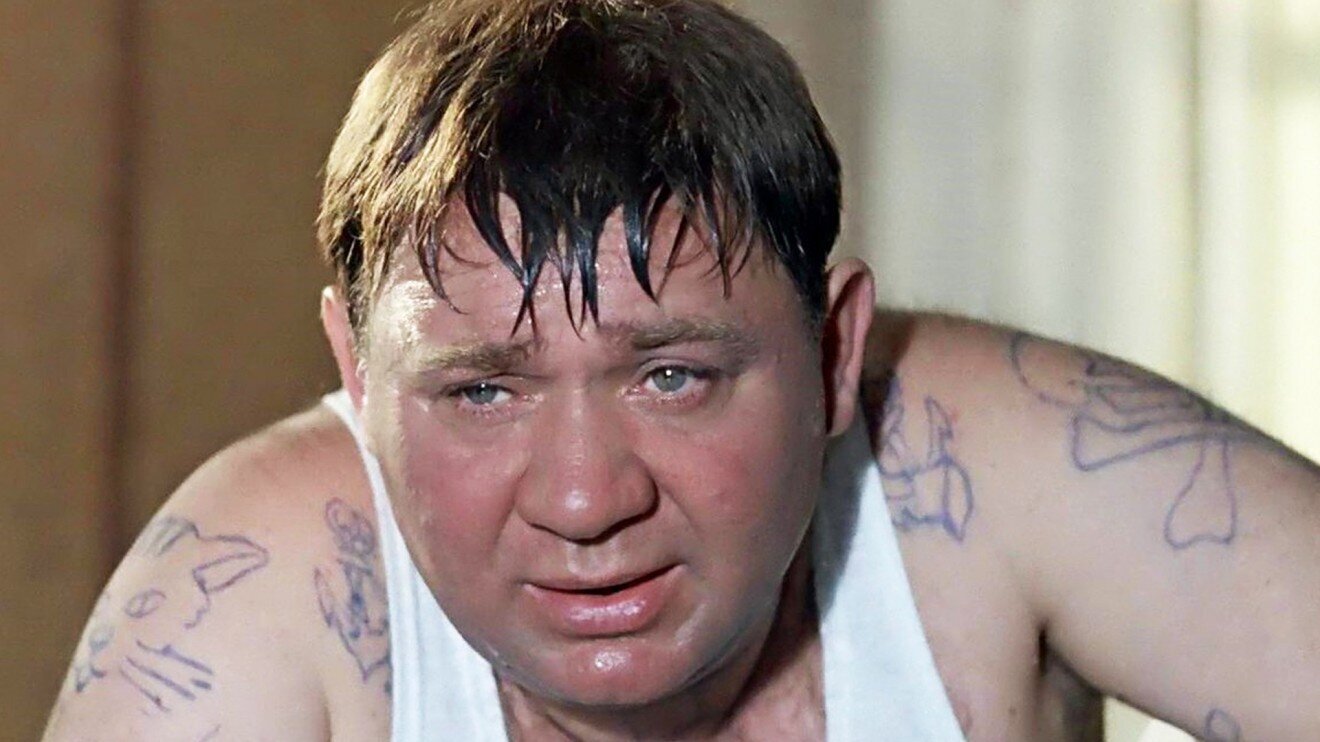
The nickname «the Deputy» became a household name in Russian culture thanks to the film «Gentlemen of Fortune» (1971). In the context of the novel, where Yasha is called the Deputy behind his back, the comparison turns out to be remarkably dense and layered – mocking, dangerous, and in a way even humiliating, all at once. To understand the full scope of this cultural shorthand – who the Deputy is, who Leonov is, and why the comparison enrages Yasha in particular – it helps to trace the reference back to its source.
«Gentlemen of Fortune» and the Character of the Deputy
In the film «Gentlemen of Fortune,» the Deputy is the nickname of a repeat offender whose real name is Alexander Alexandrovich Bely. He is a career criminal living by the thieves’ code – cold, ruthless, with a sharp instinct for profit and for other people’s weaknesses. He has no sentimentality, only an intuitive cruelty and a criminal’s cunning.
The Deputy leads a small gang that also includes Khmyr and Kosoy. The scene in the desert where he first attacks Troshkin and then hands over his «business card» – «The Deputy, candidate of sciences» – has long since become a meme. It’s an ironic nod to his nickname, sharpening the contrast between the thug and the scholar.
The title «Deputy» (a shorthand for a junior academic rank, roughly equivalent to «associate professor») wasn’t chosen at random – in the Soviet mind it symbolized an academic degree, membership in the intelligentsia elite. In the mouth of a criminal, the word takes on a grotesque tint – much like his refined manners, his glasses, and his faintly haughty tone. And yet the Deputy is no intellectual at all, but rather a wolf in glasses: sharp, but dangerous, calculating, and without a moral compass.
Yevgeny Leonov: An Actor Playing Two Roles
What gives the Deputy’s image its full weight is Yevgeny Pavlovich Leonov, who played both roles at once – the Deputy himself, and his double, kindergarten director Yevgeny Ivanovich Troshkin. It’s a unique feat of transformation, with Leonov brilliantly setting two archetypes against one another.
Yevgeny Troshkin is good-natured, naive, a little shy, genuinely fond of children and of his work – the embodiment of a positive hero in the classic Soviet-cinema sense. He doesn’t drink, doesn’t smoke, lives with his mother, and carries an endless sense of duty to society.
Alexander Bely (the Deputy) is his exact opposite. He smokes, drinks, swears, is coarse and violent. He is a product of the labor-camp world, stripped of social and moral brakes. His reactions defy logic – he lives on instinct, impulse, calculation.
Against the backdrop of Soviet comedy’s usually faceless antagonists, the Deputy stands out for his edge and his charisma. He’s dangerous, yet charming; unpleasant, yet magnetic.
The Deputy’s Real-Life Prototype: Alexander Sery
The film’s director, Alexander Sery, was in part the Deputy’s own prototype. In his youth he served time in a labor camp, and after his release enrolled in directing courses. His personal experience as a convict was central to building the film’s convincing atmosphere. It was Sery who insisted on authenticity in the slang, the movements, the behavior of the criminals on screen.
Sery knew prison culture from the inside and understood exactly how a repeat offender ought to carry himself. His approach was anything but perfunctory: the actors rehearsed with real convicts, and Leonov visited Butyrka prison to observe the inmates. All of it lent the Deputy a chilling credibility.
The Cultural Weight of the Image
In the 1970s, the word «Deputy» took on a special meaning in the USSR. It became a household term – used for someone outwardly intelligent, but cynical, amoral, and dangerous. Someone who puts their «cleverness» to use for harm rather than good.
Comparing Yasha to the Deputy isn’t just a joke. It’s a deep accusation. Yasha, like the Deputy, is nominally a «scholar.» He heads a «research group» – formally part of the same world as Yevgeny Troshkin. And yet no one respects him. He’s held in contempt. He provokes laughter, not trust. Which means that, in everyone’s eyes, he isn’t Troshkin. He’s the Deputy. Clever, but not kind. Calculating. Sly. A man from whom betrayal or manipulation is expected.
Why the Comparison to Leonov Enrages Him
Because Yasha isn’t a hero -- he’s an antihero. He’s told: you’re like Leonov. But not like the good-natured Troshkin -- like the criminal Deputy. In other words, you look like an intellectual on the outside, but inside you’re not who you pretend to be. It’s a painful, humiliating comparison. It demolishes his self-image as a scholar, undermines his standing in the group, turns him from a candidate of sciences into a laughingstock.
What’s more, Leonov was an actor the entire country adored. His voice gave life to the Soviet Winnie-the-Pooh; he was a symbol of kindness. And now this Leonov -- the nation’s darling -- is being compared to you. Not to Winnie-the-Pooh, though. To a convict in glasses. Even as a joke, it stings.
Troshkin vs. the Deputy: A Symbol of Morality
At the heart of «Gentlemen of Fortune» is more than a comic plot -- it’s a moral dilemma: can good triumph over evil while remaining good?
Troshkin infiltrates the criminal underworld without losing his humanity. Along the way he even grows attached to the Deputy’s crew – despite their past, he sees them as people. That’s the humanism of Soviet cinema at work: even the most hardened repeat offenders can be moved, if treated humanely.
Yasha, in the novel, lacks that quality entirely. He doesn’t love people. He’s a functionary, a mechanism. Comparing him to the Deputy is almost a pointed hint: no, you’re not a criminal, but you’re every bit as cold, cynical, and distrustful.
Leonov: An Actor of the People’s Soul
Yevgeny Leonov (1926–1994) was one of the most beloved actors of the Soviet era. His unique gift for playing kind, simple, but vividly alive people made him a symbol of «the real thing.» He was born in Moscow, lived through the war, worked at an aircraft factory, and later moved into theater and film.
Among his best-known roles: Winnie-the-Pooh, the Deputy in «Gentlemen of Fortune,» the mechanic Makarych in «The Crew,» the father in «Afonya,» and Vanyushin in the stage production «Vanyushin’s Children.» He had a distinctive voice, a gentleness, and something piercingly honest in his eyes.
His dual role in «Gentlemen» was the peak of his career. There he managed to show the full range – from tenderness to menace, from kindness to violence. He was a people’s artist not by official title, but in substance.
Why It Matters for the Novel
When a reader hears the word «the Deputy» applied to a character in the novel, they automatically pull up this whole tangled cultural backdrop:
criminal slang;
glasses and intellectual polish worn as a mask;
danger hiding behind logic;
the duality of the image;
mockery and distrust.
Comparing Yasha to the Deputy is a layered device that needs no direct explanation in the text. A reader familiar with the film understands it all without a word being said. That’s the power of a reference like this.
Conclusion
The Deputy’s image in the novel is more than just a nickname. It’s a mirror the character finds painful to look into -- what makes him ridiculous in other people’s eyes, and tragic in his own. The Deputy is a symbol of the gap between the outer and the inner, between logic and humanity, between status and substance.
The comparison to Leonov is a slap in the face. Because Leonov played both heroes and antiheroes alike. But whether you yourself are a hero -- that’s an entirely different question.