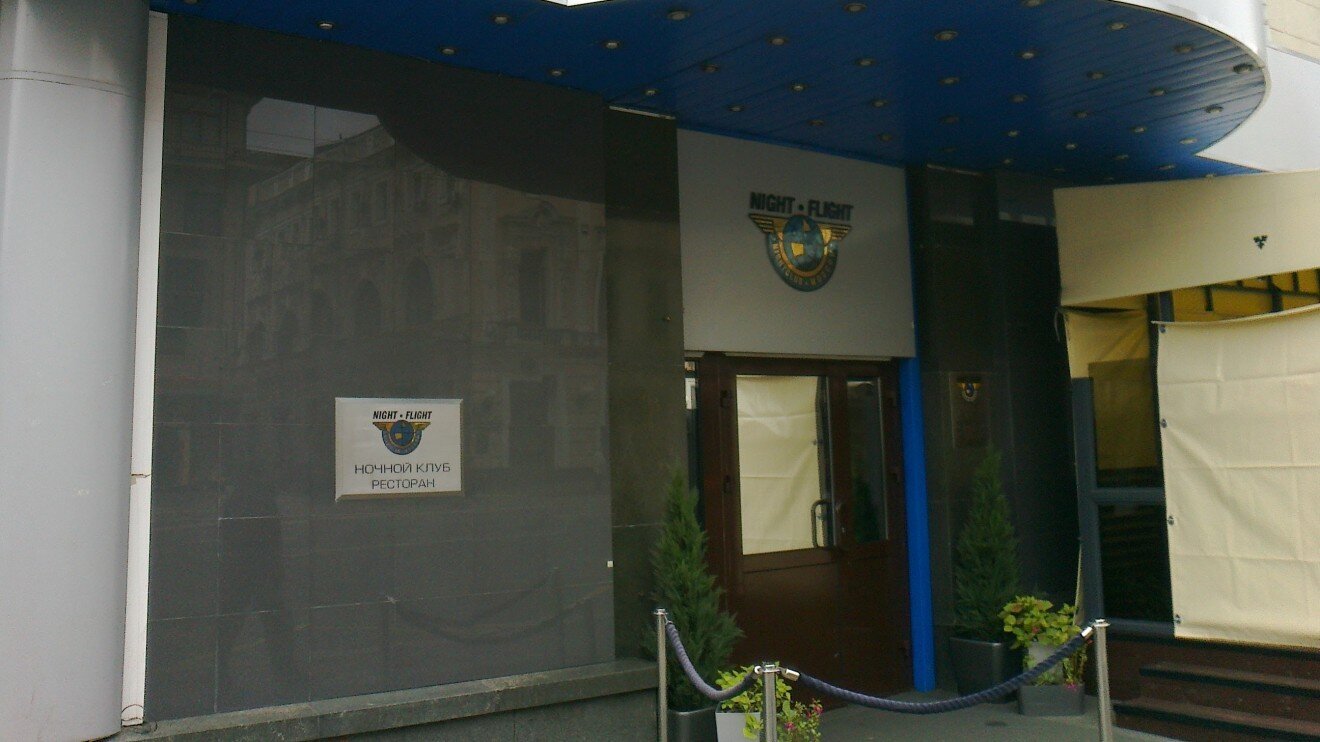
Night Flight was a legendary Moscow nightclub that opened in October 1991 and became a symbol of the new era in the Russian capital. Located in the very heart of Moscow on Tverskaya Street, in the building of the former ice-cream café «Sever» («North»), it was the city’s first genuine Western-style nightclub.
Origins
The club was created as a Soviet-Swedish joint venture called «Sever-Nord.» The driving force behind it was Swedish entrepreneur Sonny Lundqvist, who already had experience running a small club in St. Petersburg. The Russian side was headed by Yuri Giverts, who handled the legal work and the many required permits.
The club opened at a turning point in the country’s history – barely a few months after the August 1991 coup attempt. All the equipment, furniture, and even the smallest interior details, down to the toothpicks and ashtrays, were brought in from Sweden. Notably, the last shipment arrived just three days before the coup, which could easily have derailed the whole project.
Concept and atmosphere
Night Flight was originally conceived as a club for foreigners – expats, businessmen, and representatives of joint ventures, of whom there were quite a few in Moscow in the early 1990s. Unlike Soviet discotheques, the club ran on Western standards: open from 9 p.m. to 5 a.m., with strict face control and a European level of service.
The place quickly earned the unofficial nickname «the Swedish embassy» among the public – that’s how strongly it was associated with its Scandinavian partners and Western culture. From the outset, management declared its «negative attitude toward Moscow streetwalkers» and promised they wouldn’t be allowed in, though in practice the reality proved more complicated.
The clientele in the 1990s
During the period the novel is set in (1996), the club was at its peak. About 90% of its patrons were foreigners – representatives of Western business who had come to Russia in search of new opportunities. These were adventurous types, ready to work in a country that still lacked a developed legal system or service infrastructure.
Admission was paid, and only in hard currency, which automatically excluded a large share of the local population. IDs were checked – management required patrons to be at least 21 (men had to be at least 30). The dress code was strict: business or evening wear only.
Regular patrons included Western celebrities, footballers, and businessmen. The club became a place where representatives of Russian joint ventures entertained their foreign partners, showing them a «civilized» Moscow.
The female clientele
A distinct category of patrons consisted of young women drawn, in the 1990s, by the chance to meet foreigners. According to eyewitness accounts, at the time these were mostly ordinary women who dreamed of «getting a look at people with money from another world and marrying a foreigner.» Many of them really did find partners and moved away to Sweden, America, or London.
Taxi drivers picking up wealthy foreigners at the airport often advertised the club as a place to meet «Russian girls» and «models.» That reputation stuck to the establishment for years, though management always officially distanced itself from such characterizations.
Security and atmosphere
Amid the «wild nineties,» Night Flight stood out for its level of security. From the very start, the owners signed a contract with a serious private security firm that took on all security matters, including potential trouble with criminal groups.
As one of the founders recalled, figures from the criminal world occasionally showed up at the club but felt uncomfortable in its unfamiliar international atmosphere. The «crimson jackets» found themselves in an environment where they couldn’t flaunt their toughness, and they usually didn’t come back.
Economic realities
The club operated at a time when shops were plagued by shortages, and even the assortment at the elite «Yeliseyevsky» grocery store was limited to bread, cheese, and two kinds of sausage. A special truck brought all of Night Flight’s supplies in from Sweden every week. Alcohol was also imported – a special wholesale license wasn’t yet required at the time.
Prices were set freely, since joint ventures, unlike Soviet organizations, had the right to free pricing. During a slow dance, patrons might toss hundred-dollar bills at the dancers – that was the purchasing power of hard-currency clients in those years.
A fixture of Moscow life
By 1996 Night Flight had already become an inseparable part of Moscow’s business life. Important partners were taken there, successful deals were celebrated there, useful connections were made there. For Russian businessmen working with foreign capital, the club became a kind of calling card – a place to show foreign colleagues that Moscow had establishments of European caliber.
Its location on Tverskaya, steps from the central hotels and offices, made it convenient for business meetings. Many of the deals that shaped the face of Russia’s 1990s economy were discussed right there, at the bar or in the club’s cozy corners.
Management and staff
The club’s general manager was a Swede, Mats Jansson, who joined in 1994, initially on a three-month contract as head of security. Times were genuinely dangerous: there were incidents of patrons rejected by face control driving their cars into the club’s doors, or of security guards for Muammar Gaddafi’s son brawling at the entrance.
Jansson noted a particular quirk of working with Russian staff: everyone was terrified of making independent decisions, constantly checking with management even over the smallest matters. That created certain management challenges, but it didn’t stand in the way of the venture’s overall success.
Symbolic significance
Night Flight became a symbol of the new era in Russia – a time when the country was opening up to the Western world, when the first joint ventures were appearing and a new class of entrepreneurs was taking shape. The club embodied dreams of the «good life» by Western standards, of a chance to join in international entertainment culture.
For many Muscovites of that era, Night Flight was a window into another world – a world where you could hear good music, try genuine imported drinks, and immerse yourself in an atmosphere of international company. It was a place where a new lifestyle for Russia’s 1990s elite was being born.
In the context of the novel, the mention of provincial directors being taken to Night Flight accurately conveys the realities of the time: the club really was used as a way to impress business partners, to show them the capital’s reach and draw them into the new entertainment culture that was only just taking shape in post-Soviet Russia.