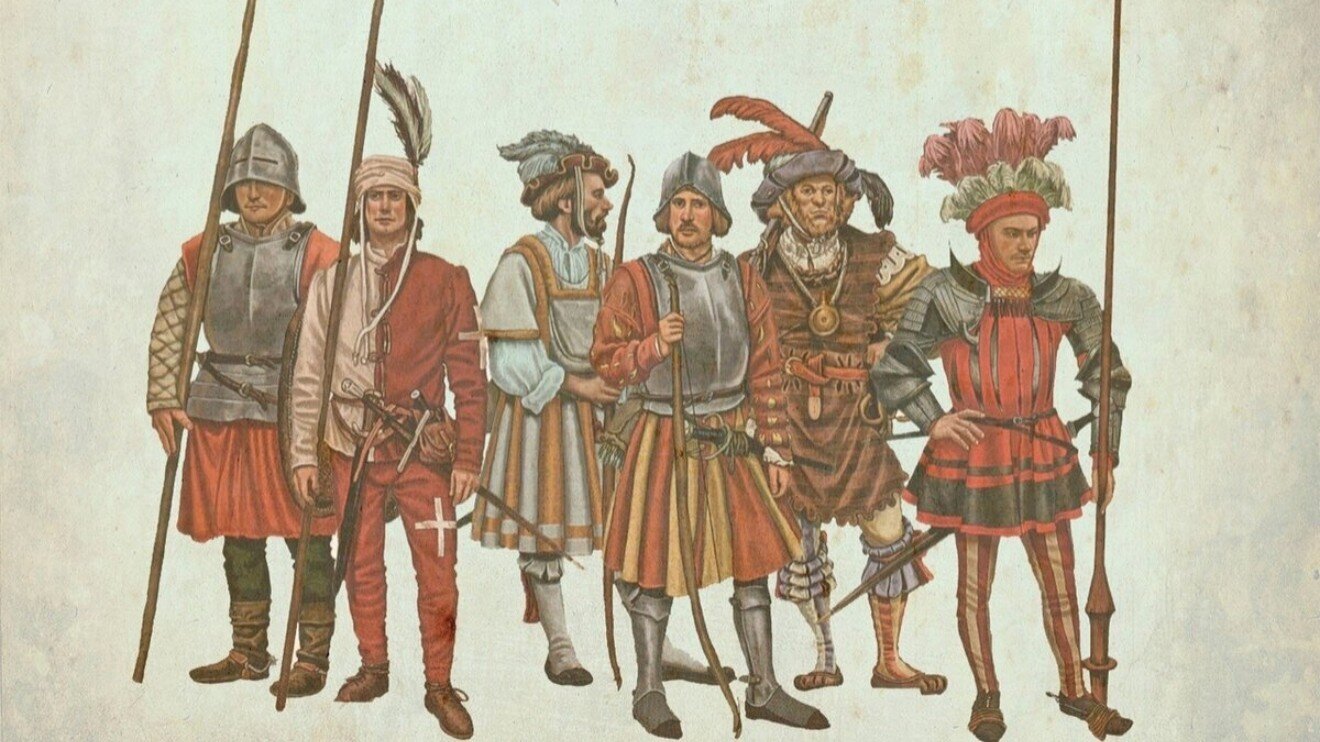
In the context of early-1990s Russia, the word "condottieri" took on a distinctive, ironic meaning, evoking the historical mercenary commanders of the Renaissance but applied to the new realities of post-Soviet society.
The origin of the term
The word "condottiere" comes from the Italian condottiere (plural condottieri), literally meaning "leader" or "commander." The term's root traces to the Italian word condotta — a contract, an agreement. Originally, this was the name given to the commanders of mercenary military bands, who signed contracts with city-states or noble rulers to provide military services. So condottiero originally meant "contractor" in the military sphere — someone working under contract.
Over time the term's meaning broadened, and in Italian, condottiero came to denote any military commander, whether serving as a mercenary or in a permanent post.
The conditions that gave rise to the condottieri
The condottieri phenomenon arose in medieval Italy as a response to specific political and economic conditions. In the 13th and 14th centuries, the Italian city-states — Venice, Florence, Genoa, Milan — achieved unprecedented prosperity through trade with the East. Yet their wealth contrasted sharply with their own extremely small standing armies.
Citizens of these trading republics preferred commerce to soldiering. When threatened by neighboring states or foreign powers, the ruling elites found it more advantageous to hire professional soldiers than to maintain permanent armies or force citizens into military service.
An additional factor was the end of the Crusades (1095–1291). European knights and professional soldiers, having gained rich combat experience in the Holy Land, found themselves without steady work. Many of them made their way to Italy in search of military employment, forming the first masnade — bands of wandering soldiers.
The early period: foreign mercenaries
The first mercenary bands in Italy consisted mostly of foreigners. Among them were Flemings from the Duchy of Brabant (called Brabanzoni), as well as Spanish soldiers, who arrived in Italy in 1282 with King Peter III of Aragon during the War of the Sicilian Vespers, and stayed on seeking military work after the conflict ended.
In 1333, mercenaries arrived in Italy to take part in Perugia's war against Arezzo, fighting as part of the "Compagnia della Colomba" ("Company of the Dove") under John of Bohemia. The real founders of organized mercenary service in Italy, however, were Duke Werner von Urslingen and Count Konrad von Landau, who created the first disciplined "Ventura Companies."
Werner's company stood apart from other mercenary bands by introducing military discipline and a fair division of contract income. Over time, this band grew into the formidable "Great Company," numbering around 3,000 barbute (each barbuta comprising a knight and a sergeant).
The rise of the Italian condottieri
A turning point came in 1339, with the creation of the first mercenary company under Italian command — the "Company of St. George," led by Lodrisio Visconti. Although this company was defeated and destroyed by another condottiere, Luchino Visconti of Milan (Lodrisio's uncle), in April 1339, it laid the groundwork for the future development of Italian mercenary service.
A decisive role was played by Alberico da Barbiano, Count of Cunio, who in 1377 formed a second "Company of St. George," made up entirely of Italians. His triumph at Marino in 1379, where he crushed the Breton company serving the antipope Clement VII, ushered in an era of Italian dominance in the mercenary trade. Alberico became the mentor to an entire generation of famous condottieri, including Facino Cane and Braccio da Montone.
The golden age of the condottieri
The 15th century was the golden age of the condottieri. By this time, most of them were Italian nobles who had chosen a military career as a way to earn a living. They turned warfare into a genuine science, studying Roman military treatises (especially Vegetius's "Epitoma rei militaris") and developing new tactical approaches.
The condottieri moved away from the medieval view of war as a display of valor and physical courage. Instead, they approached military operations from the standpoint of military science, favoring maneuver and undermining the enemy's capacity to wage war over direct confrontation on the battlefield. This was a revolutionary break from the traditions of chivalry.
Niccolò Machiavelli sardonically noted that the condottieri fought grand but often nearly bloodless battles against one another. They avoided winter campaigns, hard labor, and unnecessary risk, since losing trained soldiers was both economically costly and politically dangerous.
Organization and pay
The condottieri system was clearly organized. Commanders selected their own soldiers for hire. A contract (condotta) was signed for a set period (ferma), after which the company entered a waiting period (aspetto), during which the hiring city-state decided whether to renew the agreement.
If the contract finally lapsed, the condottiere could not declare war on his former employer for two years. This tradition was strictly observed, since professional reputation was the foundation of the condottieri's business.
Payment for military service was quite generous:
- 1432: Micheletto Attendolo received 1,900 florins a month from Florence
- 1448: William VIII of Montferrat received 6,600 florins a month from Francesco Sforza
- 1505: Francesco II Gonzaga received 33,000 scudi a year for 250 men from Florence
- 1505: Francesco Maria I della Rovere received 100,000 scudi a year for 200 men from Florence
Famous condottieri
John Hawkwood (c. 1320-1394)
An English knight, the best-known of the foreign condottieri. After the end of the Hundred Years' War in 1360, he led an army of English mercenaries into Italy, known as the "White Company." Over thirty years, he played a key role in Italian conflicts, known for his advanced tactical methods.
Braccio da Montone (1368-1424)
One of the greatest Italian condottieri, a student of Alberico da Barbiano. He controlled a significant part of central Italy, including Perugia. He founded a military school, where he trained future condottieri. His rivalry with Muzio Attendolo Sforza shaped Italy's military situation in the early 15th century.
Francesco Sforza (1401-1466)
The son of Muzio Attendolo, he became not only an outstanding condottiere but a statesman. In 1450, he seized Milan and founded the Sforza dynasty, which ruled the duchy until 1535. His career shows how military power could be transformed into political authority.
Giovanni delle Bande Nere (1498-1526)
The son of Caterina Sforza, known as the "Last Condottiere." His military career fell during the Italian Wars, when the condottieri's traditional methods of warfare collided with the new realities of Europe's military revolution. His son, Cosimo I de' Medici, became Grand Duke of Tuscany.
Political influence
Many condottieri did not limit themselves to military activity, becoming influential political figures. Some, like Francesco Sforza, founded their own dynasties. Others, such as Sigismondo Pandolfo Malatesta, Lord of Rimini, and Federico da Montefeltro, Duke of Urbino, combined military careers with ruling their own territories.
As Machiavelli observed, by the 15th century, "the arms of Italy were in the hands either of minor princes, or of men who had no state." This paradox — the wealthiest city-states relying on mercenaries, while military power concentrated in the hands of relatively modest military entrepreneurs — shaped Italy's political instability.
Decline and transformation
The beginning of the end for the condottieri era came with the French invasion of Italy in 1494, under King Charles VIII, which set off the Italian Wars (1494–1559). The French royal army, like other national armies of Europe, differed radically from the Italian mercenary bands.
The new armies consisted of professional infantry — pikemen and musketeers — backed by artillery. The condottieri, by contrast, still relied on heavy cavalry and traditional medieval weaponry, making them ineffective against modern tactical formations.
The decisive Battle of Calliano in 1487, where the Venetians successfully held off German landsknechts and Swiss infantry — the finest soldiers in Europe at the time — was one of the last triumphs of the traditional Italian military system.
From the mid-16th century, the condottieri's importance as a military force declined sharply, though they persisted into the 17th century. The practice of hiring foreign mercenaries did not disappear entirely either — the Swiss Guard of the Vatican, for example, is a modern-day remnant of a historically effective mercenary force.
The evolution of the term
Although the condottieri military system gradually disappeared, the term condottiero itself survived in Italian, undergoing significant evolution. During the Italian Wars and Europe's religious wars of the 16th and 17th centuries, "condottieri" continued to denote outstanding Italian generals who served European states, monarchs, and popes.
In this broader sense, such "condottieri" included the Marquis of Pescara (1489–1525), the Marquis del Vasto (1502–1546), Ferrante Gonzaga (1507–1557), Marcantonio II Colonna (1535–1584), Alessandro Farnese (1545–1592), Torquato Conti (1591–1636), Ambrogio Spinola (1569–1630), Ottavio Piccolomini (1599–1656), Raimondo Montecuccoli (1609–1680), and many others.
In Italian, then, the term condottiero ultimately became a synonym for "military commander" or "leader," losing its original meaning of a mercenary military entrepreneur.
"Condottieri" of the 1990s
In Russia's era of "wild capitalism," the term "condottieri" became a metaphor for a new class of managers, drifting from one company to another. Like their Italian predecessors, the Russian "condottieri" of the 1990s were marked by pragmatism, a readiness to work at any company, and a knack for profiting from the chaos of the transitional period.
The parallels between the historical condottieri and 1990s Russian business managers are quite telling. Like the military entrepreneurs of Renaissance Italy, Russia's "condottieri" were marked by:
- Mobility — a readiness to change "employers" quickly, depending on the offers made
- Professionalism — a specific set of management skills suited to conditions of uncertainty
- Pragmatism — an absence of long-term commitment to any particular company or project
- Adaptability — the ability to adjust quickly to the shifting conditions of a transitional economy
The irony of the term lies in how it underscores the temporary, hired nature of many business relationships of that era. Like the historical condottieri, Russia's "condottieri" of the 1990s rarely held long-term commitments to a single "employer" or project — they went wherever the pay was better, and wherever better opportunities opened up.
The term reflected the realities of an era when traditional corporate structures had not yet taken shape, and success depended on personal qualities and the ability to navigate constantly shifting conditions quickly. Russia's "condottieri" of the 1990s, like their historical prototypes, were products of a transitional time — a period when the old institutions had collapsed, and the new ones had not yet taken hold.