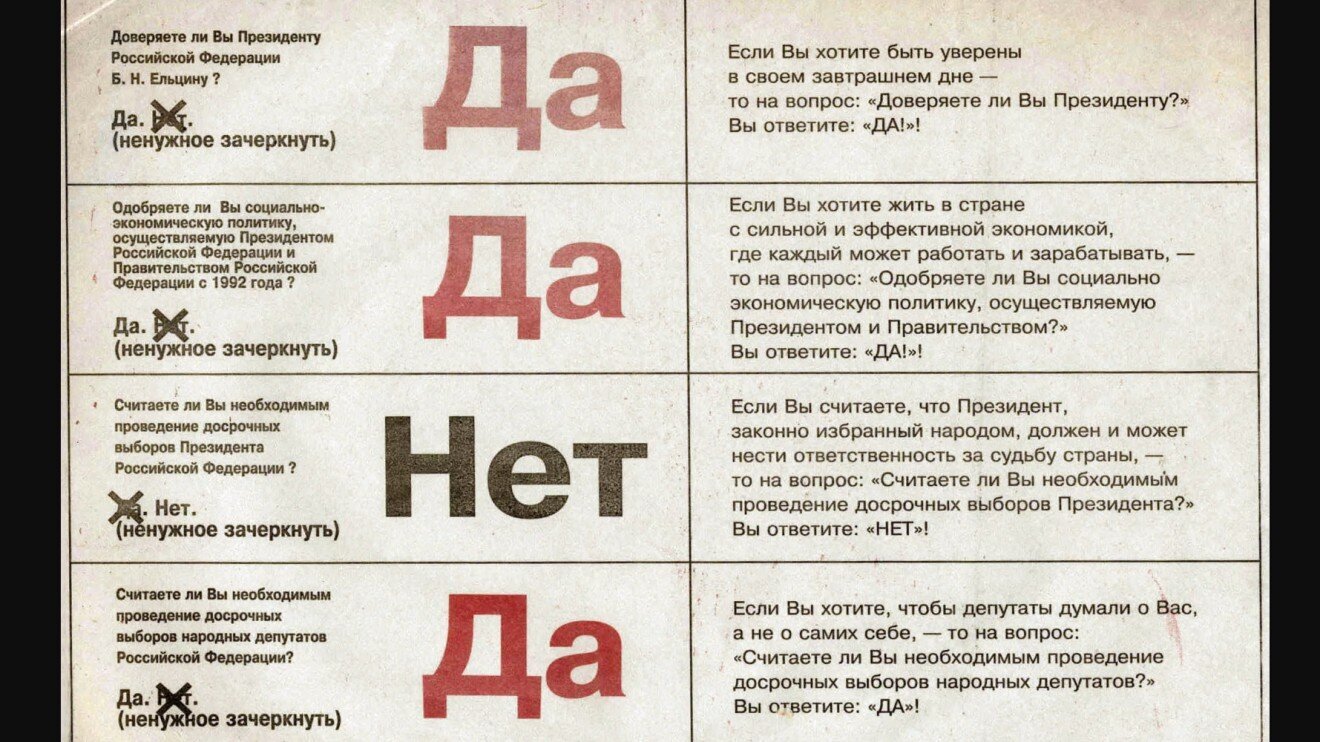
The formula "Yes-Yes-No-Yes" became one of the most recognizable political slogans of early-1990s Russia, symbolizing the sharp standoff between President Boris Yeltsin and the Supreme Soviet during the constitutional crisis.
Historical context
The spring of 1993 in Russia was marked by a deep political crisis. The confrontation between President Boris Yeltsin and the parliament — the Congress of People's Deputies and the Supreme Soviet — had reached a breaking point. The conflict touched on fundamental questions: the course of economic reform, the distribution of power, and the country's future path.
Under these conditions, a decision was made to hold an all-Russian referendum, intended to break the political deadlock and gauge public opinion on key questions of state structure.
The referendum's four questions
On April 25, 1993, four questions were put to an all-Russian referendum:
- "Do you have confidence in Russian Federation President B.N. Yeltsin?"
- "Do you approve of the socioeconomic policy pursued by the President and Government of the Russian Federation since 1992?"
- "Do you consider it necessary to hold early elections for the Russian Federation Presidency?"
- "Do you consider it necessary to hold early elections of Russian Federation people's deputies?"
The birth of the "Yes-Yes-No-Yes" slogan
The formula "Yes-Yes-No-Yes" was devised by Yeltsin's supporters as the optimal voting strategy. The logic ran as follows:
- The first "Yes" — express confidence in President Yeltsin
- The second "Yes" — approve the economic reforms he was pursuing
- "No" — reject the idea of early presidential elections
- The fourth "Yes" — support dissolving parliament and holding early elections of deputies
Interestingly, Yeltsin himself initially leaned toward "all four Yeses," but his political strategists convinced him it was better to reject the third question, so as not to create unnecessary risk for himself.
The campaign
The "Yes-Yes-No-Yes" slogan spread widely thanks to an intensive advertising campaign. The formula was broadcast heavily on radio and television, and printed on leaflets and posters. The slogan's simplicity and rhythm made it easy to remember, turning it into a genuine political meme of the era.
The campaign was so intensive that the formula "Yes-Yes-No-Yes" became firmly lodged in the popular consciousness and began to be used in everyday situations as a joking response to a series of questions — exactly as reflected in the novel's text.
How the votes were counted
Russia's Constitutional Court established an important distinction in the vote-counting method: for the first two questions (of a "moral-evaluative and political character"), a simple majority of those who voted was needed to pass; for the third and fourth questions (of a "constitutional character"), a majority of the total number of eligible voters was required.
This meant that rejecting early elections of deputies would have required more than 77.9% of the votes cast (at the existing turnout) — a practically unattainable figure.
The referendum's results
The voting results proved contradictory:
- Confidence in Yeltsin was expressed by 58.7% of those who voted (the measure passed)
- The socioeconomic policy was approved by 53.0% (the measure passed)
- Early presidential elections were supported by 49.5% of those who voted, amounting to just 31.7% of all eligible voters (the measure failed)
- Early elections of deputies were supported by 67.2% of those who voted, but this amounted to only 41.1% of all eligible voters (the measure failed)
Historical significance
The referendum did not resolve the political crisis, only temporarily strengthening Yeltsin's position. The standoff with parliament continued and reached its climax in the fall of 1993, in the form of armed conflict in Moscow (the events of October 3–4), the dissolution of the Supreme Soviet, and the adoption of a new Constitution.
The "Yes-Yes-No-Yes" slogan remained in history as a symbol of that era — a time of fierce political battles, when the country's fate was decided in a struggle between different branches of power. In popular memory, the formula became fixed as an ironic label for automatic, not fully considered answers to a set of questions.
In the context of the novel: The character's use of the formula "yes-yes-no-yes" in an everyday situation reflects how the political slogans of the era seeped into daily life and became part of colloquial speech, turning from serious political appeals into elements of everyday humor.