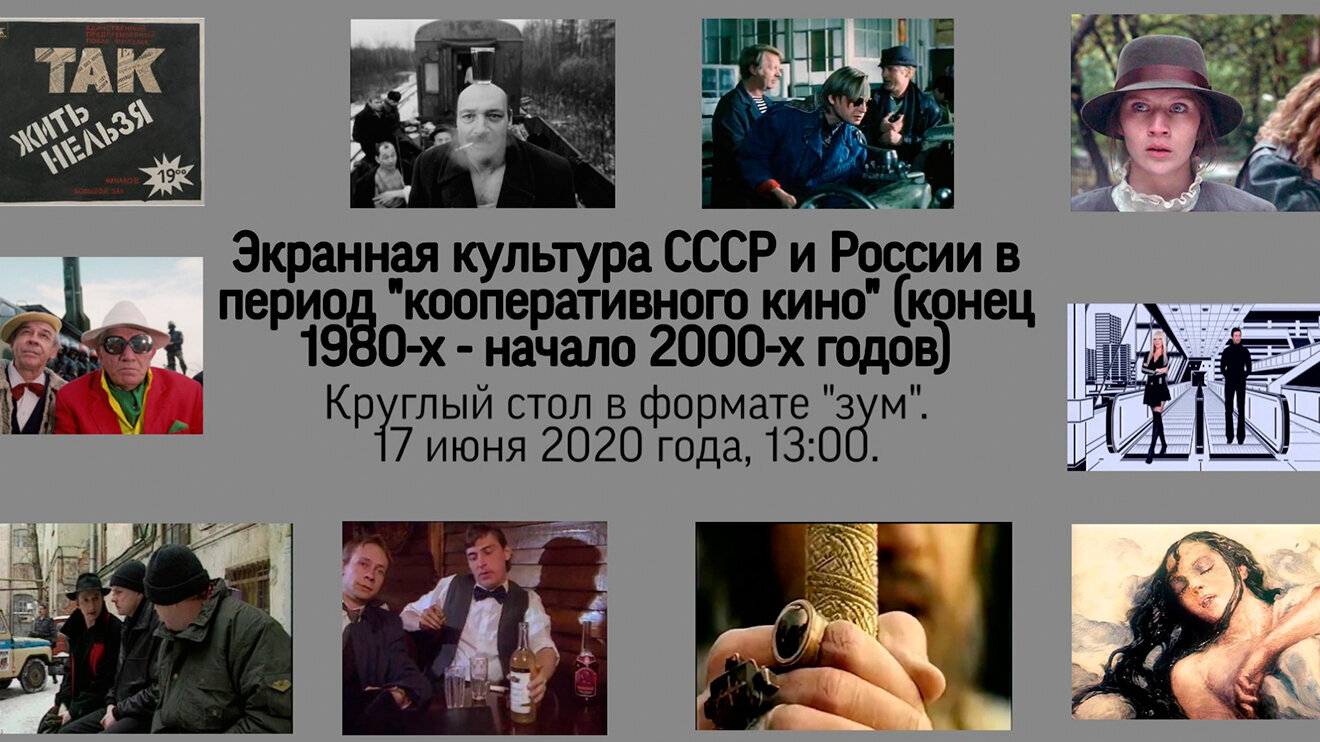
The novel’s mention of directors who shoot «punchy boob comedies» featuring Soviet film stars, along with actors Shcherbakov, Pankratov-Chorny, and Kokshenov, is a direct reference to the phenomenon of cooperative cinema, which had reached its peak by precisely 1997, the year the novel is set.
What Cooperative Cinema Was
Cooperative cinema was a unique phenomenon in Russian filmmaking, born during perestroika and flourishing through the 1990s. This wave was defined by films made by independent studios, film associations, and cooperatives working outside the traditional state film studio system.
The main difference between cooperative cinema and the rest of perestroika-era filmmaking lay in its funding sources: while ordinary films were shot on state money, cooperative pictures were financed by private individuals and companies, operating on a self-funding basis. A significant share of that financial flow was tied to laundering sponsors’ money — a practice that became an inseparable part of the «wild nineties.»
Defining Traits
Cooperative cinema had several characteristic features:
Low budgets and fast production. Films were shot quickly and cheaply, minimizing costs and speeding up returns. Few of these pictures ever reached wide theatrical release — most circulated through video rental or played in small theaters.
Genre preferences. Low-brow variations on popular genres dominated: pulpy melodrama, comedy, «criminal romance,» bloody action, and detective stories. Filmmakers eagerly turned to previously forbidden themes and characters, sometimes to absurd lengths in their bids to grab an audience.
Marketing tricks. A vivid example: Olga Zhukova’s film «Merry Christmas in Paris» (1991), released under the title «The Lesbian Gang» purely to draw viewers.
Historical Development
The first film cooperatives appeared in 1988, with the passage of the law «On Cooperation in the USSR.» But by December 28 of that same year, a Council of Ministers decree banned cooperatives from producing, selling, or distributing film and video products.
The ban was met with official protest from the Union of Cinematographers, and cooperative studios found ways around it by partnering with state or social-political organizations, including the Komsomol. After a meeting between representatives of the Union of Cinematographers, led by Andrei Smirnov, and Council of Ministers chairman Nikolai Ryzhkov, the ban was lifted.
By 1997, the cooperative movement in film had fully matured, developing its own tactics for skirting any regulations. The best-known legal studios of the time were Fora, Paritet, Podarok, Pilot, and others.
Key Figures
A leading figure of cooperative cinema was director Anatoly Eiramdzhan, and the genre’s «first swallow» was his picture «For the Beautiful Ladies!» (1989), made at Andrei Razumovsky’s studio Fora.
The actors mentioned in the novel’s text were stars of precisely this circuit:
Alexander Pankratov-Chorny appeared regularly in cooperative pictures and even shared memories of how Anatoly Eiramdzhan once sought funding from the owner of a furniture store to finance his films.
Mikhail Kokshenov became a genuine star of cooperative cinema, appearing in a huge number of low-budget comedies. His film «The Nephew, or Russian Business 2» (2002) is generally considered to mark the end of the cooperative-cinema era.
Economic Mechanisms
The funding sources for cooperative cinema were wildly varied and often dubious. Director and screenwriter Olga Zhukova brought in funding for her films from semi-legal St. Petersburg brothels, whose numbers she found in classified ads. Alexander Polynnikov made films about the gangster life on commission from the gangsters themselves.
As a rule, the funding was tied to laundering money from the shadow economy. By the late 1980s, the country had accumulated significant amounts of «dirty» money, and state agencies were cracking down on attempts to legalize it. The film set became an ideal place for the emerging class of «new Russians» to absorb and launder that money.
The mechanism was simple: a film’s declared budget significantly exceeded its actual production costs, and the difference was returned to the «sponsor» as a kickback. Many film cooperatives were formed for a single picture, or didn’t produce anything at all, preferring instead to cheaply acquire pirated copies of foreign films.
Cultural Significance
Prominent film critic D. Dondurey called «fear and laughter» the best tools for luring a «hungry population» into movie theaters. He also described the cooperative-cinema era as «a premonition of freedom» — a sickness, a defeat, and an agony of Soviet power — comparing this brand of cinema to insects eating away at Soviet authority, and to a bulldozer that demolished the Goskino system.
Despite its generally low artistic quality, cooperative cinema left a notable mark on Russian film. Many of these pictures still air on central TV channels today, largely thanks to the strong work of popular actors.
Cooperative Cinema by 1997
By the time the novel takes place (1997), cooperative cinema was at the height of its development. The system had fully matured, with established schemes for financing and production. Directors had learned to squeeze maximum efficiency out of limited budgets, and Soviet-era actors — like the novel’s Shcherbakov, Pankratov-Chorny, and Kokshenov — became regular fixtures of such projects.
It was during this period that the practice took hold of casting Soviet-era film stars in dubious low-budget pictures — a phenomenon ironically reflected in the novel through the character of the director Kirill, «regularly flying in from Hollywood» to shoot «punchy boob comedies.»
The line about the character «forgetting to write the right names into the contract» reflects a real practice of the time, when a project’s success often depended not on artistic merit but on the right connections and arrangements in the film world.